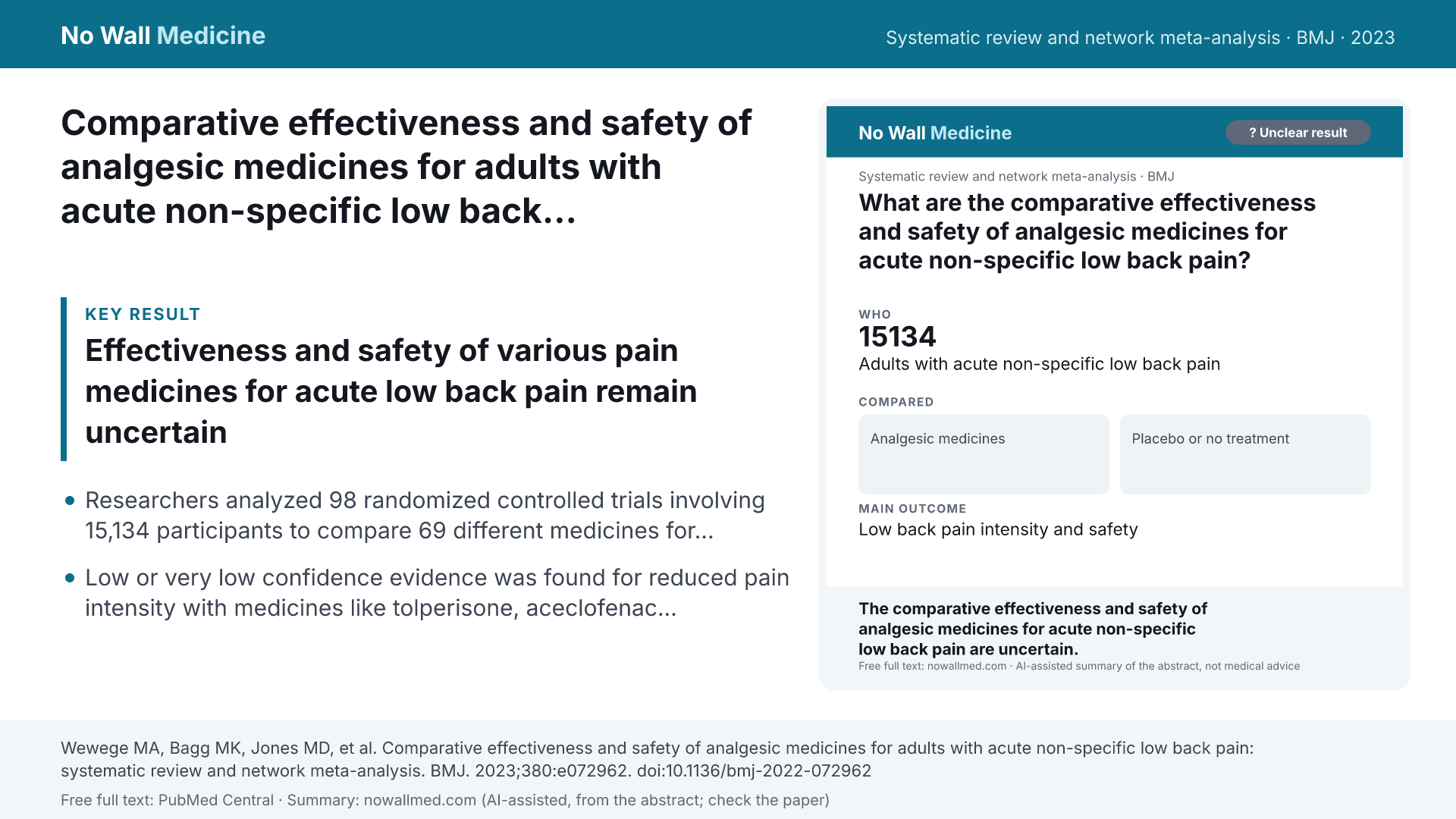
Effectiveness and safety of various pain medicines for acute low back pain remain uncertain
Comparative effectiveness and safety of analgesic medicines for adults with acute non-specific low back pain: systematic review and network meta-analysis
Systematic review and network meta-analysisUnclear result
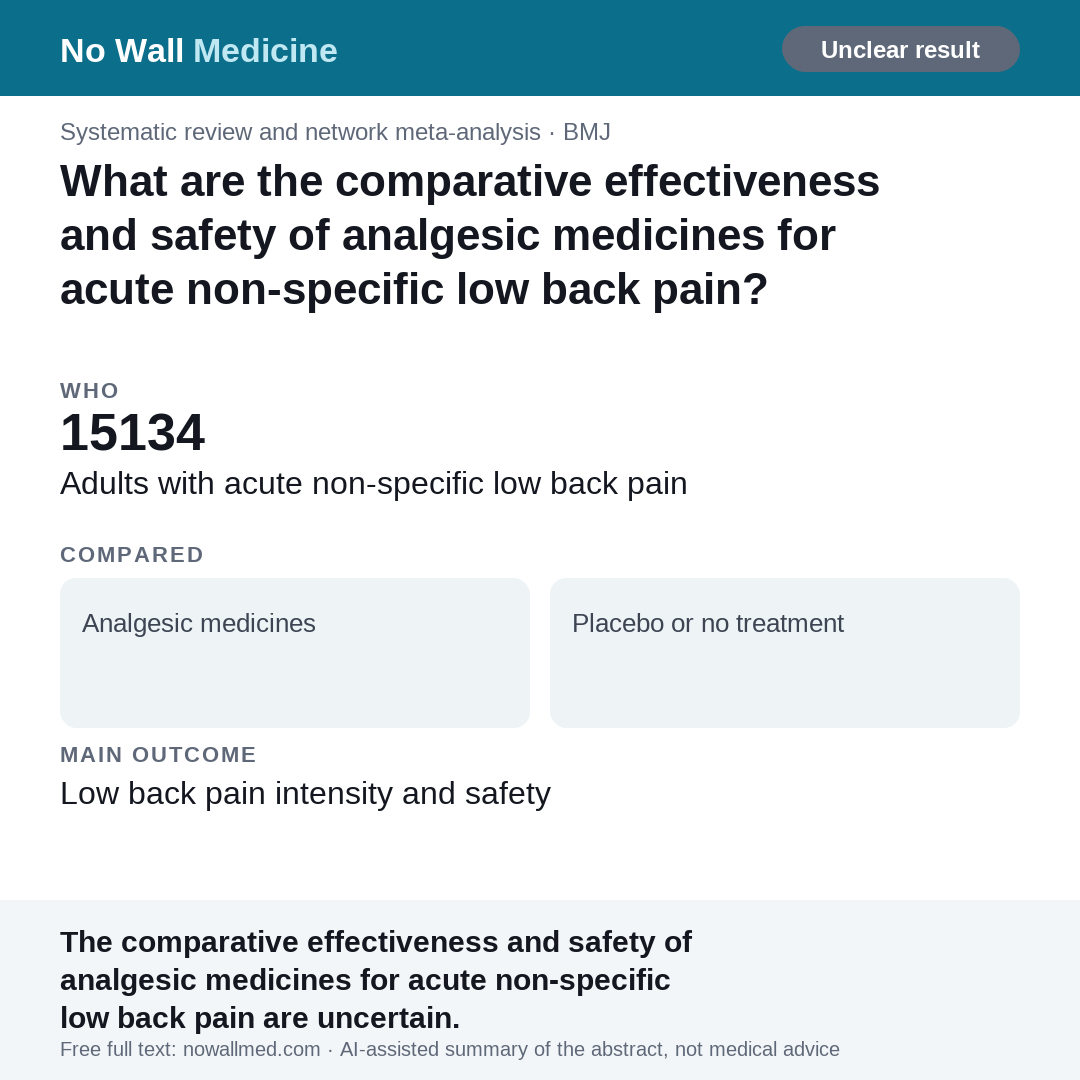
What are the comparative effectiveness and safety of analgesic medicines for acute non-specific low back pain?
Who
15134
Adults with acute non-specific low back pain
Compared
Analgesic medicines
Placebo or no treatment
Main outcome
Low back pain intensity and safety
Bottom line: The comparative effectiveness and safety of analgesic medicines for acute non-specific low back pain are uncertain.
Limitation: Low or very low confidence in evidence for many medicines and secondary outcomes.
BMJ · 2023-03-22Download image
Clinical question: What are the comparative effectiveness and safety of analgesic medicines for acute non-specific low back pain?
Why it matters: The comparative effectiveness and safety of different analgesic medicines for treating acute non-specific low back pain are currently uncertain.
Key points
- Researchers analyzed 98 randomized controlled trials involving 15,134 participants to compare 69 different medicines for acute non-specific low back pain.
- Low or very low confidence evidence was found for reduced pain intensity with medicines like tolperisone, aceclofenac plus tizanidine, and pregabalin compared to placebo.
- Tramadol, paracetamol plus sustained release tramadol, baclofen, and paracetamol plus tramadol were associated with an increased risk of adverse events compared to placebo.
Limitation the authors note: The authors noted low or very low confidence in the evidence for many of the reported outcomes.
Headline and key points written with AI from the paper’s abstract, with every number checked against it. Read the paper before relying on them.
Was this summary helpful?
Abstract
Objective
To evaluate the comparative effectiveness and safety of analgesic medicines for acute non-specific low back pain. Design
Systematic review and network meta-analysis. Data sources
Medline, PubMed, Embase, CINAHL, CENTRAL, ClinicalTrials.gov, clinicialtrialsregister.eu, and World Health Organization's International Clinical Trials Registry Platform from database inception to 20 February 2022. Eligibility criteria for study selection
Randomised controlled trials of analgesic medicines (eg, non-steroidal anti-inflammatory drugs, paracetamol, opioids, anti-convulsant drugs, skeletal muscle relaxants, or corticosteroids) compared with another analgesic medicine, placebo, or no treatment. Adults (≥18 years) who reported acute non-specific low back pain (for less than six weeks). Data extraction and synthesis
Primary outcomes were low back pain intensity (0-100 scale) at end of treatment and safety (number of participants who reported any adverse event during treatment). Secondary outcomes were low back specific function, serious adverse events, and discontinuation from treatment. Two reviewers independently identified studies, extracted data, and assessed risk of bias. A random effects network meta-analysis was done and confidence was evaluated by the Confidence in Network Meta-Analysis method. Results
98 randomised controlled trials (15 134 participants, 49% women) included 69 different medicines or combinations. Low or very low confidence was noted in evidence for reduced pain intensity after treatment with tolperisone (mean difference -26.1 (95% confidence intervals -34.0 to -18.2)), aceclofenac plus tizanidine (-26.1 (-38.5 to -13.6)), pregabalin (-24.7 (-34.6 to -14.7)), and 14 other medicines compared with placebo. Low or very low confidence was noted for no difference between the effects of several of these medicines. Increased adverse events had moderate to very low confidence with tramadol (risk ratio 2.6 (95% confidence interval 1.5 to 4.5)), paracetamol plus sustained release tramadol (2.4 (1.5 to 3.8)), baclofen (2.3 (1.5 to 3.4)), and paracetamol plus tramadol (2.1 (1.3 to 3.4)) compared with placebo. These medicines could increase the risk of adverse events compared with other medicines with moderate to low confidence. Moderate to low confidence was also noted for secondary outcomes and secondary analysis of medicine classes. Conclusions
The comparative effectiveness and safety of analgesic medicines for acute non-specific low back pain are uncertain. Until higher quality randomised controlled trials of head-to-head comparisons are published, clinicians and patients are recommended to take a cautious approach to manage acute non-specific low back pain with analgesic medicines. Systematic review registration
PROSPERO CRD42019145257.
Abstract reproduced under the article’s CC BY NC licence.
Subject terms
Cite this article
Wewege MA, Bagg MK, Jones MD, et al. Comparative effectiveness and safety of analgesic medicines for adults with acute non-specific low back pain: systematic review and network meta-analysis. BMJ. 2023. doi:10.1136/bmj-2022-072962
Spotted a mistake? Suggest a correction