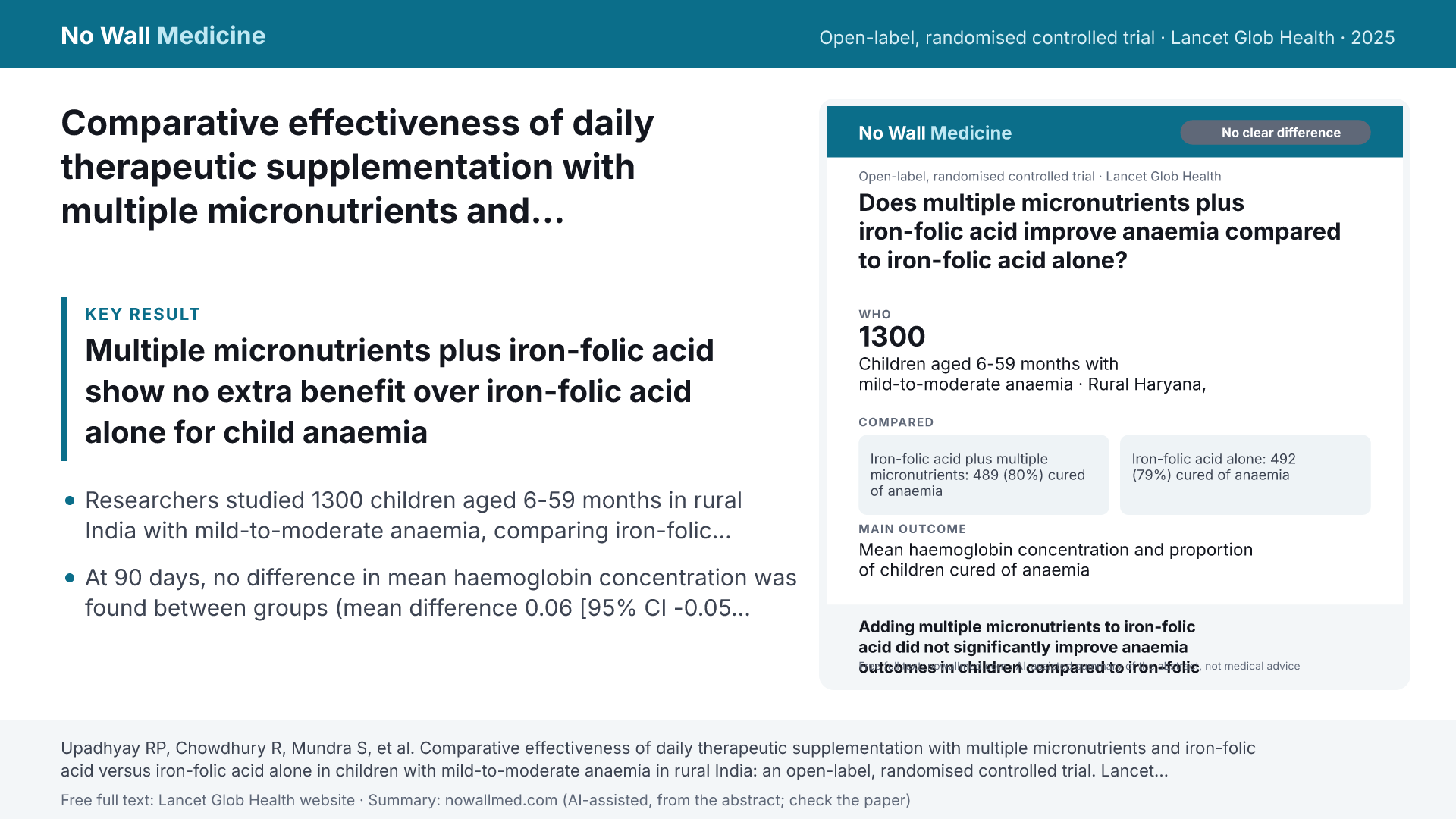
Multiple micronutrients plus iron-folic acid show no extra benefit over iron-folic acid alone for child anaemia
Comparative effectiveness of daily therapeutic supplementation with multiple micronutrients and iron-folic acid versus iron-folic acid alone in children with mild-to-moderate anaemia in rural India: an open-label, randomised controlled trial
Open-label, randomised controlled trialNo clear difference
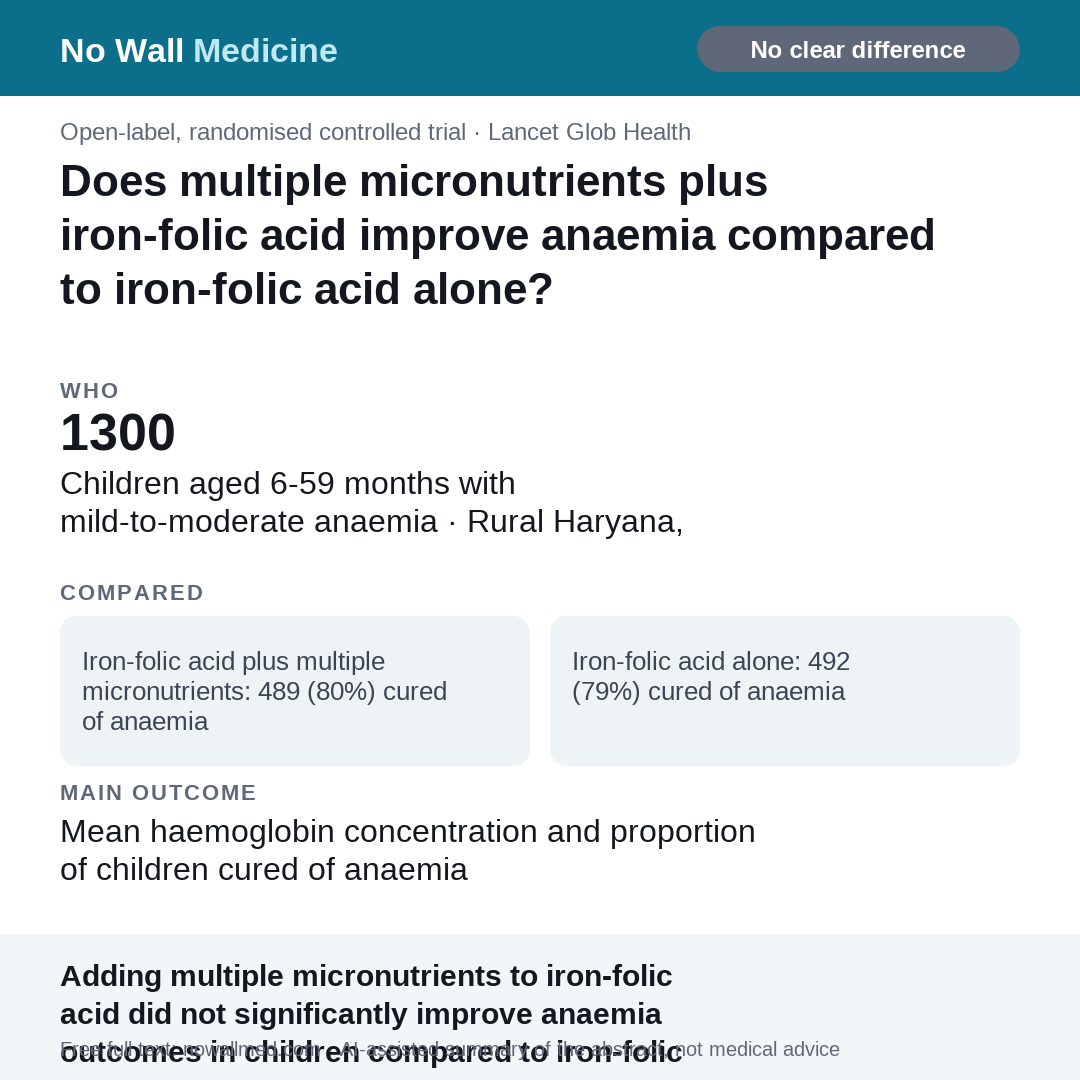
Does multiple micronutrients plus iron-folic acid improve anaemia compared to iron-folic acid alone?
Who
1300
Children aged 6-59 months with mild-to-moderate anaemia · Rural Haryana, India
Compared
Iron-folic acid plus multiple micronutrients: 489 (80%) cured of anaemia
Iron-folic acid alone: 492 (79%) cured of anaemia
Main outcome
Mean haemoglobin concentration and proportion of children cured of anaemia
Result: risk ratio 1·02 (95% CI 0·90 to 1·16)
Bottom line: Adding multiple micronutrients to iron-folic acid did not significantly improve anaemia outcomes in children compared to iron-folic acid alone.
Funded by: Indian Council of Medical Research and the Government of India
Lancet Glob Health · 2025-03-01Download image
Clinical question: Does multiple micronutrients plus iron-folic acid improve anaemia compared to iron-folic acid alone?
Why it matters: Supplementation with iron-folic acid alone has not been found to result in desired improvements in haemoglobin concentrations in children under 5 years old.
Key points
- Researchers studied 1300 children aged 6-59 months in rural India with mild-to-moderate anaemia, comparing iron-folic acid plus multiple micronutrients to iron-folic acid alone.
- At 90 days, no difference in mean haemoglobin concentration was found between groups (mean difference 0.06 [95% CI -0.05 to 0.16]) and cure rates were 80% versus 79%.
- Black stools were the most common side-effect, occurring in 99% of children in both the multiple micronutrient group and the iron-folic acid alone group.
Headline and key points written with AI from the paper’s abstract, with every number checked against it. Read the paper before relying on them.
Was this summary helpful?
Abstract
Background
Anaemia is a major public health problem among children younger than 5 years and supplementation with iron-folic acid alone has not been found to result in desired improvements in haemoglobin concentrations. We aimed to compare the effect of supplementation with iron-folic acid plus multiple micronutrients versus iron-folic acid supplementation alone on haemoglobin concentration and cure rates in children with mild-to-moderate anaemia. Methods
In this individually randomised controlled trial conducted in rural Haryana, India, children (aged 6-59 months) with mild-to-moderate anaemia (haemoglobin ≥7 to <11 g/dL) were randomly assigned (1:1) to receive either daily iron-folic acid plus multiple micronutrients or iron-folic acid alone for 90 days. The primary outcomes were mean haemoglobin concentration and the proportion of children cured of anaemia (haemoglobin ≥11 g/dL) at 90 days, assessed in the intention-to-treat population, which included all randomly assigned participants for whom primary outcome assessments were done. Safety was assessed in all randomly assigned participants. The trial was registered with the Clinical Trial Registry-India, CTRI/2020/10/028298. Findings
Between March 1, 2021, and March 7, 2022, 1300 children were randomly assigned to the iron-folic acid plus multiple micronutrients group (n=648) or the iron-folic acid alone group (n=652). At baseline, 93 (20%) of 472 children had vitamin B12 deficiency (≤203 pg/mL), 16 (3%) of 475 children had serum folate deficiency (<4 ng/mL), and 44 (9%) of 468 children had zinc deficiency (<66 μg/dL). 611 children in the iron-folic acid plus micronutrients group and 626 children in the iron-folic acid alone group had a blood sample collected at the end of the 90-day supplementation period and were included in the primary outcome assessment. At 90 days, no differences in mean haemoglobin concentration were identified between the treatment groups (mean difference 0·06 [95% CI -0·05 to 0·16]). 489 (80%) of 611 children in the iron-folic acid plus micronutrients group and 492 (79%) of 626 children in the iron-folic acid alone group were cured of anaemia (risk ratio 1·02 [95% CI 0·90 to 1·16]). Compliance rates in both groups exceeded 75%. Black stools were the most common side-effect observed in both groups (640 [99%] of 648 children in iron-folic acid plus micronutrients group and 643 [99%] of 652 children in the iron-folic acid alone group). Interpretation
In children with mild-to-moderate anaemia, supplementation with multiple micronutrients and iron-folic acid did not result in significant benefits compared with iron-folic acid alone. Efforts that focus on ensuring high compliance with iron-folic acid supplementation alone might achieve satisfactory rates of anaemia recovery. Funding
Indian Council of Medical Research and the Government of India.
Abstract reproduced under the article’s CC BY licence.
Subject terms
Cite this article
Upadhyay RP, Chowdhury R, Mundra S, Taneja S, Jacob M, Kapil U. Comparative effectiveness of daily therapeutic supplementation with multiple micronutrients and iron-folic acid versus iron-folic acid alone in children with mild-to-moderate anaemia in rural India: an open-label, randomised controlled trial. Lancet Glob Health. 2025. doi:10.1016/S2214-109X(24)00559-X
Spotted a mistake? Suggest a correction
Top studies every Monday
The week’s key trials and guidelines in your specialties, plus any topics you follow. By email, free.
Get the weekly digest