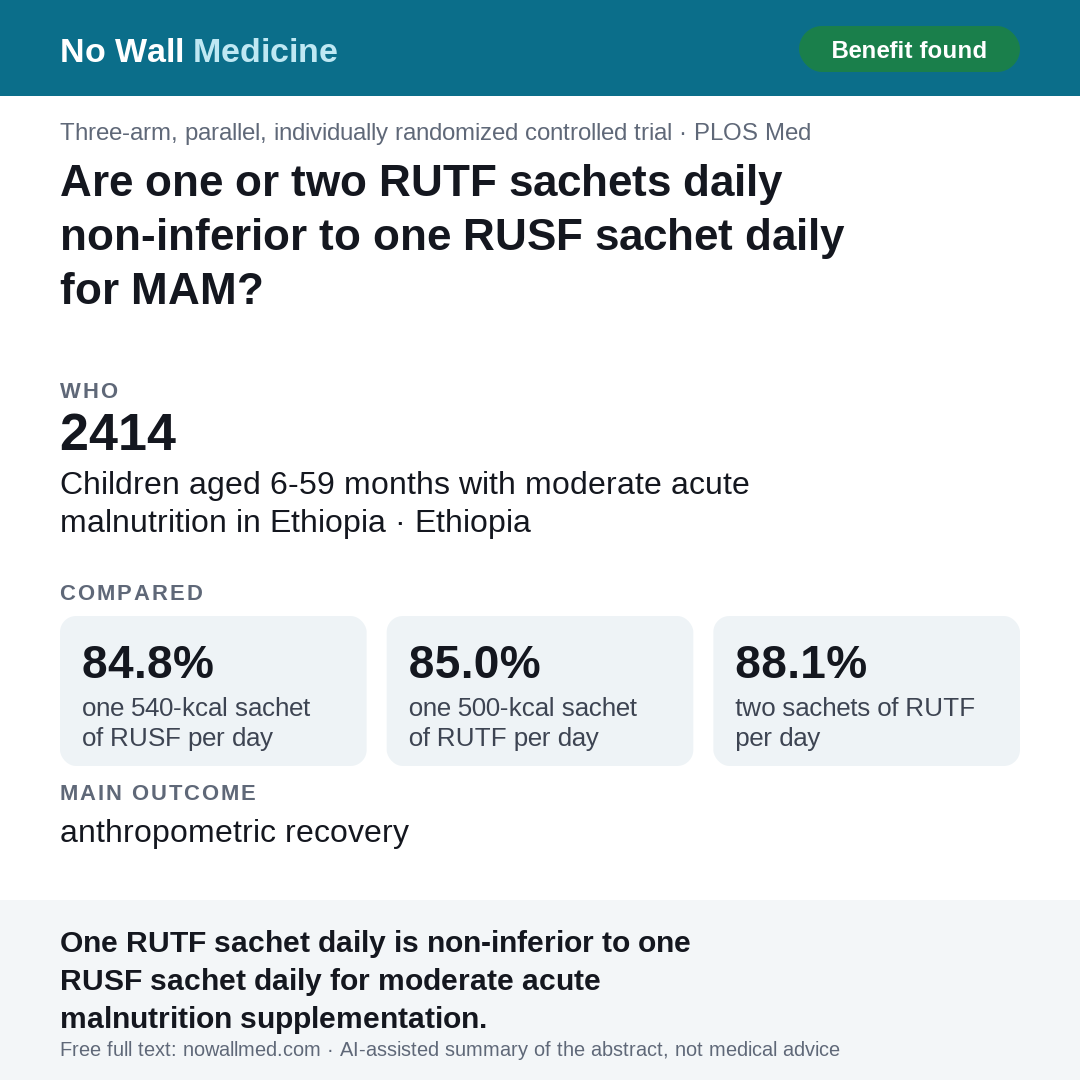
One or two sachets of ready-to-use therapeutic food are non-inferior to ready-to-use supplementary food
Comparative effectiveness of lipid-nutrient spread supplementation regimens for moderate acute malnutrition in Ethiopia: The MODAM-MAM individually randomized controlled trial
Clark BA, Legese LA, Beyene Y, Shellemew MW, Darsene H, Chitekwe S, et al
Clinical question: Are one or two RUTF sachets daily non-inferior to one RUSF sachet daily for MAM?
Why it matters: Evidence is limited regarding the optimal product and dosing strategy for children requiring supplementation for moderate acute malnutrition.
Key points
Researchers studied 2,414 children aged 6-59 months in Ethiopia with moderate acute malnutrition to compare different lipid-based nutrient supplement regimens.
Recovery rates were 84.8% for one sachet of ready-to-use supplementary food, 85.0% for one sachet of ready-to-use therapeutic food, and 88.1% for two sachets of ready-to-use therapeutic food.
Both the one-sachet and two-sachet ready-to-use therapeutic food groups met the non-inferiority criteria compared to the standard one-sachet ready-to-use supplementary food.
Limitation the authors note: The study evaluated a single ready-to-use supplementary food formulation and used earlier-than-typical case-finding due to intensive screening.
Headline and key points written with AI from the paper’s abstract, with every number checked against it. Read the paper before relying on them.
Natural-abundance carbon isotope profiling of long-chain polyunsaturated fatty acid supplement incorporation in extremely preterm infants: a sub-study of the Mega Donna Mega randomized clinical trial
From Obesity to Cancer Cachexia: PI3K/AKT/MTOR Signaling Across the Energy Balance Spectrum - A Scoping Review of Body Size, Composition, and Cancer Outcomes
Reduced Erythropoietic Signalling may be responsible for anemia without iron deficiency among Indian Pregnant Women: findings from a cross-sectional study