ClinicalAge biomarker associated with mortality and disease risk in UK datasets
ClinicalAge, a framework for modelling ageing trajectories from longitudinal electronic health records in the UK: a model development and validation study
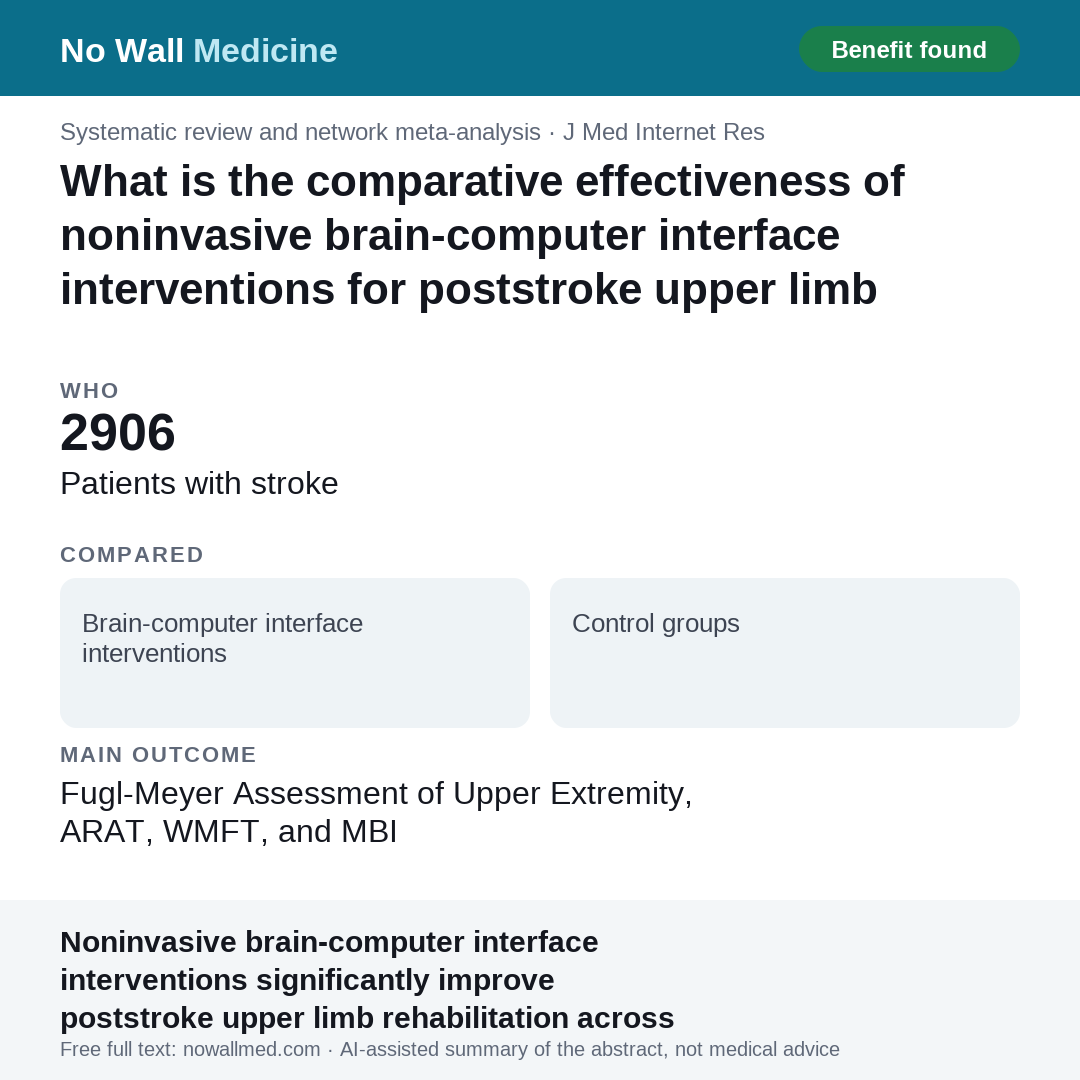
Comparative Effectiveness of Noninvasive Brain-Computer Interface-Based Interventions for Upper Limb Rehabilitation in Poststroke Hemiplegia: Systematic Review and Network Meta-Analysis of Randomized Controlled Trials
Clinical question: What is the comparative effectiveness of noninvasive brain-computer interface interventions for poststroke upper limb rehabilitation?
Why it matters: Doctors have had limited evidence on the effectiveness of noninvasive brain-computer interface-based interventions for poststroke upper limb rehabilitation
Limitation the authors note: The evidence quality ranged from very low to high and substantial heterogeneity was found, so these findings remain exploratory
Headline and key points written with AI from the paper’s abstract, with every number checked against it. Read the paper before relying on them.
Spotted a mistake? Suggest a correction
ClinicalAge, a framework for modelling ageing trajectories from longitudinal electronic health records in the UK: a model development and validation study
Foundation artificial intelligence models for health recognition by use of face photographs (FAHR-Face): a model development and validation study
A prognostic model for use at labour onset to estimate the risk of severe fetal compromise at birth: a retrospective, model development and validation study
ECG foundation models for cardiovascular screening in a cohort of young competitive athletes
Medical Reasoning in Large Language Models: Development and Evaluation of the MedEvalArena Benchmark