Three finger splints showed similar effectiveness after tendon repair
Comparative effectiveness of three splints for rehabilitation after finger flexor tendon repair (FIRST): randomised controlled trial
Randomised controlled trialNo clear difference
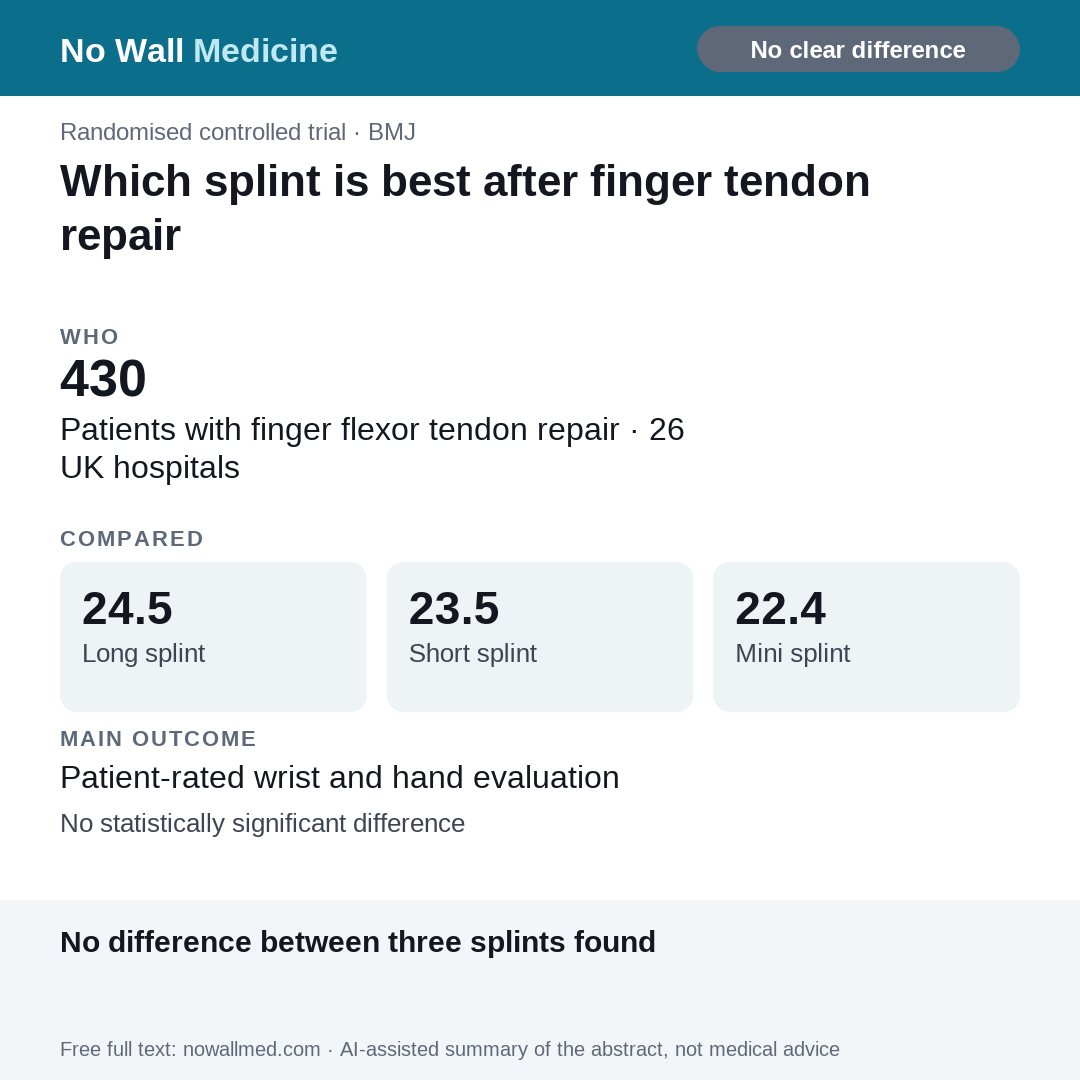
Which splint is best after finger tendon repair
Who
430
Patients with finger flexor tendon repair · 26 UK hospitals
Compared
24.5Long splint
23.5Short splint
22.4Mini splint
Main outcome
Patient-rated wrist and hand evaluation
Result: No statistically significant difference
Bottom line: No difference between three splints found
BMJ · 2026-10-27Download image
Key points
- 430 participants with finger flexor tendon repairs were compared across three splint types.
- No statistically significant difference in clinical effectiveness was found between the long, short, and mini splints.
- Serious adverse event rates were similar, around 10-11%, across all three splint groups.
Headline and key points written with AI from the paper’s abstract, with every number checked against it. Read the paper before relying on them.
Abstract
Objective
To compare the clinical effectiveness of three splints after repair of zone 1 and 2 flexor tendons: forearm based (long), Manchester short (short), and relative motion flexion (mini) splints. Design
Prospective, randomised, parallel group, pragmatic, superiority, clinical trial. Setting
26 UK hospitals. Participants
430 participants (aged ≥16 years) requiring rehabilitation after primary repair of zone 1 and 2 flexor tendons in one or two fingers of the hand according to British Society for Surgery of the Hand guidelines. Interventions
Participants were randomly assigned 1:1:1 to the long, short, or mini splint. Splints were worn continuously for five weeks and intermittently for a further week at night and in vulnerable situations such as public environments. Masking participants was not possible owing to the nature of the intervention. Main outcome measures
The primary outcome was the mean post-randomisation score on the patient-rated wrist and hand evaluation (PRWHE) instrument at 6, 12, 26, and 52 weeks, analysed by intention to treat. Results
430 participants were randomised to the long splint (n=143), short splint (n=140), or mini splint (n=147) and 403 were included in the intention-to-treat analysis. Adherence, defined as wearing the splint for a minimum of five weeks, was 83% (118/143) for the long splint, 76% (106/140) for the short splint, and 78% (115/147) for the mini splint. Mean post-randomisation PRWHE scores were 24.5 (standard deviation 15.5) in the long splint group, 23.5 (16.7) in the short splint group, and 22.4 (15.0) in the mini splint group, with adjusted between group differences of 0.3 (98.3% confidence interval -4.0 to 4.6, P=0.88) for the long versus short splint, 2.3 (-1.9 to 6.5, P=0.19) for the long versus mini splint, and 2.0 (-2.2 to 6.3, P=0.25) for the short versus mini splint. Serious adverse event rates occurred in 10% (14/143) of participants in the long splint group, 11% (15/140) in the short splint group, and 11% (16/147) in the mini splint group. Conclusion
This trial found no statistically significant difference in clinical effectiveness between the long, short, and mini splint. Apart from some small differences, secondary outcomes were comparable across all three groups. Trial registration
ISRCTN Registry ISRCTN10236011.
Abstract reproduced under the article’s CC BY licence.
Topics
Spotted a mistake? Suggest a correction