Tai Chi/Qigong and cognitive rehabilitation ranked most effective for cancer-related cognitive impairment
Comparative effectiveness of various nonpharmacological interventions, including traditional Chinese medicine-based interventions for cancer-related cognitive impairment: a comprehensive network meta-analysis
Network meta-analysis of 84 randomized controlled trialsMixed results
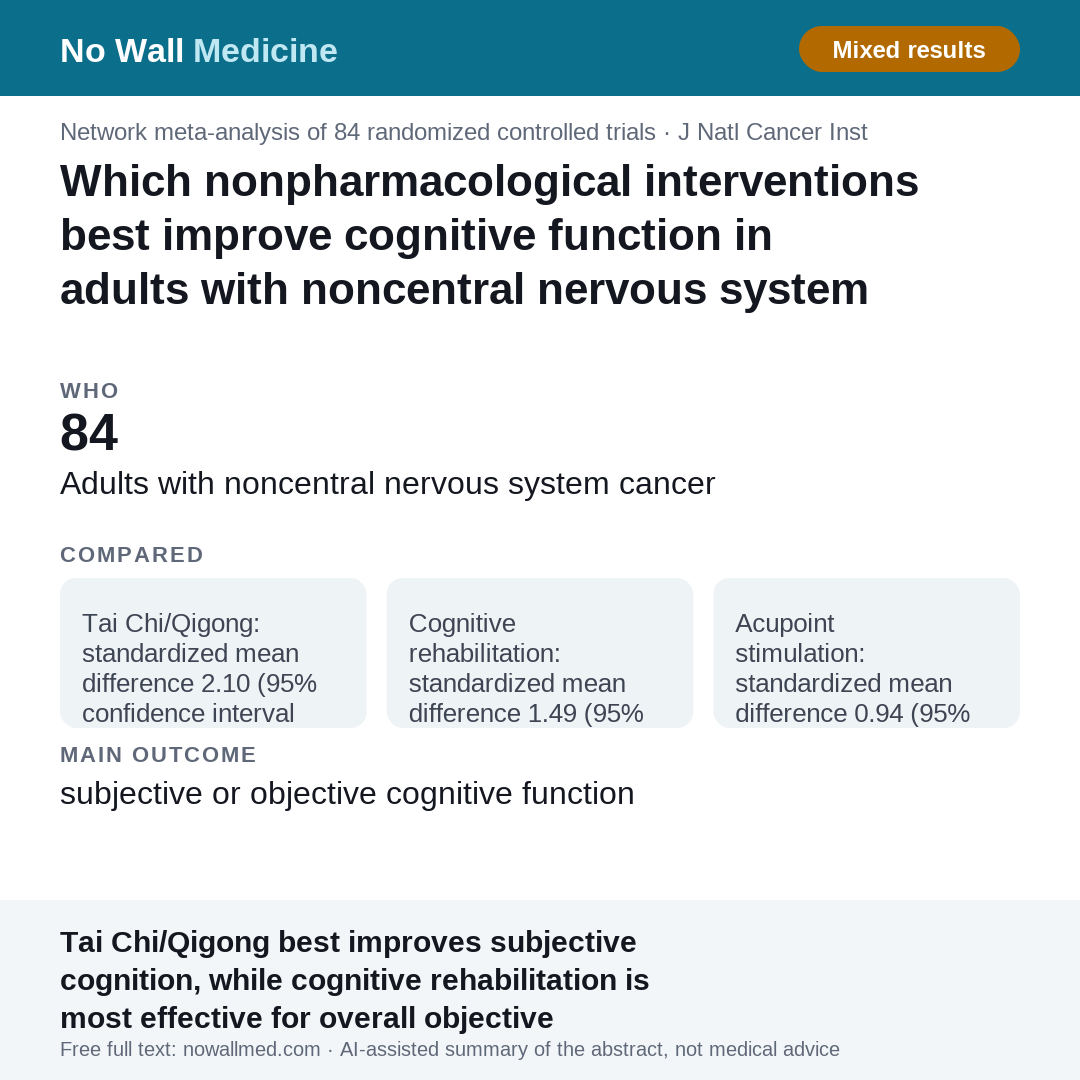
Which nonpharmacological interventions best improve cognitive function in adults with noncentral nervous system cancer?
Who
84
Adults with noncentral nervous system cancer
Compared
Tai Chi/Qigong: standardized mean difference 2.10 (95% confidence interval 0.62 to 3.59)
Cognitive rehabilitation: standardized mean difference 1.49 (95% confidence interval 0.41 to 2.58)
Acupoint stimulation: standardized mean difference 0.94 (95% confidence interval 0.13 to 1.76)
Main outcome
subjective or objective cognitive function
Bottom line: Tai Chi/Qigong best improves subjective cognition, while cognitive rehabilitation is most effective for overall objective cognitive function.
J Natl Cancer Inst · 2025-03-12Download image
Clinical question: Which nonpharmacological interventions best improve cognitive function in adults with noncentral nervous system cancer?
Why it matters: The effectiveness of traditional Chinese medicine-based interventions for improving subjective and objective cognitive functions in cancer patients has not been investigated in previous network meta-analyses.
Key points
- Researchers analyzed 84 randomized controlled trials involving 15 different nonpharmacological interventions for adults with noncentral nervous system cancer.
- Tai Chi/Qigong had the highest probability of improving subjective cognitive function with a standardized mean difference of 2.10.
- Cognitive rehabilitation was ranked best for overall cognitive function (SMD = 1.49) and executive and language domains, while acupoint stimulation was top for visuospatial and motor functions.
Headline and key points written with AI from the paper’s abstract, with every number checked against it. Read the paper before relying on them.
Topics
Cite this article
Ho MH, Wang L, Wong JWH, Xin G, Zhang Q, Lin YK. Comparative effectiveness of various nonpharmacological interventions, including traditional Chinese medicine-based interventions for cancer-related cognitive impairment: a comprehensive network meta-analysis. J Natl Cancer Inst. 2025. doi:10.1093/jnci/djaf059
Spotted a mistake? Suggest a correction
Top studies every Monday
The week’s key trials and guidelines in your specialties, by email. Free.
Get the weekly digest