Connector-assisted repair was associated with higher sensory recovery rates than direct nerve repair
Comparative Effectiveness Systematic Review and Meta-analysis of Peripheral Nerve Repair Using Direct Repair and Connector-assisted Repair
Systematic review and meta-analysisBenefit found
Are connector-assisted repair and direct repair different for peripheral nerve repair outcomes?
Who
Patients with upper extremity nerve gaps less than 5 mm
Compared
Connector-assisted repair: 96.1% (S3 threshold) and 87.1% (S3+ threshold) meaningful recovery
Direct repair: 81.3% (S3 threshold) and 54.2% (S3+ threshold) meaningful recovery
Main outcome
Sensory Medical Research Council Classification meaningful recovery rate
Bottom line: Connector-assisted repair achieved higher meaningful recovery rates and lower cold intolerance than direct repair.
Plast Reconstr Surg Glob Open · 2024-07-09Download image
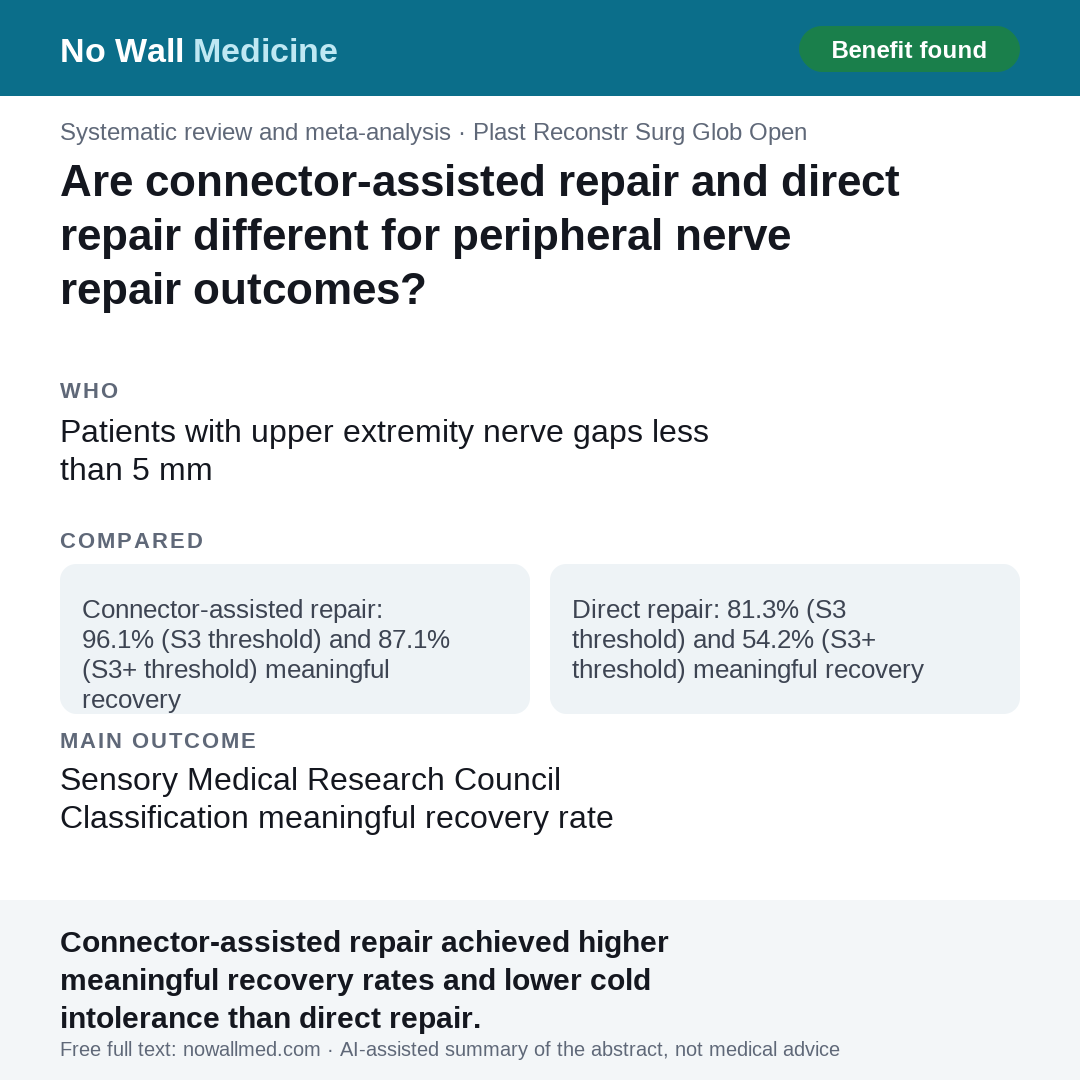
Clinical question: Are connector-assisted repair and direct repair different for peripheral nerve repair outcomes?
Why it matters: It was unknown whether connector-assisted repair or direct repair provides better sensory recovery and fewer side effects for small peripheral nerve gaps.
Key points
- Researchers analyzed studies from 1980 to August 2023 comparing connector-assisted repair (CAR) and direct repair (DR) for nerve gaps under 5 mm in the upper extremities.
- At the S3 sensory threshold, 96.1% of CAR and 81.3% of DR achieved meaningful recovery, while at the S3+ threshold, 87.1% of CAR and 54.2% of DR achieved it.
- Cold intolerance was associated with 46.2% in DR studies compared to 10.7% in the CAR group, though no differences were found in pain or neuroma rates.
Headline and key points written with AI from the paper’s abstract, with every number checked against it. Read the paper before relying on them.
Was this summary helpful?
Cite this article
Leis A, Smetana BS, Strohl AB, Styron JF. Comparative Effectiveness Systematic Review and Meta-analysis of Peripheral Nerve Repair Using Direct Repair and Connector-assisted Repair. Plast Reconstr Surg Glob Open. 2024. doi:10.1097/GOX.0000000000005927
Spotted a mistake? Suggest a correction
Top studies every Monday
The week’s key trials and guidelines in your specialties, plus any topics you follow. By email, free.
Get the weekly digest