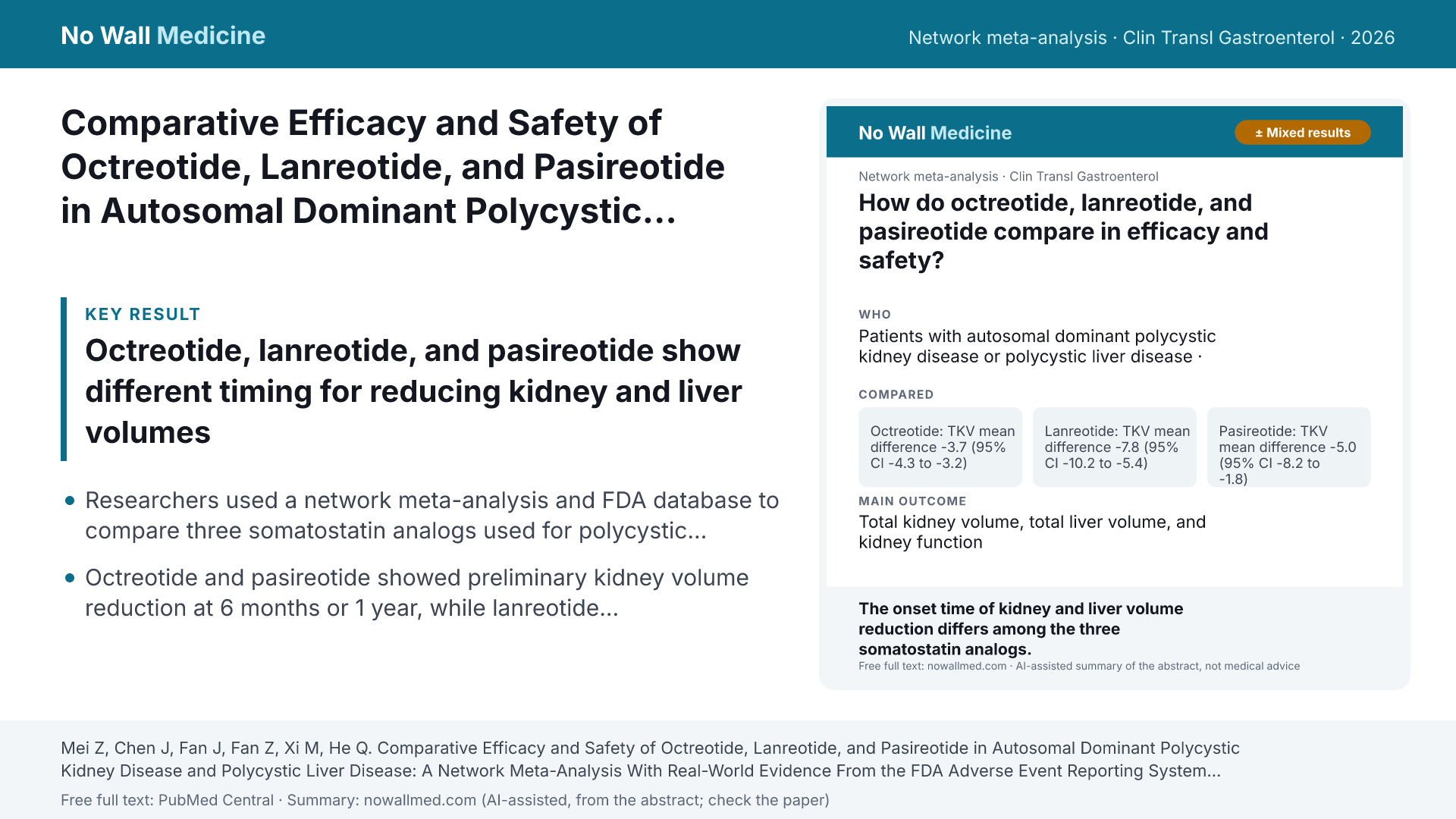
Octreotide, lanreotide, and pasireotide show different timing for reducing kidney and liver volumes
Comparative Efficacy and Safety of Octreotide, Lanreotide, and Pasireotide in Autosomal Dominant Polycystic Kidney Disease and Polycystic Liver Disease: A Network Meta-Analysis With Real-World Evidence From the FDA Adverse Event Reporting System Database
Network meta-analysisMixed results
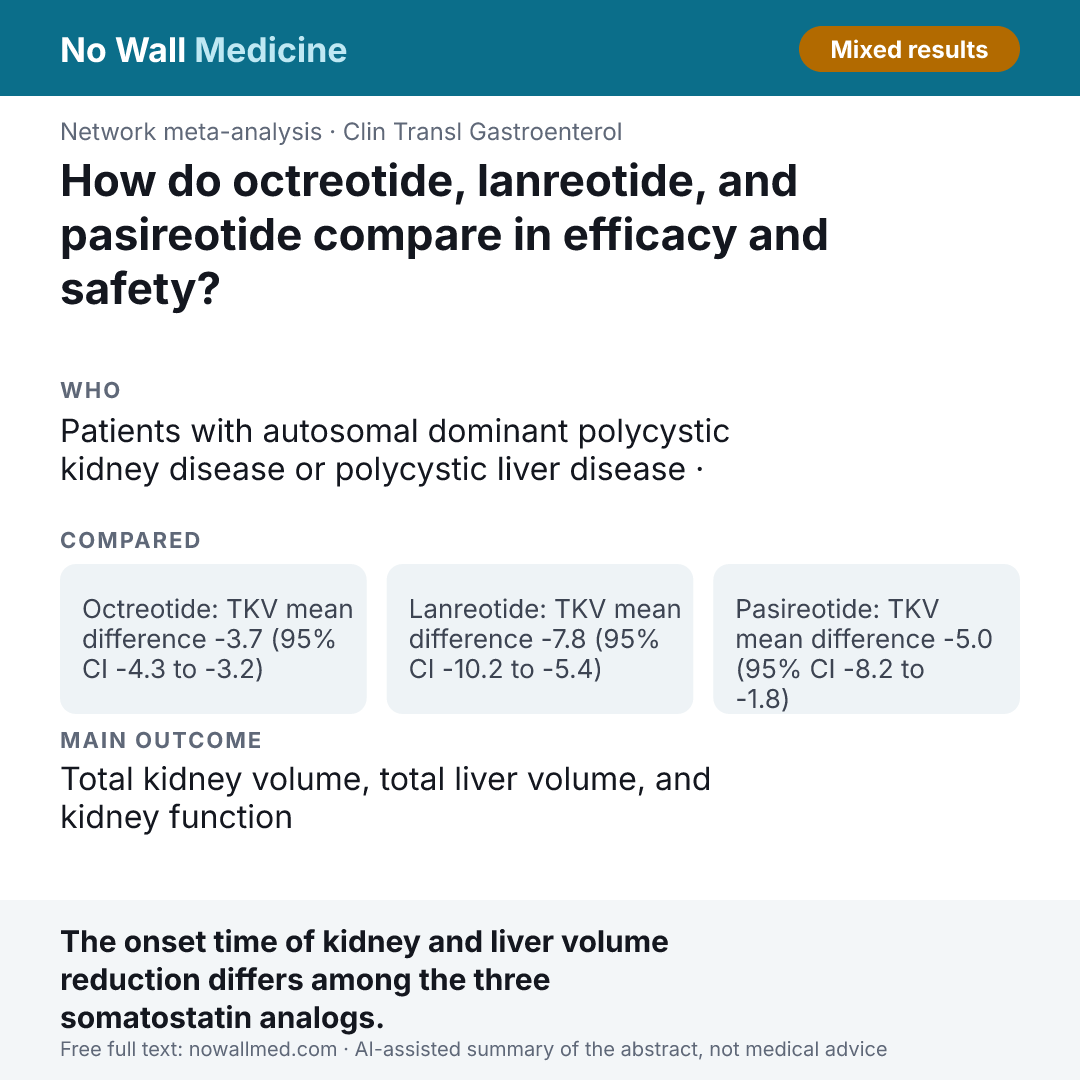
How do octreotide, lanreotide, and pasireotide compare in efficacy and safety?
Who
Patients with autosomal dominant polycystic kidney disease or polycystic liver disease · FDA Adverse Event Reporting System database
Compared
Octreotide: TKV mean difference -3.7 (95% CI -4.3 to -3.2)
Lanreotide: TKV mean difference -7.8 (95% CI -10.2 to -5.4)
Pasireotide: TKV mean difference -5.0 (95% CI -8.2 to -1.8)
Main outcome
Total kidney volume, total liver volume, and kidney function
Bottom line: The onset time of kidney and liver volume reduction differs among the three somatostatin analogs.
Limitation: Pooled estimates from limited available trials
Clin Transl Gastroenterol · 2026-07-20 · Save PNG
Clinical question: How do octreotide, lanreotide, and pasireotide compare in efficacy and safety?
Why it matters: Doctors needed to compare the efficacy and safety of three different somatostatin analogs used to treat polycystic kidney and liver diseases.
Key points
- Researchers used a network meta-analysis and FDA database to compare three somatostatin analogs used for polycystic kidney and liver diseases.
- Octreotide and pasireotide showed preliminary kidney volume reduction at 6 months or 1 year, while lanreotide showed reduction after more than 2 years.
- Cholelithiasis, or gallstones, was the most common biliary side effect, with age and specific drug type acting as independent predictors.
Headline and key points written with AI from the paper’s abstract, with every number checked against it. Read the paper before relying on them.
Was this summary helpful?
Subject terms
Headline, design, result, key points, caveat and citation as plain text.
Cite this article
Mei Z, Chen J, Fan J, Fan Z, Xi M, He Q. Comparative Efficacy and Safety of Octreotide, Lanreotide, and Pasireotide in Autosomal Dominant Polycystic Kidney Disease and Polycystic Liver Disease: A Network Meta-Analysis With Real-World Evidence From the FDA Adverse Event Reporting System Database. Clin Transl Gastroenterol. 2026;17(10):e01076. doi:10.14309/ctg.0000000000001076
Spotted a mistake? Suggest a correction