Comparative efficacy and tolerability of nutraceuticals for depressive disorder: A systematic review and network meta-analysis
Systematic review and network meta-analysisBenefit found
What is the comparative efficacy and tolerability of nutraceuticals for depressive disorder?
Who
17437
Adults with depressive disorder
Compared
Adjunctive nutraceuticals: better efficacy than antidepressants alone
Antidepressants alone
Main outcome
change in depressive symptoms
Bottom line: Several nutraceuticals offer benefits as either adjuncts or monotherapies for treating depressive disorders.
Psychol Med · 2025-05-02Download image
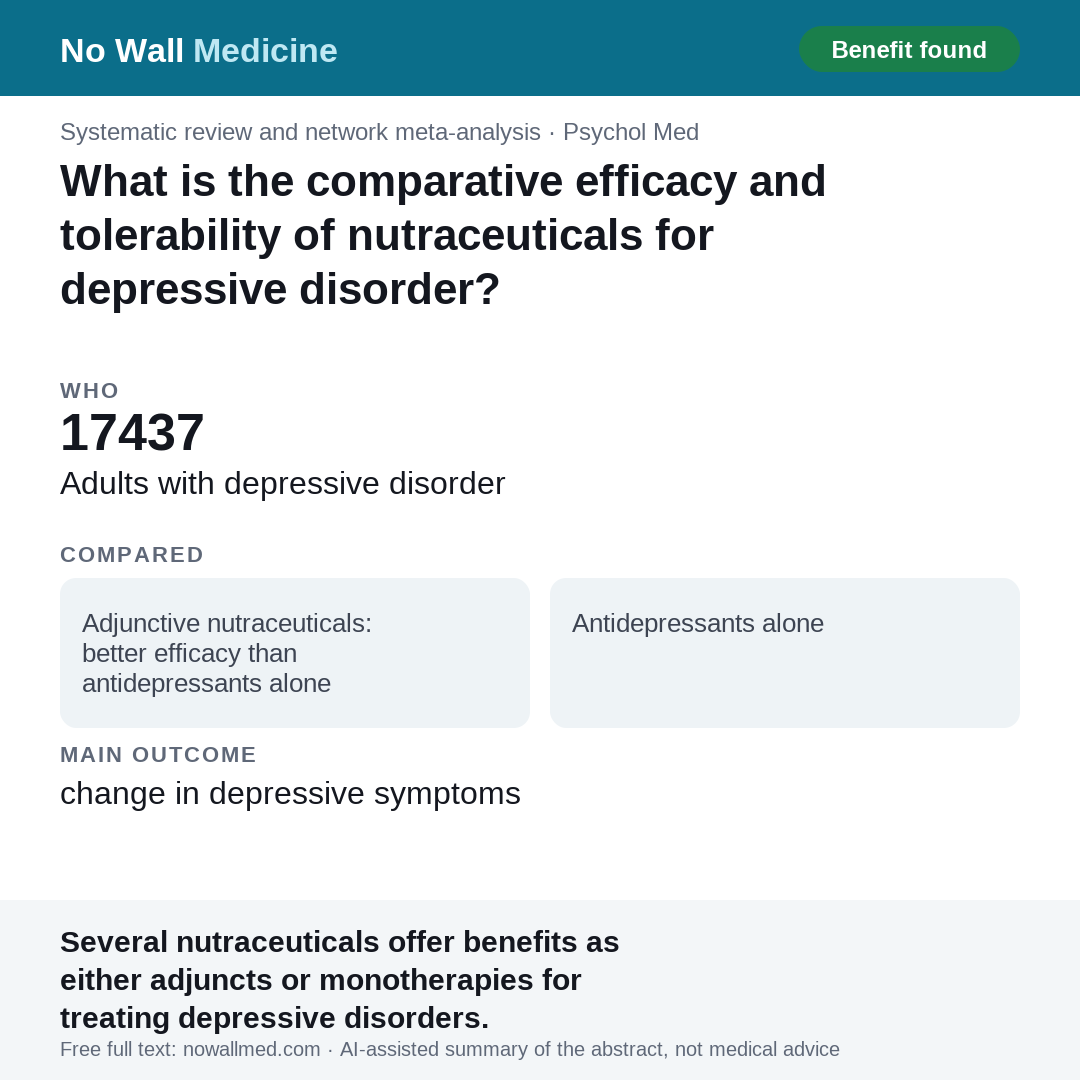
Clinical question: What is the comparative efficacy and tolerability of nutraceuticals for depressive disorder?
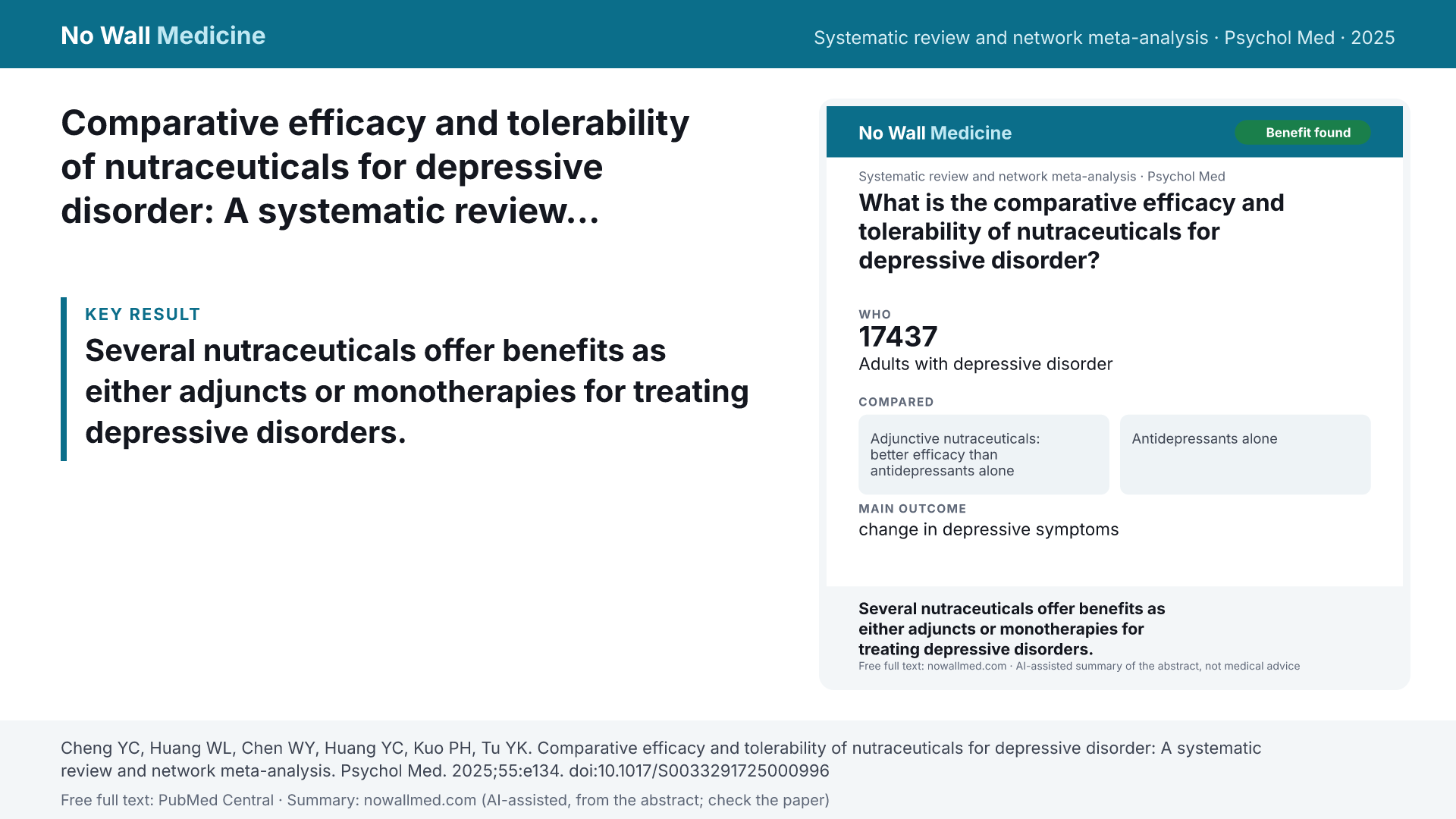
Abstract
Background
Nutraceuticals have been taken as an alternative and add-on treatment for depressive disorders. Direct comparisons between different nutraceuticals and between nutraceuticals and placebo or antidepressants are limited. Thus, it is unclear which nutraceuticals are the most efficacious. Methods
We conducted a network meta-analysis to estimate the comparative efficacy and tolerability of nutraceuticals for the treatment of depressive disorder in adults. The primary outcome was the change in depressive symptoms, as measured by the standard mean difference (SMD). Secondary outcomes included response rate, remission rate, and anxiety. Tolerability was defined as all-cause discontinuation and adverse events. Frequentist random-effect NMA was conducted. Results
Hundred and ninety-two trials involving 17,437 patients and 44 nutraceuticals were eligible for inclusion. Adjunctive nutraceuticals consistently showed better efficacy than antidepressants (ADT) alone in outcomes including SMD, remission, and response. Notable combinations were Eicosapentaenoic acid + Docosahexaenoic Acid plus ADT (EPA + DHA + ADT) (SMD 1.04, 95% confidence interval 0.64-1.44), S-Adenosyl Methionine (SAMe) + ADT (0.99, 0.31-1.68), curcumin + ADT (1.03, 0.55-1.51), Zinc + ADT (1.59, 0.63-2.55), tryptophan + ADT (1.24, 0.32-2.16), and folate + ADT (0.64, 0.17-1.10). Additionally, four nutraceutical monotherapies demonstrated superior efficacy compared to ADT: EPA + DHA (0.6, 0.32-0.88), SAMe (0.52, 0.18-0.87), curcumin (0.62, -0.17 to 1.40) and saffron (0.69, 0.34-1.04). It is noted that EPA + DHA, SAMe, and curcumin showed strong performance as either monotherapies or adjuncts to ADT. Most nutraceuticals showed comparable tolerability to placebo. Conclusions
This extensive systematic review and NMA of nutraceuticals for treating depressive disorders indicated a number of nutraceuticals that could offer benefits, either as adjuncts or monotherapies.
Subject terms
Cite this article
Cheng YC, Huang WL, Chen WY, Huang YC, Kuo PH, Tu YK. Comparative efficacy and tolerability of nutraceuticals for depressive disorder: A systematic review and network meta-analysis. Psychol Med. 2025. doi:10.1017/S0033291725000996
Spotted a mistake? Suggest a correction
Top studies every Monday
The week’s key trials and guidelines in your specialties, plus any topics you follow. By email, free.
Get the weekly digest