Growth hormone combination therapy was associated with better height outcomes than GnRHa monotherapy in children
Comparative Efficacy of GnRHa Monotherapy vs Combination Therapy for Central Precocious Puberty
Meta-analysis of 70 studiesBenefit found
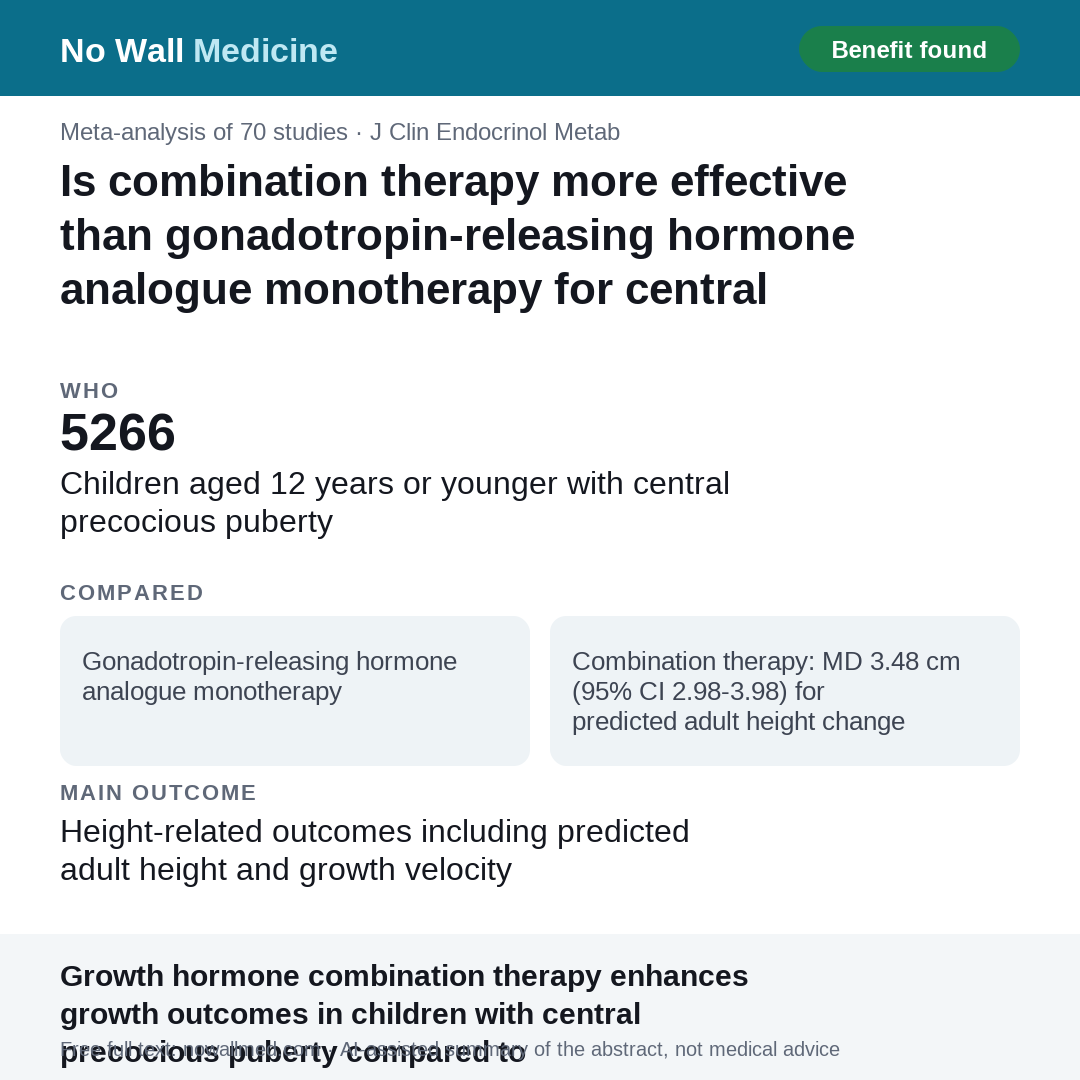
Is combination therapy more effective than gonadotropin-releasing hormone analogue monotherapy for central precocious puberty?
Who
5266
Children aged 12 years or younger with central precocious puberty
Compared
Gonadotropin-releasing hormone analogue monotherapy
Combination therapy: MD 3.48 cm (95% CI 2.98-3.98) for predicted adult height change
Main outcome
Height-related outcomes including predicted adult height and growth velocity
Result: MD 3.48 cm (95% CI 2.98-3.98) for predicted adult height change
Bottom line: Growth hormone combination therapy enhances growth outcomes in children with central precocious puberty compared to gonadotropin-releasing hormone analogue monotherapy.
Limitation: High heterogeneity remains across outcomes, which limits the certainty of these findings.
J Clin Endocrinol Metab · 2025-11-12Download image
Clinical question: Is combination therapy more effective than gonadotropin-releasing hormone analogue monotherapy for central precocious puberty?
Why it matters: Studies comparing the efficacy of gonadotropin-releasing hormone analogue monotherapy with combination therapies for height-related outcomes in children with central precocious puberty show inconsistency.
Key points
- Researchers analyzed 70 studies involving 5266 children aged 12 years or younger with central precocious puberty, which is early onset of puberty.
- In randomized controlled trials, growth hormone combination therapy was associated with a predicted adult height change difference of 3.48 cm and growth velocity difference of 1.82 cm/y.
- In cohort studies, combination therapy was associated with a height gain difference of 3.81 cm and a predicted adult height change difference of 3.06 cm.
Limitation the authors note: High heterogeneity remains across outcomes, which limits the certainty of these findings.
Headline and key points written with AI from the paper’s abstract, with every number checked against it. Read the paper before relying on them.
Topics
Cite this article
Tsai CE, Fan HY, Tsai MC, Chang HY, Lin CM, Yang C. Comparative Efficacy of GnRHa Monotherapy vs Combination Therapy for Central Precocious Puberty. J Clin Endocrinol Metab. 2025. doi:10.1210/clinem/dgaf617
Spotted a mistake? Suggest a correction