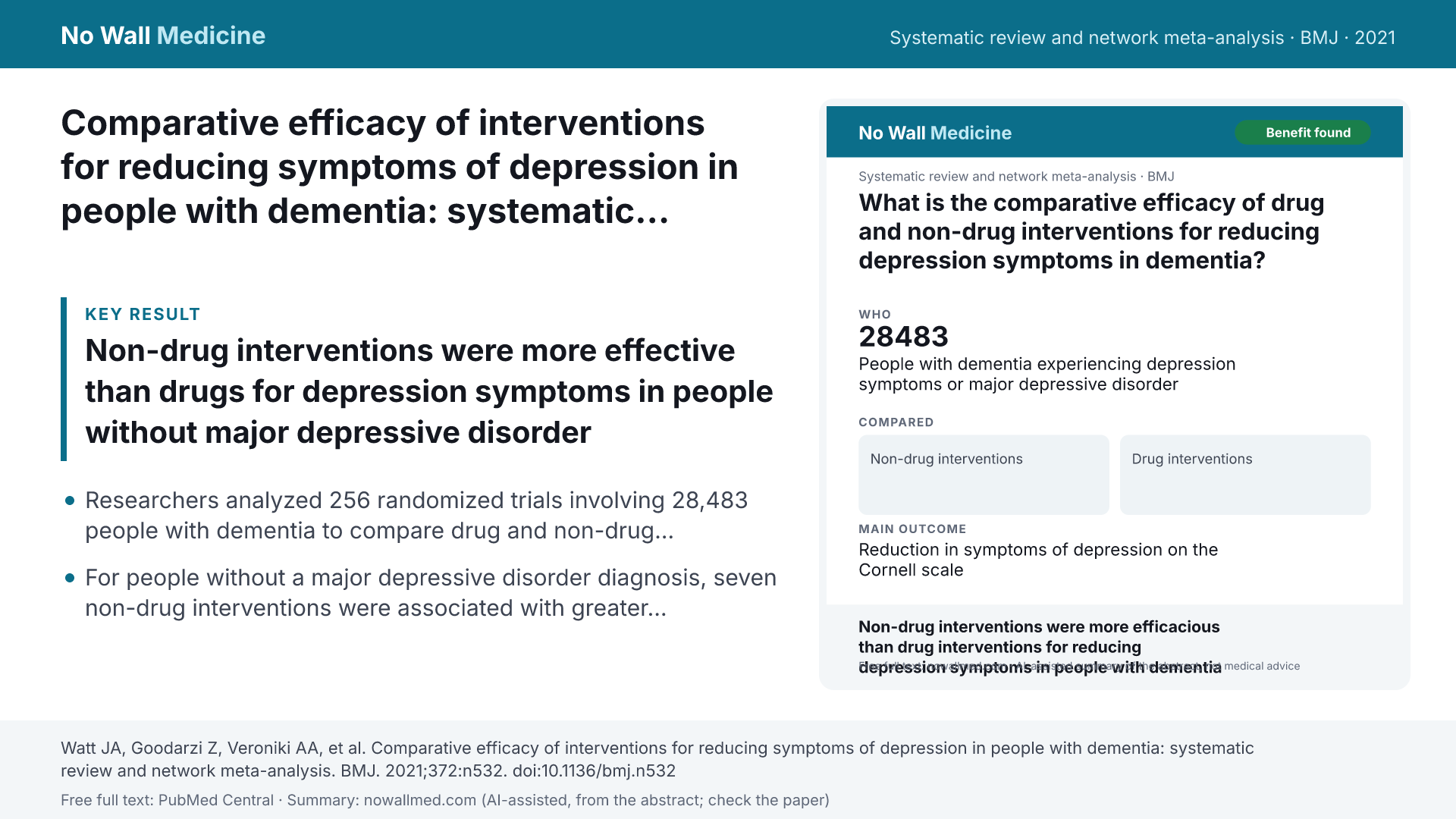
Non-drug interventions were more effective than drugs for depression symptoms in people without major depressive disorder
Comparative efficacy of interventions for reducing symptoms of depression in people with dementia: systematic review and network meta-analysis
Systematic review and network meta-analysisBenefit found
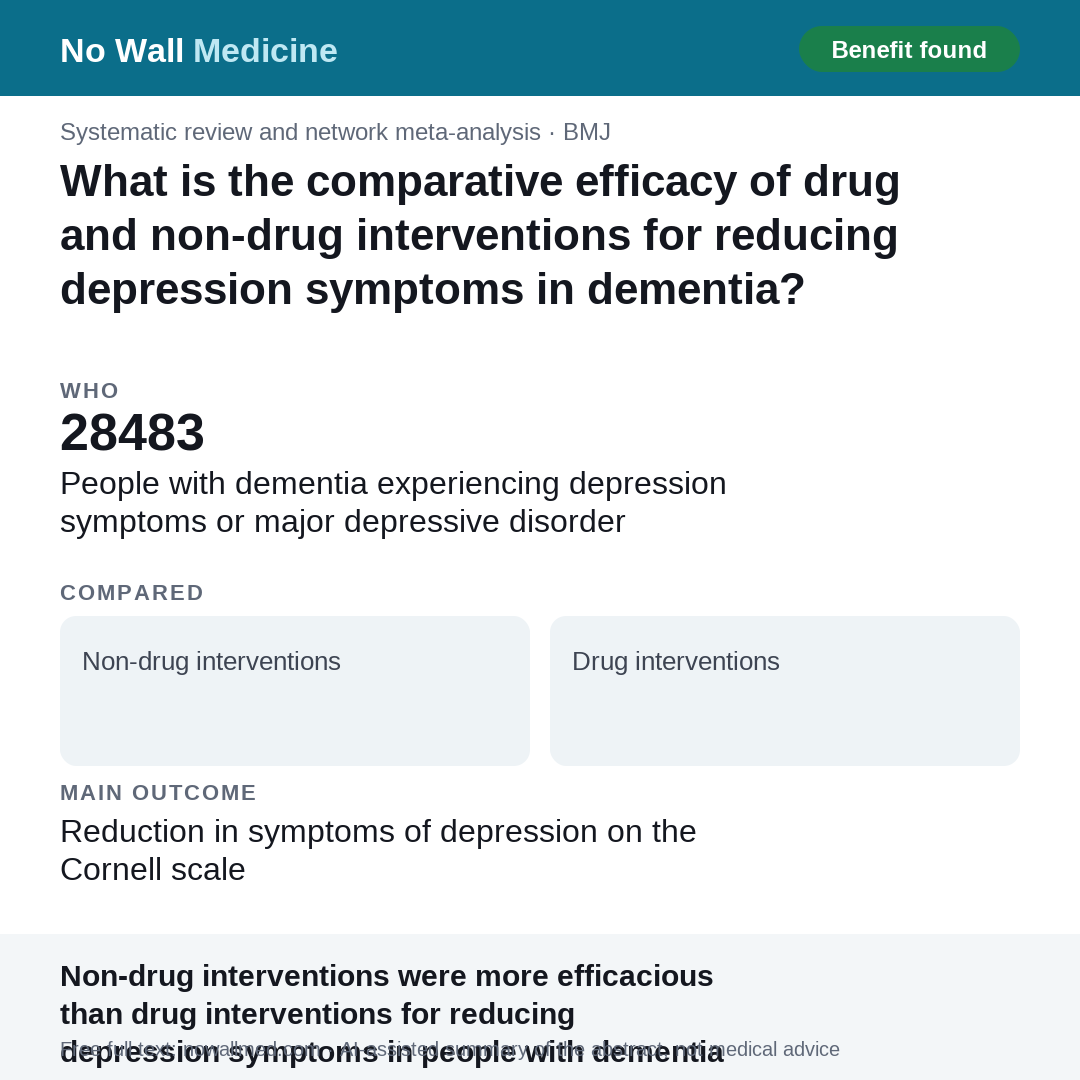
What is the comparative efficacy of drug and non-drug interventions for reducing depression symptoms in dementia?
Who
28483
People with dementia experiencing depression symptoms or major depressive disorder
Compared
Non-drug interventions
Drug interventions
Main outcome
Reduction in symptoms of depression on the Cornell scale
Bottom line: Non-drug interventions were more efficacious than drug interventions for reducing depression symptoms in people with dementia without major depressive disorder.
Limitation: Missing data posed the greatest risk to review findings.
BMJ · 2021-03-24Download image
Clinical question: What is the comparative efficacy of drug and non-drug interventions for reducing depression symptoms in dementia?
Why it matters: It is unclear whether drug or non-drug interventions are more effective for managing depression symptoms in people with dementia.
Key points
- Researchers analyzed 256 randomized trials involving 28,483 people with dementia to compare drug and non-drug treatments for depression symptoms.
- For people without a major depressive disorder diagnosis, seven non-drug interventions were associated with greater symptom reduction compared to usual care.
- Exercise combined with social interaction and cognitive stimulation showed a mean difference of -12.37 on the Cornell scale for depression in dementia.
Limitation the authors note: Missing data posed the greatest risk to the review findings.
Headline and key points written with AI from the paper’s abstract, with every number checked against it. Read the paper before relying on them.
Was this summary helpful?
Abstract
Objective
To describe the comparative efficacy of drug and non-drug interventions for reducing symptoms of depression in people with dementia who experience depression as a neuropsychiatric symptom of dementia or have a diagnosis of a major depressive disorder. Design
Systematic review and meta-analysis. Data sources
Medline, Embase, the Cochrane Library, CINAHL, PsycINFO, and grey literature between inception and 15 October 2020. Eligibility criteria for study selection
Randomised trials comparing drug or non-drug interventions with usual care or any other intervention targeting symptoms of depression in people with dementia. Main outcome measures
Pairs of reviewers screened studies, abstracted aggregate level data, and appraised risk of bias with the Cochrane risk of bias tool, which facilitated the derivation of standardised mean differences and back transformed mean differences (on the Cornell scale for depression in dementia) from bayesian random effects network meta-analyses and pairwise meta-analyses. Results
Of 22 138 citations screened, 256 studies (28 483 people with dementia) were included. Missing data posed the greatest risk to review findings. In the network meta-analysis of studies including people with dementia without a diagnosis of a major depressive disorder who were experiencing symptoms of depression (213 studies; 25 177 people with dementia; between study variance 0.23), seven interventions were associated with a greater reduction in symptoms of depression compared with usual care: cognitive stimulation (mean difference -2.93, 95% credible interval -4.35 to -1.52), cognitive stimulation combined with a cholinesterase inhibitor (-11.39, -18.38 to -3.93), massage and touch therapy (-9.03, -12.28 to -5.88), multidisciplinary care (-1.98, -3.80 to -0.16), occupational therapy (-2.59, -4.70 to -0.40), exercise combined with social interaction and cognitive stimulation (-12.37, -19.01 to -5.36), and reminiscence therapy (-2.30, -3.68 to -0.93). Except for massage and touch therapy, cognitive stimulation combined with a cholinesterase inhibitor, and cognitive stimulation combined with exercise and social interaction, which were more efficacious than some drug interventions, no statistically significant difference was found in the comparative efficacy of drug and non-drug interventions for reducing symptoms of depression in people with dementia without a diagnosis of a major depressive disorder. Clinical and methodological heterogeneity precluded network meta-analysis of studies comparing the efficacy of interventions specifically for reducing symptoms of depression in people with dementia and a major depressive disorder (22 studies; 1829 patients). Conclusions
In this systematic review, non-drug interventions were found to be more efficacious than drug interventions for reducing symptoms of depression in people with dementia without a major depressive disorder. Systematic review registration
PROSPERO CRD42017050130.
Abstract reproduced under the article’s CC BY NC licence.
Subject terms
Cite this article
Watt JA, Goodarzi Z, Veroniki AA, et al. Comparative efficacy of interventions for reducing symptoms of depression in people with dementia: systematic review and network meta-analysis. BMJ. 2021. doi:10.1136/bmj.n532
Spotted a mistake? Suggest a correction