Sugarless gum and electrical nerve stimulation ranked most effective for dry mouth in dialysis patients
Comparative efficacy of non-pharmacological interventions on xerostomia and salivary flow rate among haemodialysis patients: A systematic review and network meta-analysis
Systematic review and network meta-analysisBenefit found
Which non-pharmacological interventions are most effective for xerostomia and salivary flow rate?
Who
739
haemodialysis patients
Compared
sugarless chewing gum: significantly reduced the symptoms of xerostomia
transcutaneous electrical nerve stimulation: effective in improving the unstimulated whole salivary rate
Main outcome
xerostomia severity and salivary flow rate
Bottom line: Sugarless chewing gum and transcutaneous electrical nerve stimulation are top-ranked interventions for improving oral symptoms in dialysis patients.
Clin Kidney J · 2024-10-26Download image
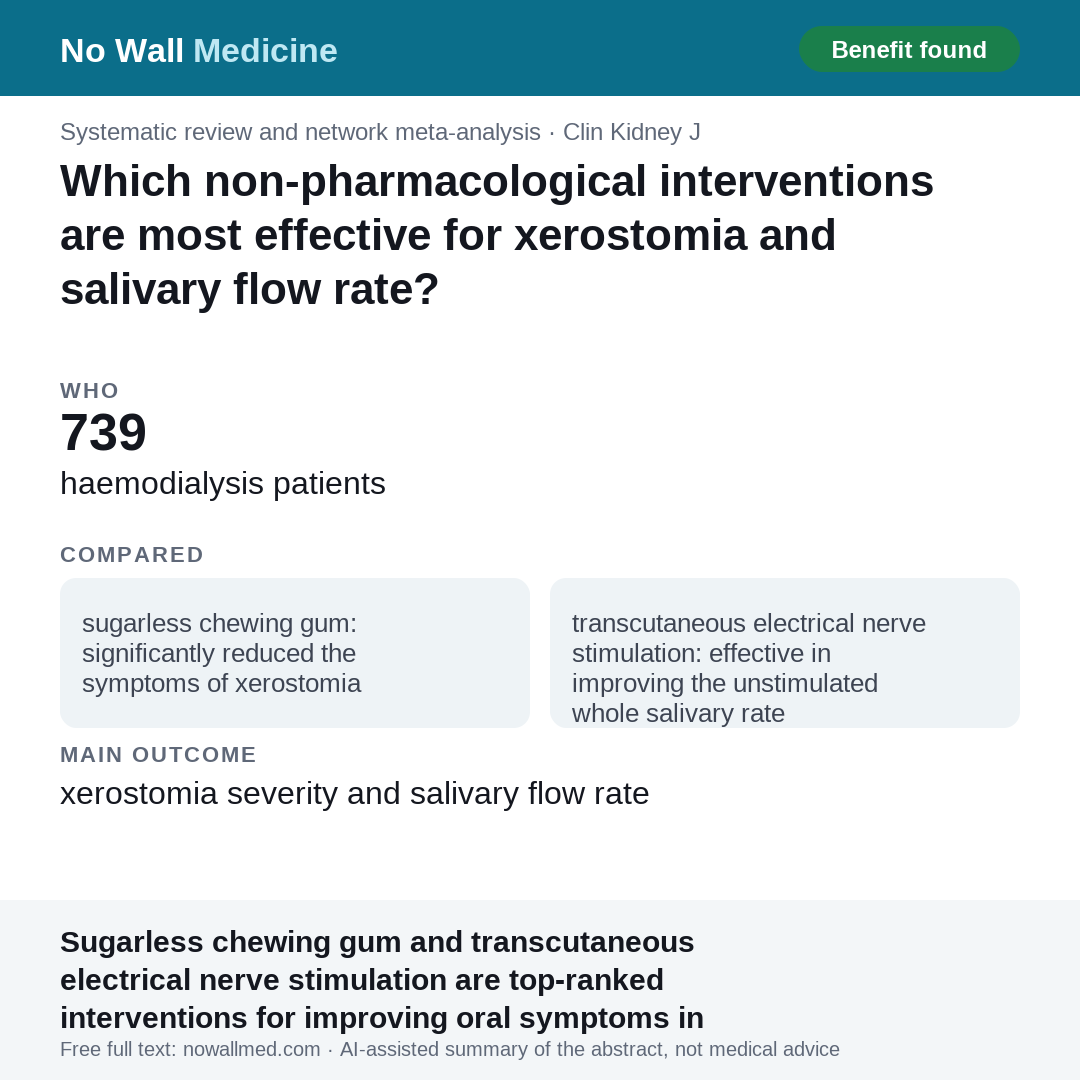
Clinical question: Which non-pharmacological interventions are most effective for xerostomia and salivary flow rate?
Why it matters: It was unknown which non-pharmacological interventions are most effective for managing xerostomia and saliva flow rates in patients undergoing dialysis.
Key points
- Researchers analyzed 11 randomized controlled trials involving 739 patients to compare eight non-pharmacological interventions for dry mouth and saliva flow.
- Sugarless chewing gum was ranked as the top intervention for reducing xerostomia, which is the sensation of dry mouth.
- Transcutaneous electrical nerve stimulation, or TENS, was ranked as the top intervention for improving the unstimulated whole salivary rate.
Headline and key points written with AI from the paper’s abstract, with every number checked against it. Read the paper before relying on them.
Was this summary helpful?
Cite this article
Sharifnia AM, Chu G, Zhang X, Green H, Fernandez R. Comparative efficacy of non-pharmacological interventions on xerostomia and salivary flow rate among haemodialysis patients: A systematic review and network meta-analysis. Clin Kidney J. 2024. doi:10.1093/ckj/sfae334
Spotted a mistake? Suggest a correction
Top studies every Monday
The week’s key trials and guidelines in your specialties, plus any topics you follow. By email, free.
Get the weekly digest