Subcutaneous infliximab biosimilar showed greater improvements in rheumatoid arthritis compared to intravenous versions
Comparative efficacy of subcutaneous (CT-P13) and intravenous infliximab in adult patients with rheumatoid arthritis: a network meta-regression of individual patient data from two randomised trials
Network meta-regression of individual patient dataBenefit found
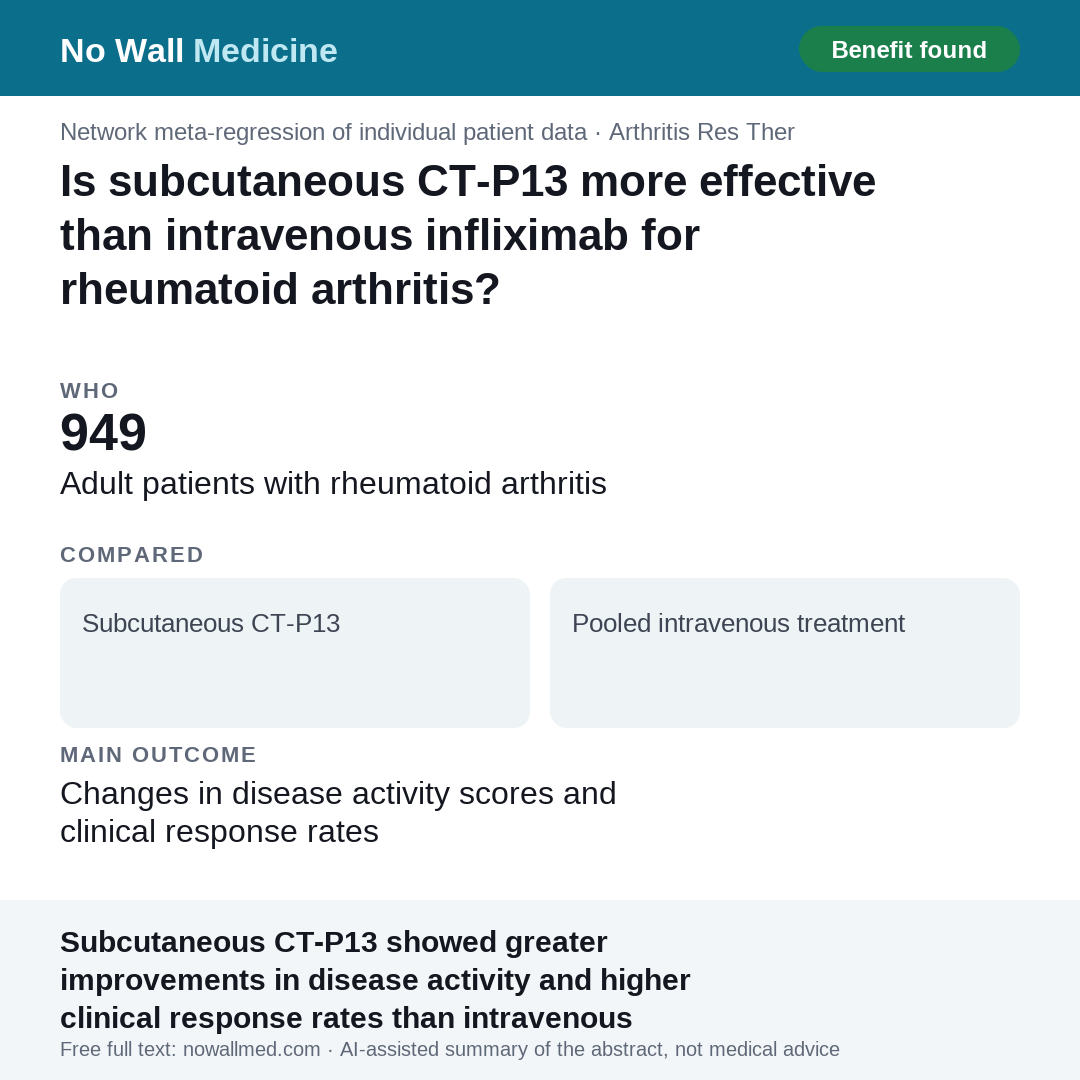
Is subcutaneous CT-P13 more effective than intravenous infliximab for rheumatoid arthritis?
Who
949
Adult patients with rheumatoid arthritis
Compared
Subcutaneous CT-P13
Pooled intravenous treatment
Main outcome
Changes in disease activity scores and clinical response rates
Result: DAS28-CRP difference -0.578 (95% CI -0.831, -0.325)
Bottom line: Subcutaneous CT-P13 showed greater improvements in disease activity and higher clinical response rates than intravenous infliximab.
Arthritis Res Ther · 2021-04-16Download image
Clinical question: Is subcutaneous CT-P13 more effective than intravenous infliximab for rheumatoid arthritis?
Why it matters: It was unknown if the subcutaneous formulation of the infliximab biosimilar CT-P13 offers improved efficacy compared to intravenous infliximab formulations for rheumatoid arthritis.
Key points
- Researchers analyzed individual patient data from 949 adults with rheumatoid arthritis across two randomized trials.
- At 30 weeks, subcutaneous CT-P13 showed significantly greater changes in DAS28-CRP (-0.578), CDAI (-3.502), and SDAI (-4.031) scores compared to pooled intravenous treatments.
- Subcutaneous CT-P13 was also associated with higher rates of remission, low disease activity, and clinically meaningful improvement in functional disability.
Headline and key points written with AI from the paper’s abstract, with every number checked against it. Read the paper before relying on them.
Was this summary helpful?
Subject terms
Cite this article
Combe B, Allanore Y, Alten R, Caporali R, Durez P, Iannone F. Comparative efficacy of subcutaneous (CT-P13) and intravenous infliximab in adult patients with rheumatoid arthritis: a network meta-regression of individual patient data from two randomised trials. Arthritis Res Ther. 2021. doi:10.1186/s13075-021-02487-x
Spotted a mistake? Suggest a correction
Top studies every Monday
The week’s key trials and guidelines in your specialties, plus any topics you follow. By email, free.
Get the weekly digest