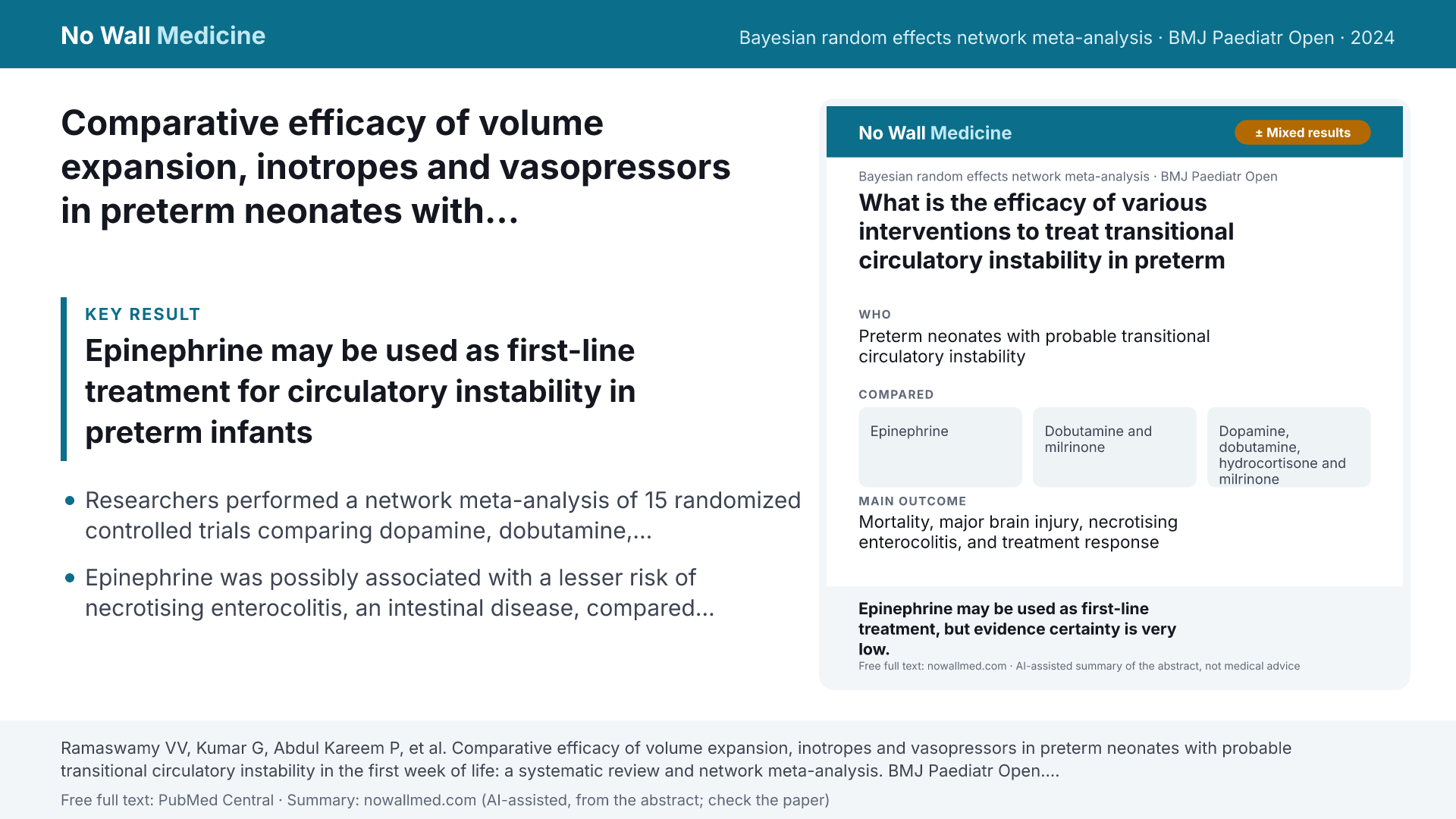
Epinephrine may be used as first-line treatment for circulatory instability in preterm infants
Comparative efficacy of volume expansion, inotropes and vasopressors in preterm neonates with probable transitional circulatory instability in the first week of life: a systematic review and network meta-analysis
Bayesian random effects network meta-analysisMixed results
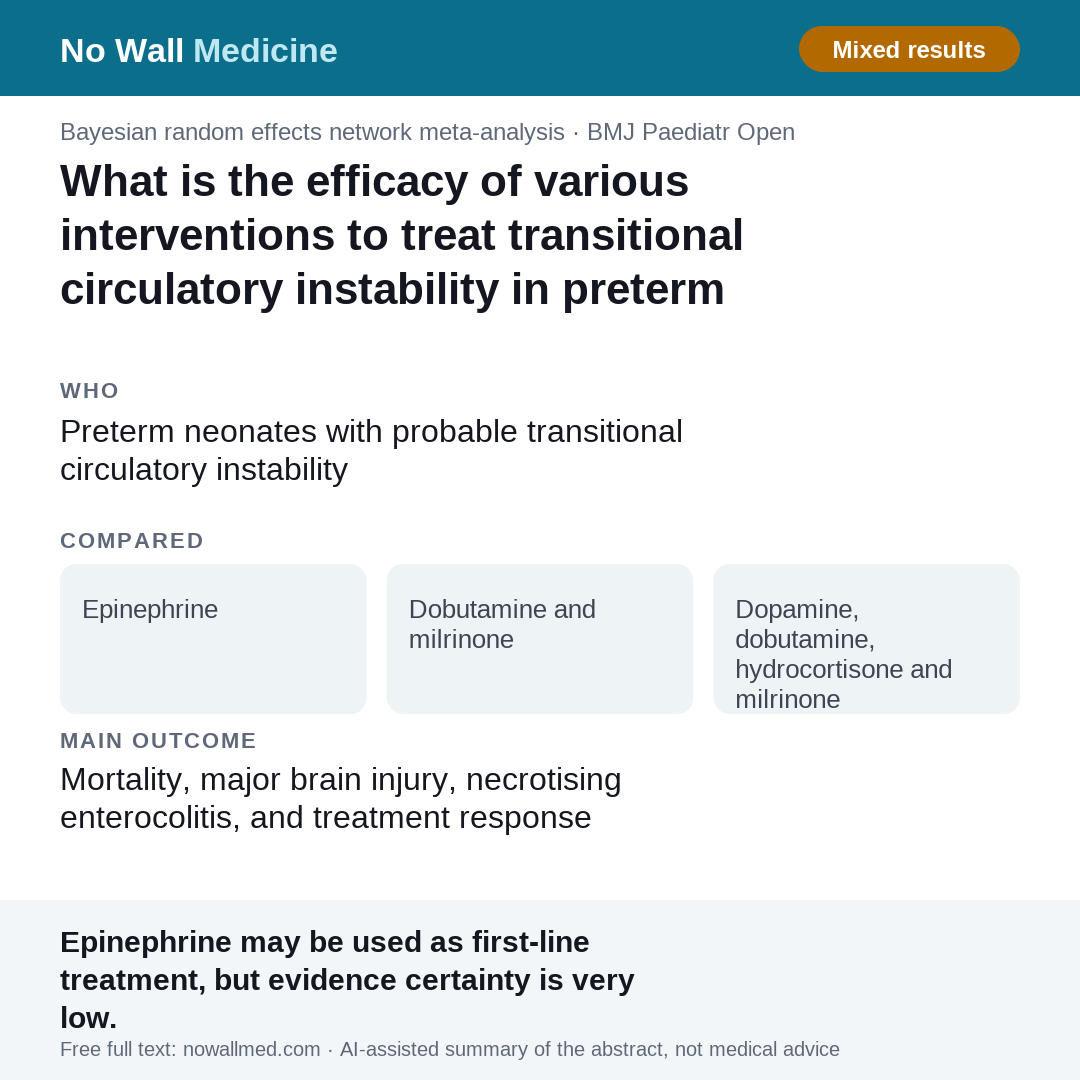
What is the efficacy of various interventions to treat transitional circulatory instability in preterm neonates?
Who
Preterm neonates with probable transitional circulatory instability
Compared
Epinephrine
Dobutamine and milrinone
Dopamine, dobutamine, hydrocortisone and milrinone
Main outcome
Mortality, major brain injury, necrotising enterocolitis, and treatment response
Bottom line: Epinephrine may be used as first-line treatment, but evidence certainty is very low.
Limitation: Evidence certainty for outcomes was very low.
BMJ Paediatr Open · 2024-05-20Download image
Clinical question: What is the efficacy of various interventions to treat transitional circulatory instability in preterm neonates?
Why it matters: There is limited agreement on the recommended treatments for transitional circulatory instability in preterm neonates during their first week of life.
Key points
- Researchers performed a network meta-analysis of 15 randomized controlled trials comparing dopamine, dobutamine, epinephrine, hydrocortisone, vasopressin, milrinone, volume, and placebo in preterm neonates.
- Epinephrine was possibly associated with a lesser risk of necrotising enterocolitis, an intestinal disease, compared to dopamine, dobutamine, hydrocortisone, and milrinone.
- Clinical benefit or harm could not be ruled out for mortality or the overall response to treatment.
Limitation the authors note: The certainty of the evidence for the findings was very low.
Headline and key points written with AI from the paper’s abstract, with every number checked against it. Read the paper before relying on them.
Was this summary helpful?
Abstract
Background
There exists limited agreement on the recommendations for the treatment of transitional circulatory instability (TCI) in preterm neonates OBJECTIVE: To compare the efficacy of various interventions used to treat TCI METHODS: Medline and Embase were searched from inception to 21st July 2023. Two authors extracted the data independently. A Bayesian random effects network meta-analysis was used. Recommendations were formulated using the Grading of Recommendations, Assessment, Development, and Evaluations (GRADE) framework. Interventions
Dopamine, dobutamine, epinephrine, hydrocortisone, vasopressin, milrinone, volume and placebo. Main outcome measures
Mortality, major brain injury (MBI) (intraventricular haemorrhage > grade 2 or cystic periventricular leukomalacia), necrotising enterocolitis (NEC) ≥stage 2 and treatment response (as defined by the author). Results
15 Randomized Controlled Trials (RCTs) were included from the 1365 titles and abstracts screened. Clinical benefit or harm could not be ruled out for the critical outcome of mortality. For the outcome of MBI, epinephrine possibly decreased the risk when compared to dobutamine and milrinone (very low certainty). Epinephrine was possibly associated with a lesser risk of NEC when compared with dopamine, dobutamine, hydrocortisone and milrinone (very low certainty). Dopamine was possibly associated with a lesser risk of NEC when compared with dobutamine (very low certainty). Vasopressin possibly decreased the risk of NEC compared with dopamine, dobutamine, hydrocortisone and milrinone (very low certainty). Clinical benefit or harm could not be ruled out for the outcome response to treatment. Conclusions
Epinephrine may be used as the first-line drug in preterm neonates with TCI, the evidence certainty being very low. We suggest future trials evaluating the management of TCI with an emphasis on objective criteria to define it.
Abstract reproduced under the article’s CC BY NC licence.
Subject terms
Cite this article
Ramaswamy VV, Kumar G, Abdul Kareem P, et al. Comparative efficacy of volume expansion, inotropes and vasopressors in preterm neonates with probable transitional circulatory instability in the first week of life: a systematic review and network meta-analysis. BMJ Paediatr Open. 2024. doi:10.1136/bmjpo-2024-002500
Spotted a mistake? Suggest a correction