M-CHAT-R/F screening tool shows inconsistent sensitivity and high false-positive rates for autism
Comparative screening accuracy of the Modified Checklist for Autism in Toddlers, Revised with Follow-Up (M-Chat-R/F) for early autism spectrum disorder: a systematic review
Systematic reviewMixed results
What is the screening accuracy of the M-CHAT-R/F compared to other autism screening tools?
Who
12633
Children aged 12-48 months
Compared
M-CHAT-R/F: variable sensitivity, high negative predictive value, variable specificity, and low positive predictive value
Alternative screening tools
Main outcome
Screening accuracy metrics for autism spectrum disorder
Bottom line: The M-CHAT-R/F has high negative predictive value but variable sensitivity and low positive predictive value, creating false-positive burdens.
Limitation: Accuracy is highly age-dependent, with performance degrading outside the 16-30-month window.
Fam Med Community Health · 2026-06-09Download image
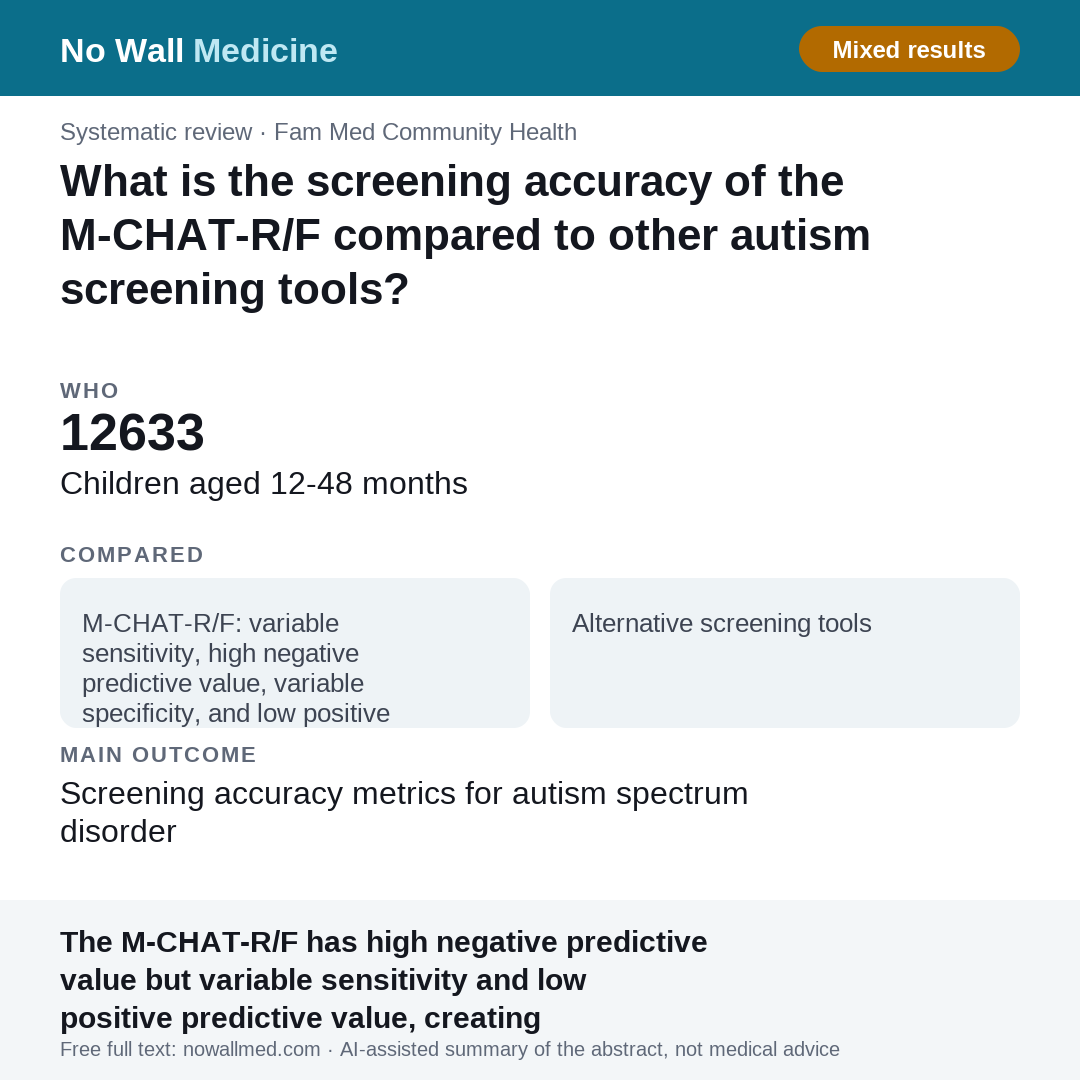
Clinical question: What is the screening accuracy of the M-CHAT-R/F compared to other autism screening tools?
Why it matters: A recent systematic synthesis of the comparative accuracy of the M-CHAT-R/F autism screening tool was lacking.
Key points
- Researchers analyzed six high-quality studies involving 12,633 participants aged 12-48 months to compare the M-CHAT-R/F autism screening tool against other instruments.
- The tool had a consistently high negative predictive value but showed variable sensitivity and a persistently low positive predictive value.
- Accuracy was highly dependent on age, with performance declining outside the 16-30-month window compared to other specialized tools.
Headline and key points written with AI from the paper’s abstract, with every number checked against it. Read the paper before relying on them.
Abstract
Objective
Early screening for autism spectrum disorder (ASD) is critical for timely intervention, making the Modified Checklist for Autism in Toddlers, Revised with Follow-Up (M-CHAT-R/F) a widely adopted tool globally. However, a recent systematic synthesis of its comparative accuracy is lacking. This review aimed to evaluate the screening accuracy of the M-CHAT-R/F against other ASD screening instruments. Design
A systematic review was conducted in accordance with Preferred Reporting Items for Systematic Reviews and Meta-Analyses guidelines. A narrative synthesis was employed to integrate findings across diverse study designs and methodological quality was assessed using the Joanna Briggs Institute checklist. Eligibility criteria
Peer-reviewed, English-language observational studies published between January 2020 and October 2025 that compared the accuracy metrics of the M-CHAT-R/F with alternative screening tools. Information sources
Scopus, PubMed, ScienceDirect and ProQuest. Results
From 172 identified articles, six high-quality studies encompassing 12 633 participants aged 12-48 months were analysed. The synthesis revealed a complex performance profile for the M-CHAT-R/F. While its sensitivity for detecting potential cases was highly inconsistent, its negative predictive value remained consistently high, reliably identifying children who screened negative. Conversely, the tool demonstrated variable specificity and a persistently low positive predictive value, indicating a substantial false-positive burden and reduced confidence in positive results. Furthermore, the M-CHAT-R/F's accuracy was highly age-dependent, with performance degrading outside the optimal 16-30-month window compared with other specialised tools. Conclusions
The M-CHAT-R/F may not be an optimal instrument in every clinical setting. Its clinical utility may be limited by variable sensitivity and a lower positive predictive value, potentially creating a higher false-positive burden. Clinicians and health systems should consider adopting age-specific, tiered screening protocols to improve diagnostic efficiency and better allocate intervention resources.
Abstract reproduced under the article’s CC BY NC licence.
Topics
Spotted a mistake? Suggest a correction