Treatment effectiveness for metastatic prostate cancer varies by disease volume and timing of metastasis
Comparative Survival in Metastatic Hormone-sensitive Prostate Cancer by Volume of Disease and Timing of Metastasis: A Living Network Meta-analysis
Living network meta-analysisMixed results
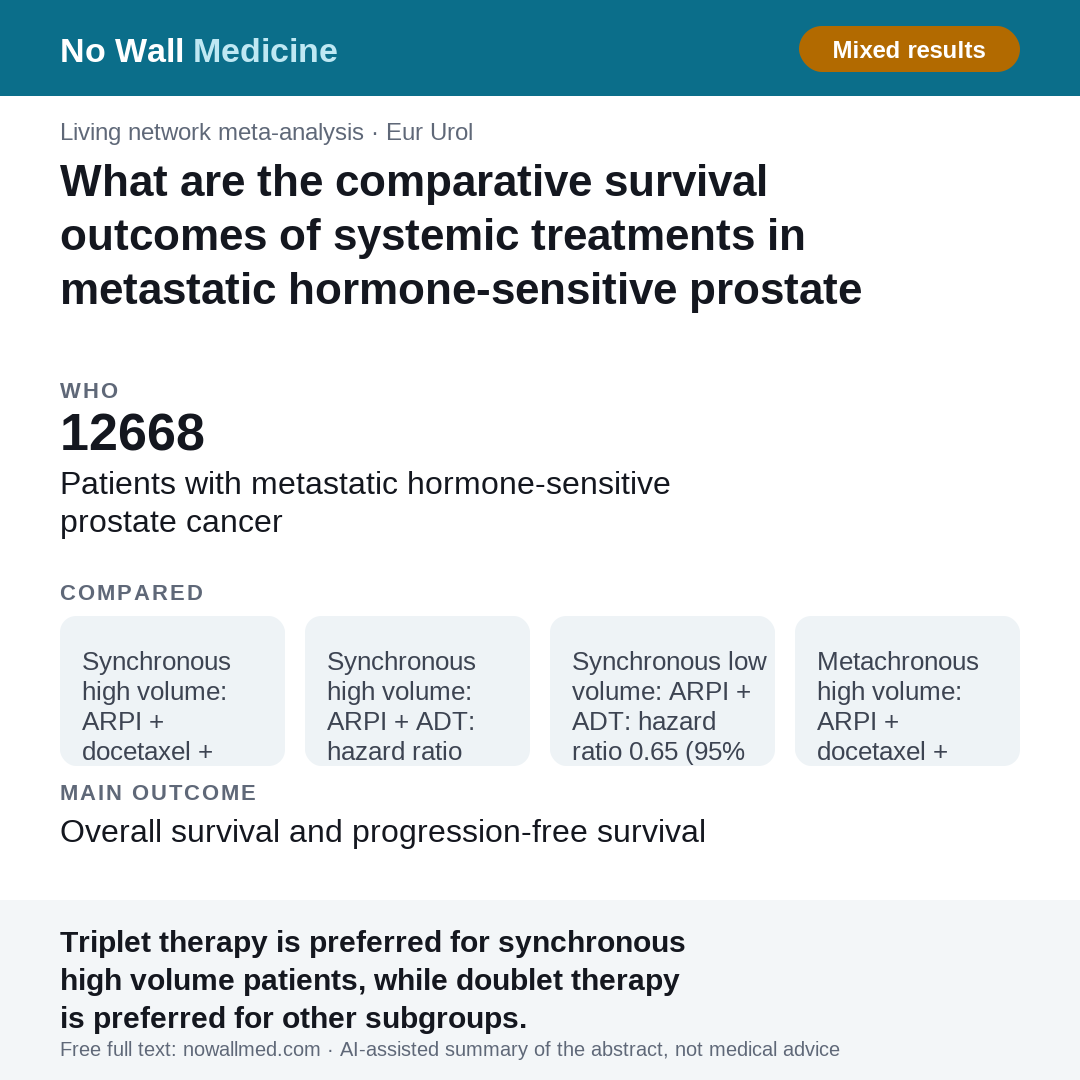
What are the comparative survival outcomes of systemic treatments in metastatic hormone-sensitive prostate cancer subgroups?
Who
12668
Patients with metastatic hormone-sensitive prostate cancer
Compared
Synchronous high volume: ARPI + docetaxel + ADT: hazard ratio 0.72 (95% CI 0.62-0.83) vs docetaxel + ADT
Synchronous high volume: ARPI + ADT: hazard ratio 0.71 (95% CI 0.53-0.97) vs docetaxel + ADT
Synchronous low volume: ARPI + ADT: hazard ratio 0.65 (95% CI 0.52-0.80) vs ADT alone
Metachronous high volume: ARPI + docetaxel + ADT: hazard ratio 0.89 (95% CI 0.43-1.85) vs ARPI + ADT
Main outcome
Overall survival and progression-free survival
Bottom line: Triplet therapy is preferred for synchronous high volume patients, while doublet therapy is preferred for other subgroups.
Limitation: Inability to account for patient- and cancer-related factors influencing physician decisions to offer docetaxel.
Eur Urol · 2025-11-04Download image
Clinical question: What are the comparative survival outcomes of systemic treatments in metastatic hormone-sensitive prostate cancer subgroups?
Why it matters: Clinicians need to know which systemic treatment combinations are most effective based on the volume of cancer and whether it appeared simultaneously or after initial treatment.
Key points
- Researchers analyzed 11 randomized controlled trials involving 12,668 patients to compare treatments for metastatic hormone-sensitive prostate cancer.
- In patients with synchronous high disease volume, adding docetaxel chemotherapy to androgen receptor pathway inhibitors and androgen deprivation therapy improved overall survival.
- For patients with low disease volume, whether synchronous or metachronous, androgen receptor pathway inhibitors plus androgen deprivation therapy improved overall survival compared to androgen deprivation therapy alone.
Headline and key points written with AI from the paper’s abstract, with every number checked against it. Read the paper before relying on them.
Was this summary helpful?
Subject terms
Cite this article
Riaz IB, Ahmed Naqvi SA, Faisal KS, He H, Rubab Khakwani KZ, Childs DS. Comparative Survival in Metastatic Hormone-sensitive Prostate Cancer by Volume of Disease and Timing of Metastasis: A Living Network Meta-analysis. Eur Urol. 2025. doi:10.1016/j.eururo.2025.09.007
Spotted a mistake? Suggest a correction
Top studies every Monday
The week’s key trials and guidelines in your specialties, plus any topics you follow. By email, free.
Get the weekly digest