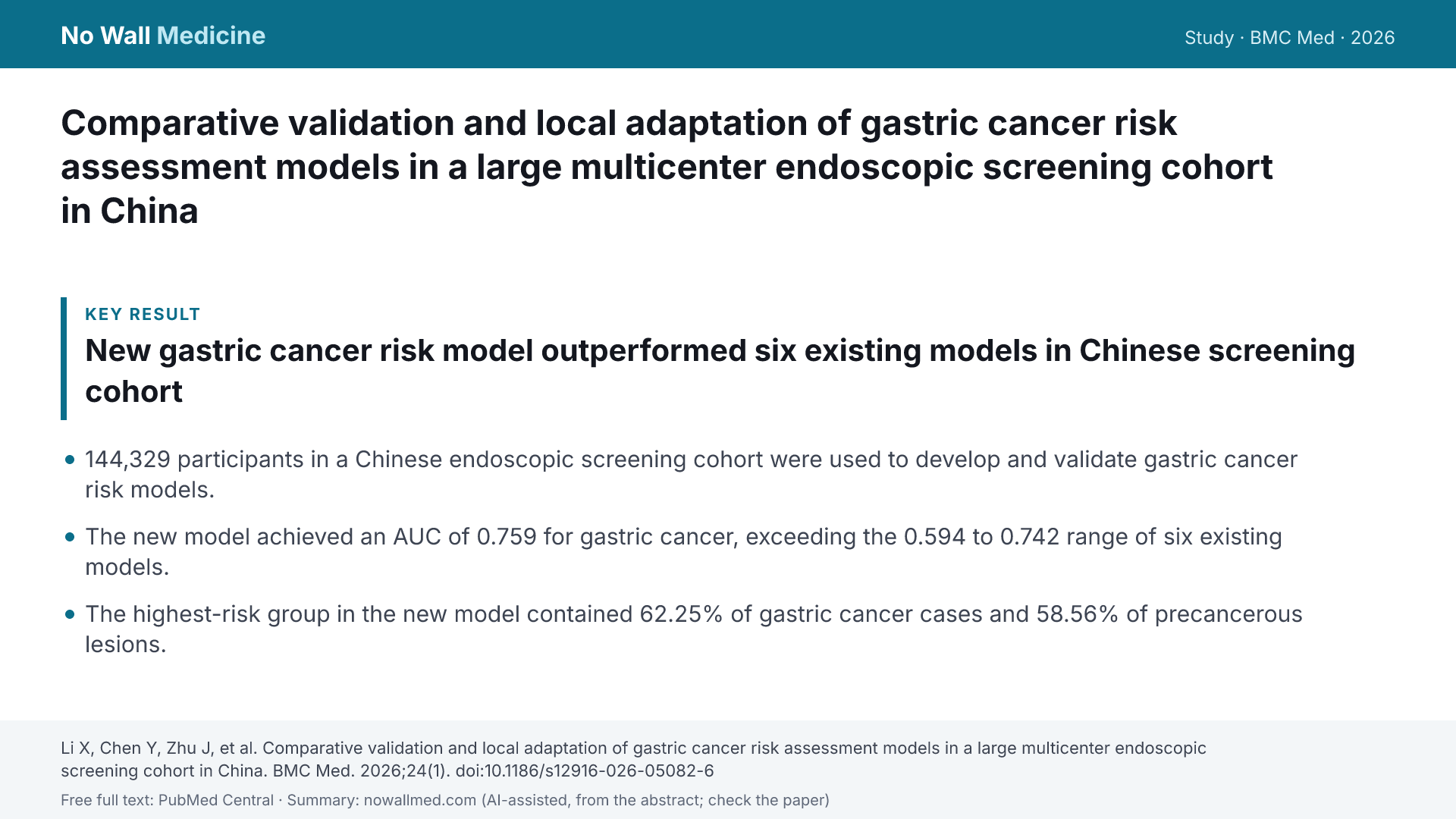
New gastric cancer risk model outperformed six existing models in Chinese screening cohort
Comparative validation and local adaptation of gastric cancer risk assessment models in a large multicenter endoscopic screening cohort in China
Why it matters: Existing gastric cancer risk models have not been sufficiently validated or adapted for effective early detection in Chinese populations.
Key points
- 144,329 participants in a Chinese endoscopic screening cohort were used to develop and validate gastric cancer risk models.
- The new model achieved an AUC of 0.759 for gastric cancer, exceeding the 0.594 to 0.742 range of six existing models.
- The highest-risk group in the new model contained 62.25% of gastric cancer cases and 58.56% of precancerous lesions.
Study type: Observational study: it can show a link, but not prove that one thing causes another.
Headline and key points written with AI from the paper’s abstract, with every number checked against it. Read the paper before relying on them.
Was this summary helpful?
Subject terms
Headline, design, result, key points, caveat and citation as plain text.
Cite this article
Li X, Chen Y, Zhu J, et al. Comparative validation and local adaptation of gastric cancer risk assessment models in a large multicenter endoscopic screening cohort in China. BMC Med. 2026;24(1). doi:10.1186/s12916-026-05082-6
Spotted a mistake? Suggest a correction