Comparing binary efficacy outcomes for systemic immunomodulatory treatments for atopic dermatitis in a living systematic review and network meta-analysis
Living systematic review and network meta-analysisMixed results
How do systemic immunomodulatory treatments compare for binary efficacy in atopic dermatitis?
Who
22 122
Participants with moderate-to-severe atopic dermatitis
Compared
Upadacitinib 30 mg daily: OR 2.5 (95% CrI 1.3-5.0)
Dupilumab
Main outcome
Proportion achieving EASI 50, EASI 75, EASI 90, and IGA success
Result: OR 2.5 (95% CrI 1.3-5.0) for upadacitinib 30 mg vs dupilumab
Bottom line: Upadacitinib 30 mg and abrocitinib 200 mg showed highest efficacy for binary endpoints in moderate-to-severe atopic dermatitis.
Br J Dermatol · 2023-10-13Download image
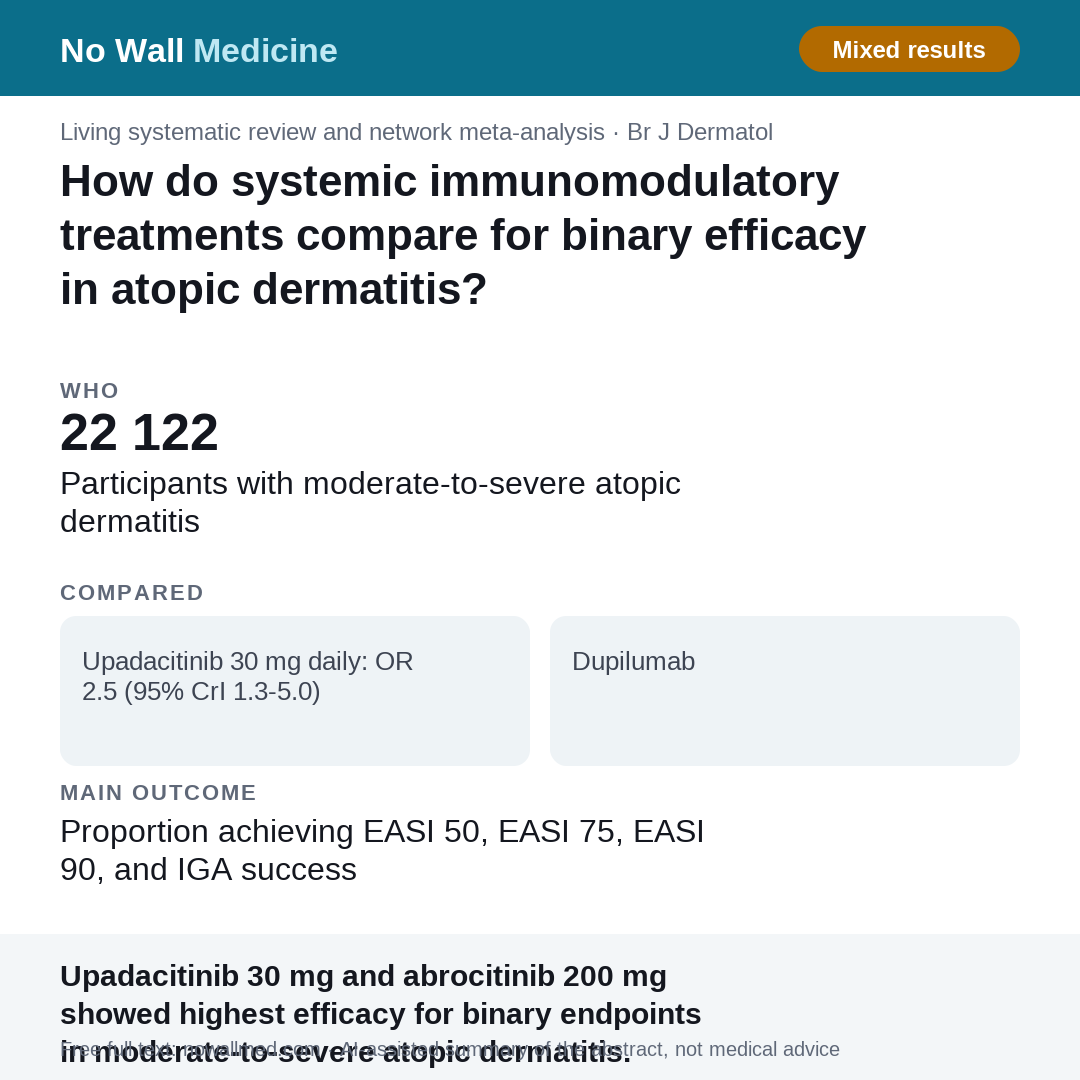
Clinical question: How do systemic immunomodulatory treatments compare for binary efficacy in atopic dermatitis?
Abstract
Background
Systemic treatments for atopic dermatitis (AD) are evaluated primarily in placebo-controlled trials with binary efficacy outcomes. In a living systematic review and network meta-analysis (NMA), we previously analysed continuous efficacy measures. Objectives
To compare binary efficacy outcomes of systemic treatments for AD. Methods
We searched the Cochrane Central Register of Controlled Trials (CENTRAL), MEDLINE, Embase, Latin American and Caribbean Health Science Information (LILACS) database, Global Resource for Eczema Trials (GREAT) database and trial registries up to 1 March 2023. We included randomized trials examining ≥ 8 weeks of treatment with systemic immunomodulatory medications for moderate-to-severe AD. We screened titles, abstracts and full texts and abstracted data independently, in duplicate. Outcomes included the proportion of patients achieving at least 50%, 75% and 90% improvements in Eczema Area and Severity Index (EASI 50, EASI 75 and EASI 90, respectively) and Investigator Global Assessment (IGA) success. We performed random-effects Bayesian NMAs to calculate odds ratios (OR) and 95% credible intervals (CrIs) between each intervention for each outcome. Results
Eighty-three trials with 22 122 participants were included in the systematic review. In analyses limited to trials of 8-16 weeks' duration with predominantly adult populations, abrocitinib 200 mg daily (OR 1.5, 95% CrI 1.1-2.2) and upadacitinib 15 mg daily (OR 1.7, 95% CrI 0.9-3.3) and 30 mg daily (OR 2.5, 95% CrI 1.3-5.0) were associated with higher odds of achieving EASI 50 vs. dupilumab. Abrocitinib 100 mg daily (OR 0.7, 95% CrI 0.5-1.0), baricitinib 2 mg daily (OR 0.4, 95% CrI 0.3-0.5) and 4 mg daily (OR 0.5, 95% CrI 0.3-0.7), and tralokinumab (OR 0.4, 95% CrI 0.3-0.6) were associated with lower odds of achieving EASI 50 vs. dupilumab. Results were similar for EASI 75, EASI 90 and IGA success. Conclusions
Supporting results for continuous outcome measures, upadacitinib 30 mg daily and abrocitinib 200 mg daily are the most efficacious with regard to binary efficacy endpoints up to 16 weeks in adults with moderate-to-severe AD, followed by upadacitinib 15 mg daily, dupilumab and abrocitinib 100 mg daily. Dupilumab and both doses of upadacitinib and abrocitinib are more efficacious than baricitinib 4 and 2 mg daily and tralokinumab.
Subject terms
Cite this article
Drucker AM, Lam M, Elsawi R, Prieto-Merino D, Malek R, Ellis AG. Comparing binary efficacy outcomes for systemic immunomodulatory treatments for atopic dermatitis in a living systematic review and network meta-analysis. Br J Dermatol. 2023. doi:10.1093/bjd/ljad393
Spotted a mistake? Suggest a correction
Top studies every Monday
The week’s key trials and guidelines in your specialties, plus any topics you follow. By email, free.
Get the weekly digest