Continuous propofol infusion was associated with lower emergence agitation in preschool children undergoing day surgery
Comparing different administration methods of subanaesthetic propofol to mitigate emergence agitation in preschool children undergoing day surgery: a double-blind, randomised controlled study
Randomized, double-blind trialBenefit found
Best propofol method to reduce emergence agitation
Who
160
preschool children undergoing day surgery
Compared
65.0%Control
30.0%Bolus A
32.5%Bolus B
5.0%Continuous infusion
Main outcome
emergence agitation incidence
Bottom line: Continuous infusion reduced emergence agitation
BMJ Paediatr Open · 2025-03-15Download image
Why it matters: The optimal administration method for subanaesthetic propofol to mitigate emergence agitation in paediatric patients remains under investigation.
Key points
- Researchers studied 160 preschool children aged 2 to 5 years undergoing laparoscopic inguinal hernia repair under sevoflurane anaesthesia.
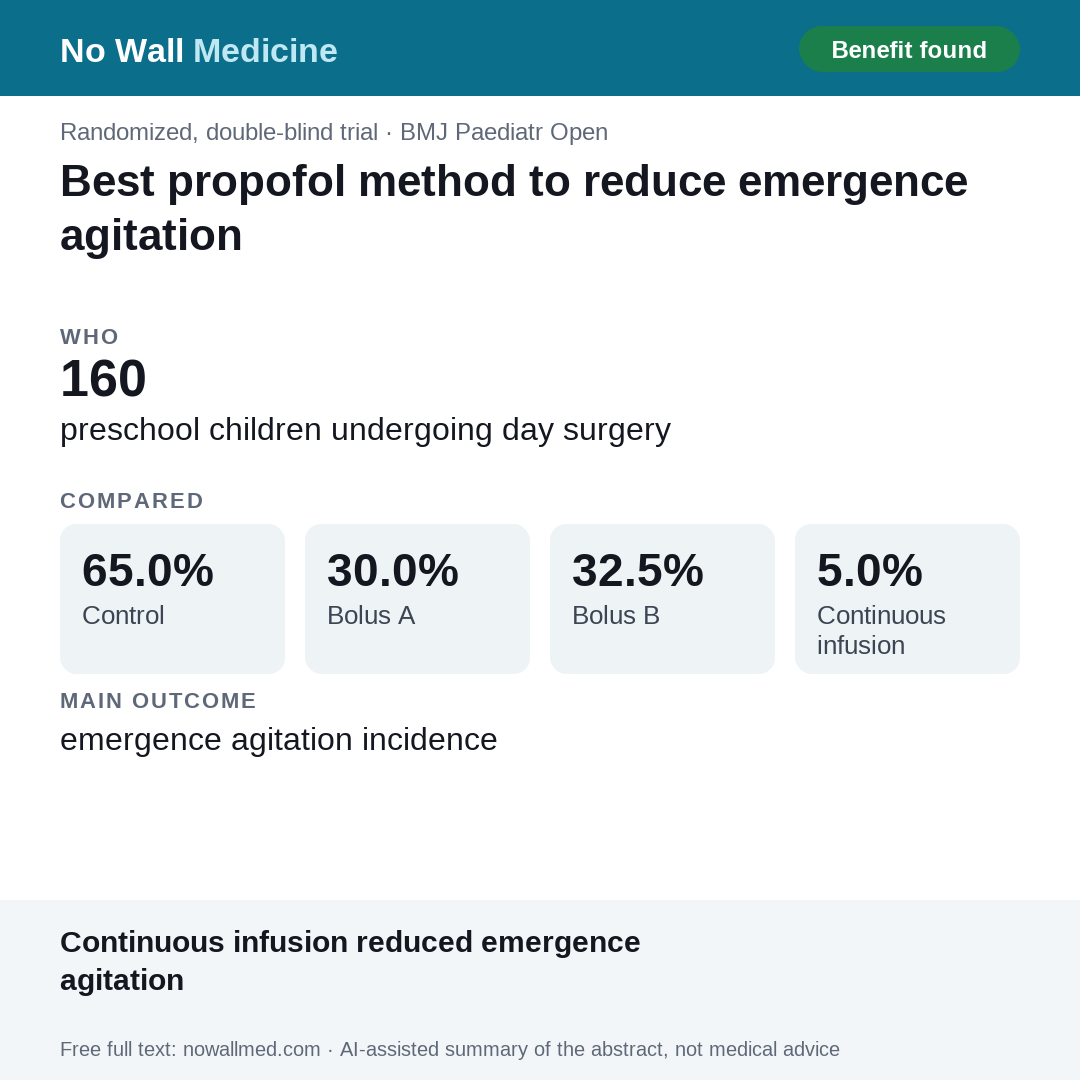
- The incidence of emergence agitation was 65.0% in the control group, 30.0% in the bolus A group, 32.5% in the bolus B group, and 5.0% in the continuous infusion group.
- While peak Paediatric Anaesthesia Emergence Delirium scores were lower with continuous infusion, extubation time and emergence time showed no differences among the groups.
Headline and key points written with AI from the paper’s abstract, with every number checked against it. Read the paper before relying on them.
Abstract
Background
Preschool children who received sevoflurane anaesthesia were associated with a high incidence of emergence agitation (EA). Studies have shown that a subanaesthetic dose of propofol (1 mg/kg) at the end of inhalational anaesthesia could reduce EA in paediatric patients, but the optimal administrations are still under investigation. Methods
In a double-blind trial, 160 preschool children (ASA I or II, 2-5 years old) undergoing day surgery of laparoscopic inguinal hernia repair with sevoflurane anaesthesia were randomly assigned into four groups: the control group, single bolus 3 min before the end of the surgery (bolus A), single bolus at the end of the surgery (bolus B) and continuous infusion for 3 min at the end of the surgery (continuous infusion). The dose of propofol in the bolus A group, bolus B group and continued infusion group is 1 mg/kg. The primary outcomes were the incidence and severity of EA assessed by the Paediatric Anaesthesia Emergence Delirium (PAED) scale and Watcha scales. The secondary outcomes included extubation time, emergence time, mean arterial pressure and heart rate. Results
The incidence of EA was as follows: 65.0% in the control group, 30.0% in the bolus A group, 32.5% in the bolus B group and 5.0% in the continuous infusion group (p<0.05). Furthermore, the peak PAED scores in the continuous infusion group were significantly lower than those in the other groups. However, extubation time and emergence time showed no differences among groups. Conclusions
Continuous infusion of subanaesthetic dose propofol (1 mg/kg) for 3 min at the end of sevoflurane anaesthesia seems to be more appropriate than other administration as it reduced EA and did not prolong the time to wake. Trail registration number
NCT05420402.
Abstract reproduced under the article’s CC BY NC licence.
Topics
Cite this article
Chen J, Shi X, Hu W, Lin R, Meng L, Liang C. Comparing different administration methods of subanaesthetic propofol to mitigate emergence agitation in preschool children undergoing day surgery: a double-blind, randomised controlled study. BMJ Paediatr Open. 2025. doi:10.1136/bmjpo-2023-002376
Spotted a mistake? Suggest a correction
Top studies every Monday
The week’s key trials and guidelines in your specialties, by email. Free.
Get the weekly digest