Combination therapies failed to improve progression-free survival in platinum-resistant ovarian cancer patients
Comparing Durvalumab, Olaparib, and Cediranib Monotherapy, Combination Therapy, or Chemotherapy in Patients with Platinum-Resistant Ovarian Cancer with Prior Bevacizumab: The Phase II NRG-GY023 Trial
Randomized four-arm superiority phase II trialNo clear difference
Is durvalumab, olaparib, and cediranib combination better than standard chemotherapy in platinum-resistant ovarian cancer?
Who
153
Patients with platinum-resistant ovarian cancer with prior bevacizumab exposure
Compared
3.4 monthsStandard-of-care chemotherapy
2.9 monthsDurvalumab, olaparib, and cediranib
2.5 monthsDurvalumab and cediranib
2.8 monthsOlaparib and cediranib
Main outcome
progression-free survival
Result: hazard ratio 1.003 (95% CI 0.56-1.80), 1.108 (95% CI 0.63-1.96), and 1.021 (95% CI 0.57-1.82)
Bottom line: All experimental arms failed to improve progression-free survival compared with standard-of-care chemotherapy.
Clin Cancer Res · 2025-04-07Download image
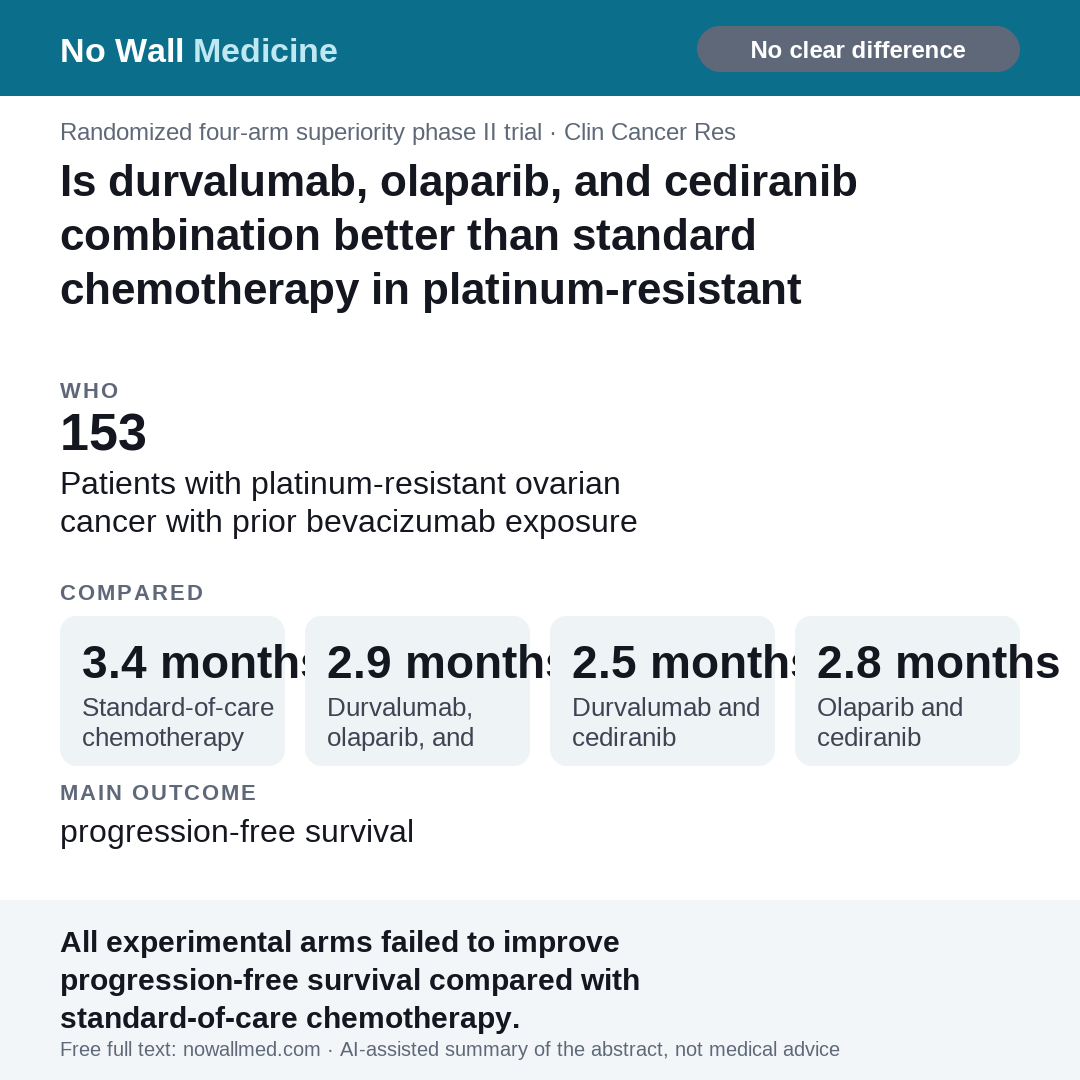
Clinical question: Is durvalumab, olaparib, and cediranib combination better than standard chemotherapy in platinum-resistant ovarian cancer?
Why it matters: It is unclear if adding durvalumab, olaparib, or cediranib to treatment improves outcomes for patients with platinum-resistant ovarian cancer who have already used bevacizumab.
Key points
- Researchers studied 153 patients with platinum-resistant ovarian cancer who previously used bevacizumab, comparing standard chemotherapy to three different drug combinations.
- The median progression-free survival was 3.4 months for standard chemotherapy, 2.9 months for durvalumab, olaparib, and cediranib, 2.5 months for durvalumab and cediranib, and 2.8 months for olaparib and cediranib.
- All experimental drug combinations failed to reach the primary objective of improving progression-free survival compared to standard chemotherapy.
Headline and key points written with AI from the paper’s abstract, with every number checked against it. Read the paper before relying on them.
Was this summary helpful?
Subject terms
Cite this article
Lee JM, Miller A, Rose PG, AlHilli M, Washington C, John VS. Comparing Durvalumab, Olaparib, and Cediranib Monotherapy, Combination Therapy, or Chemotherapy in Patients with Platinum-Resistant Ovarian Cancer with Prior Bevacizumab: The Phase II NRG-GY023 Trial. Clin Cancer Res. 2025. doi:10.1158/1078-0432.CCR-24-3877
Spotted a mistake? Suggest a correction
Top studies every Monday
The week’s key trials and guidelines in your specialties, plus any topics you follow. By email, free.
Get the weekly digest