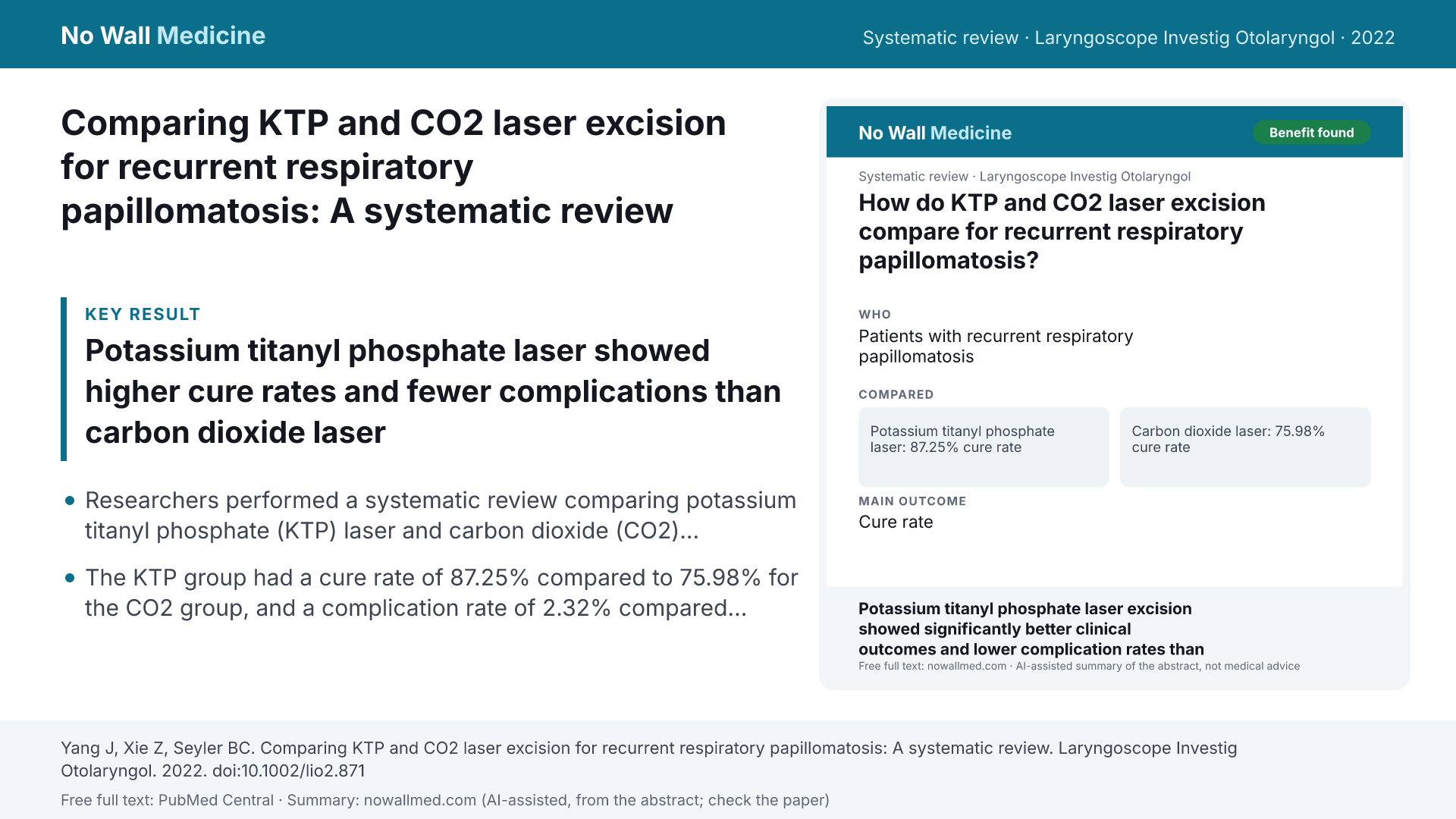
Potassium titanyl phosphate laser showed higher cure rates and fewer complications than carbon dioxide laser
Comparing KTP and CO2 laser excision for recurrent respiratory papillomatosis: A systematic review
Systematic reviewBenefit found
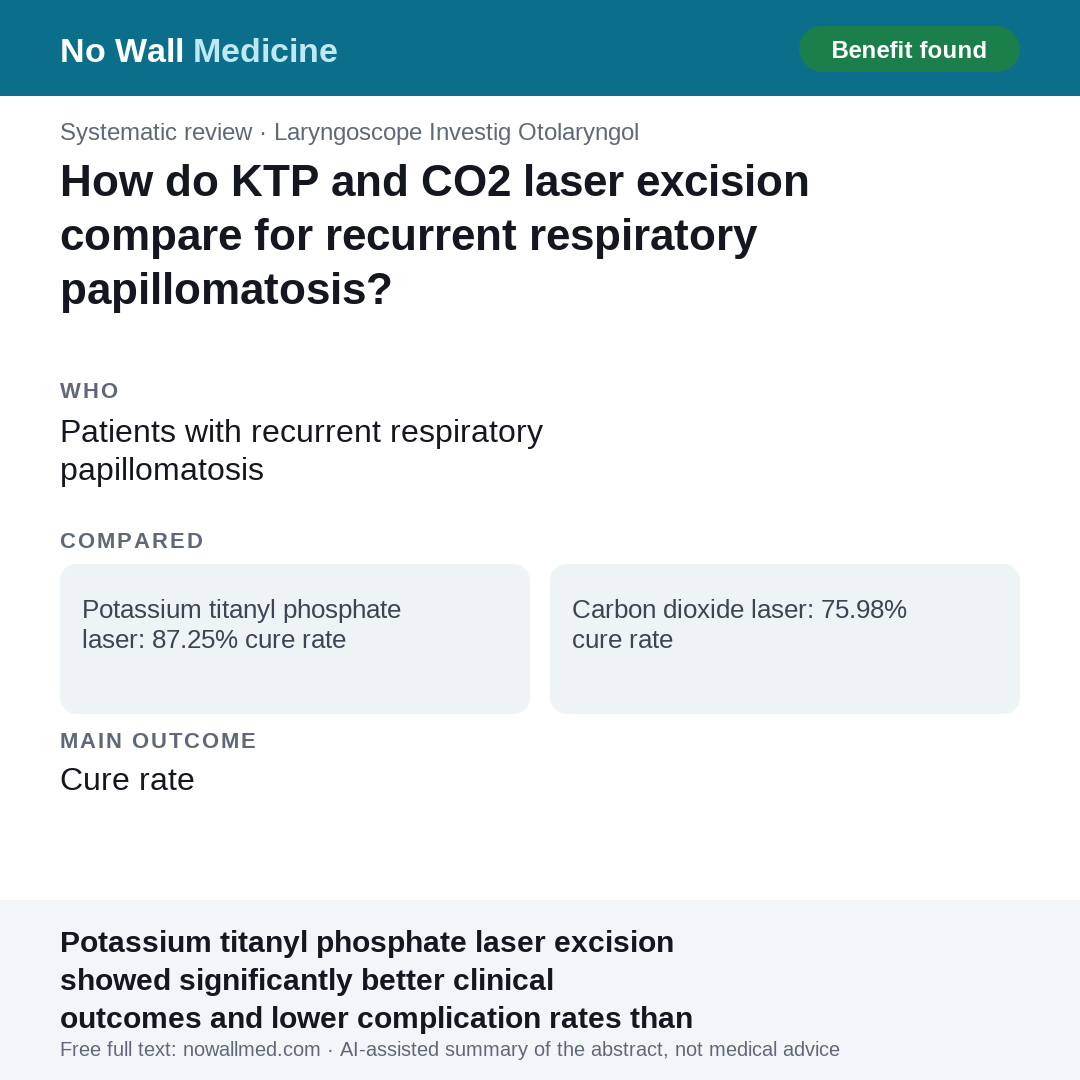
How do KTP and CO2 laser excision compare for recurrent respiratory papillomatosis?
Who
Patients with recurrent respiratory papillomatosis
Compared
Potassium titanyl phosphate laser: 87.25% cure rate
Carbon dioxide laser: 75.98% cure rate
Main outcome
Cure rate
Bottom line: Potassium titanyl phosphate laser excision showed significantly better clinical outcomes and lower complication rates than carbon dioxide laser.
Limitation: More high-quality randomized controlled studies are needed, particularly regarding functional vocal outcomes.
Laryngoscope Investig Otolaryngol · 2022-07-16Download image
Clinical question: How do KTP and CO2 laser excision compare for recurrent respiratory papillomatosis?
Key points
- Researchers performed a systematic review comparing potassium titanyl phosphate (KTP) laser and carbon dioxide (CO2) laser for treating recurrent respiratory papillomatosis, a condition involving growths in the airway.
- The KTP group had a cure rate of 87.25% compared to 75.98% for the CO2 group, and a complication rate of 2.32% compared to 17.71% for the CO2 group.
- The remission rate was 88.46% in the KTP group and 38.9% in the CO2 group, while the difference in recurrence rates was not statistically significant.
Limitation the authors note: More high-quality randomized controlled studies are needed to compare these surgical techniques, particularly regarding functional data such as vocal outcomes.
Headline and key points written with AI from the paper’s abstract, with every number checked against it. Read the paper before relying on them.
Was this summary helpful?
Headline, design, result, key points, caveat and citation as plain text.
Cite this article
Yang J, Xie Z, Seyler BC. Comparing KTP and CO2 laser excision for recurrent respiratory papillomatosis: A systematic review. Laryngoscope Investig Otolaryngol. 2022. doi:10.1002/lio2.871
Spotted a mistake? Suggest a correction