Comparing methods to secure a tracheal tube placed via a surgical cricothyroidotomy: a randomised controlled study in cadavers
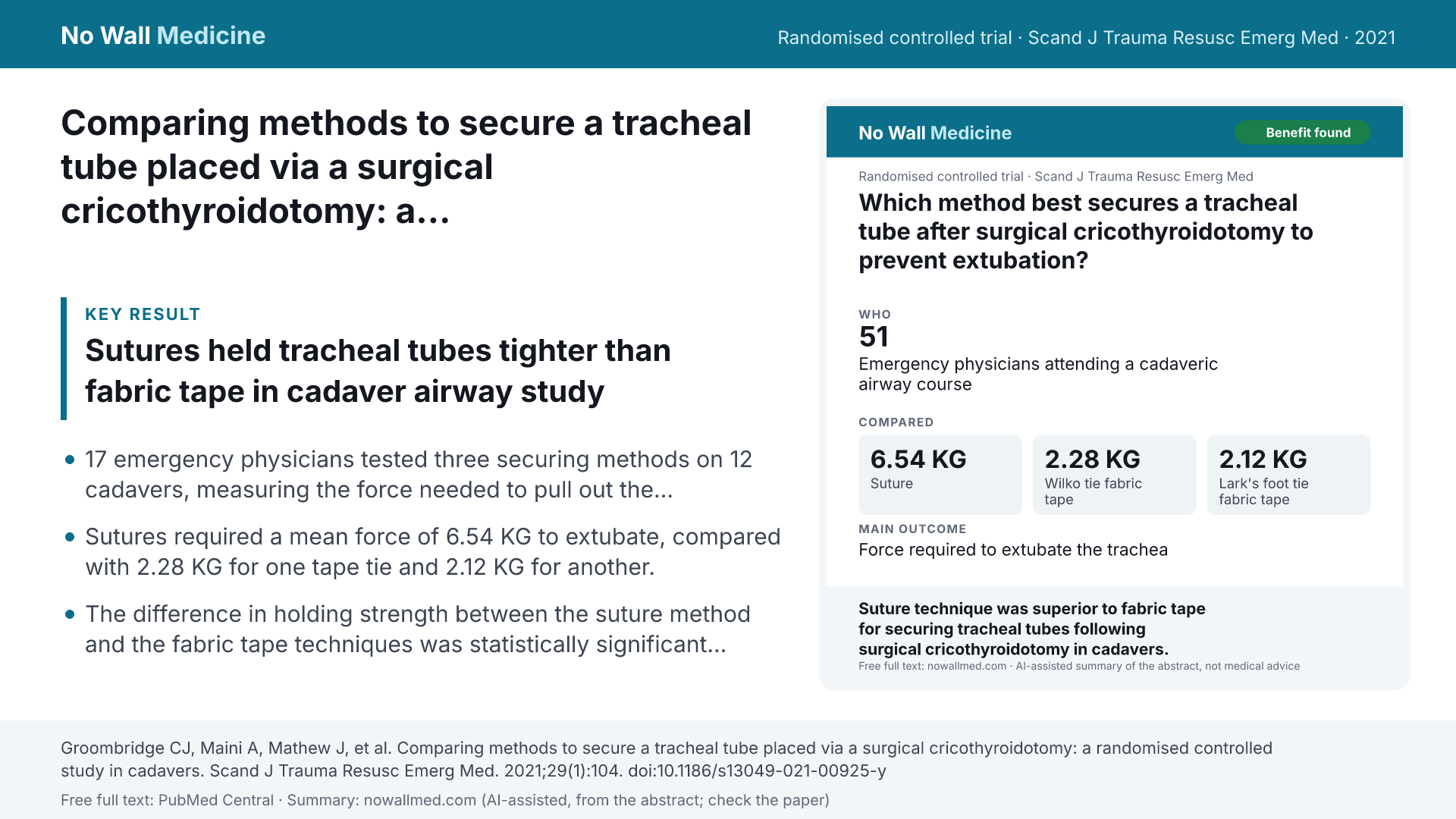
Key result: Sutures held tracheal tubes tighter than fabric tape in cadaver airway study
Randomised controlled trialBenefit found
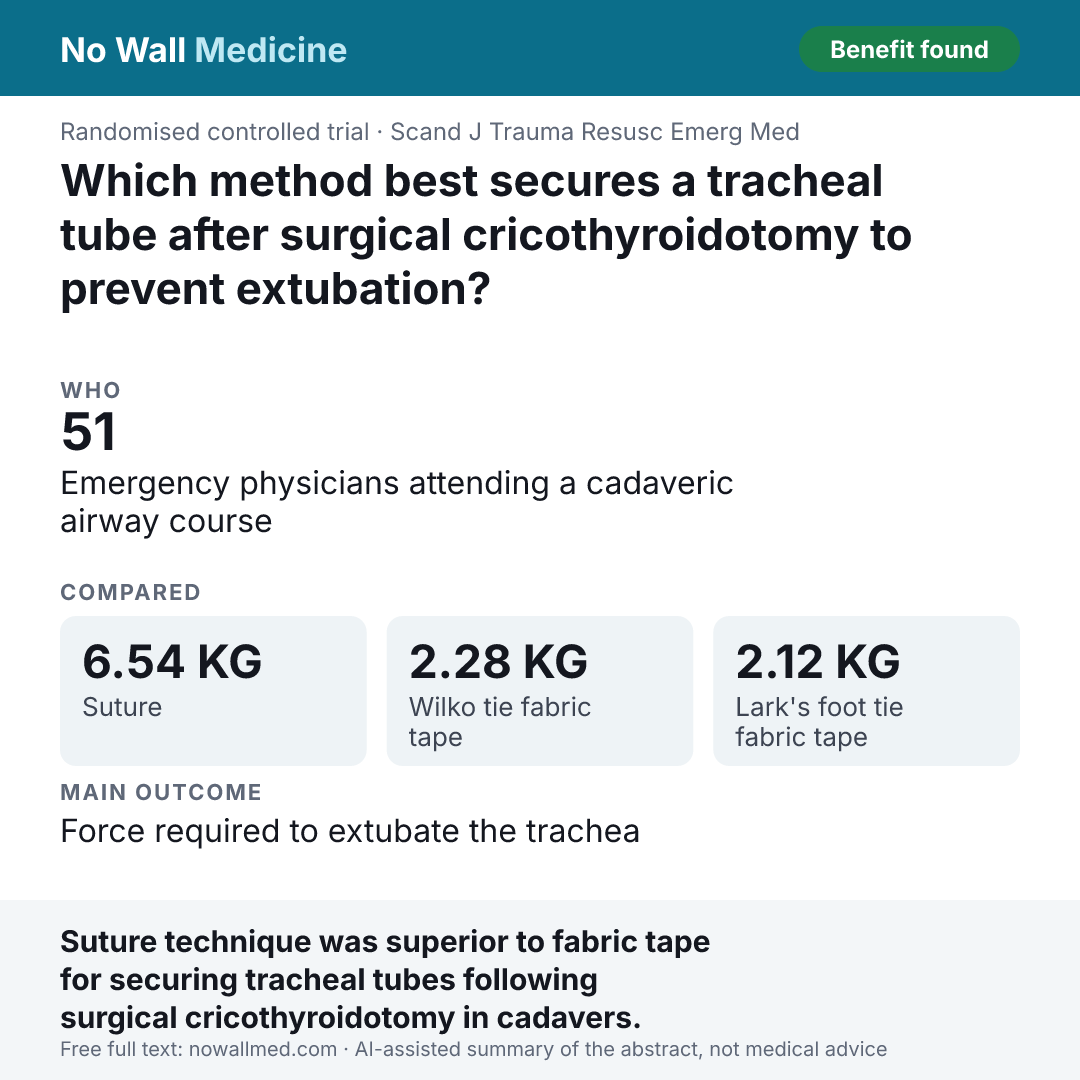
Which method best secures a tracheal tube after surgical cricothyroidotomy to prevent extubation?
Who
51
Emergency physicians attending a cadaveric airway course
Compared
6.54 KGSuture (95% CI 5.54-7.55)
2.28 KGWilko tie fabric tape (95% CI 1.91-2.64)
2.12 KGLark's foot tie fabric tape (95% CI 1.63-2.60)
Main outcome
Force required to extubate the trachea
Bottom line: Suture technique was superior to fabric tape for securing tracheal tubes following surgical cricothyroidotomy in cadavers.
Scand J Trauma Resusc Emerg Med · 2021-07-28 · Save PNG
Key points
- 17 emergency physicians tested three securing methods on 12 cadavers, measuring the force needed to pull out the tracheal tube.
- Sutures required a mean force of 6.54 KG to extubate, compared with 2.28 KG for one tape tie and 2.12 KG for another.
- The difference in holding strength between the suture method and the fabric tape techniques was statistically significant (p < 0.001).
Discussion prompts
- Would these patients look like yours? Who was left out?
- Is the main outcome one that matters to patients?
- Is the difference large enough to change what you do?
Cite: Groombridge CJ, Maini A, Mathew J, et al. Comparing methods to secure a tracheal tube placed via a surgical cricothyroidotomy: a randomised controlled study in cadavers. Scand J Trauma Resusc Emerg Med. 2021;29(1):104. doi:10.1186/s13049-021-00925-y
Free full text: PubMed Central · Summary and visual abstract: nowallmed.com/a/comparing-methods-to-secure-a-tracheal-tube-placed-via-a-surgical-zw0kuu/ (AI-assisted from the abstract; check the paper before relying on it).