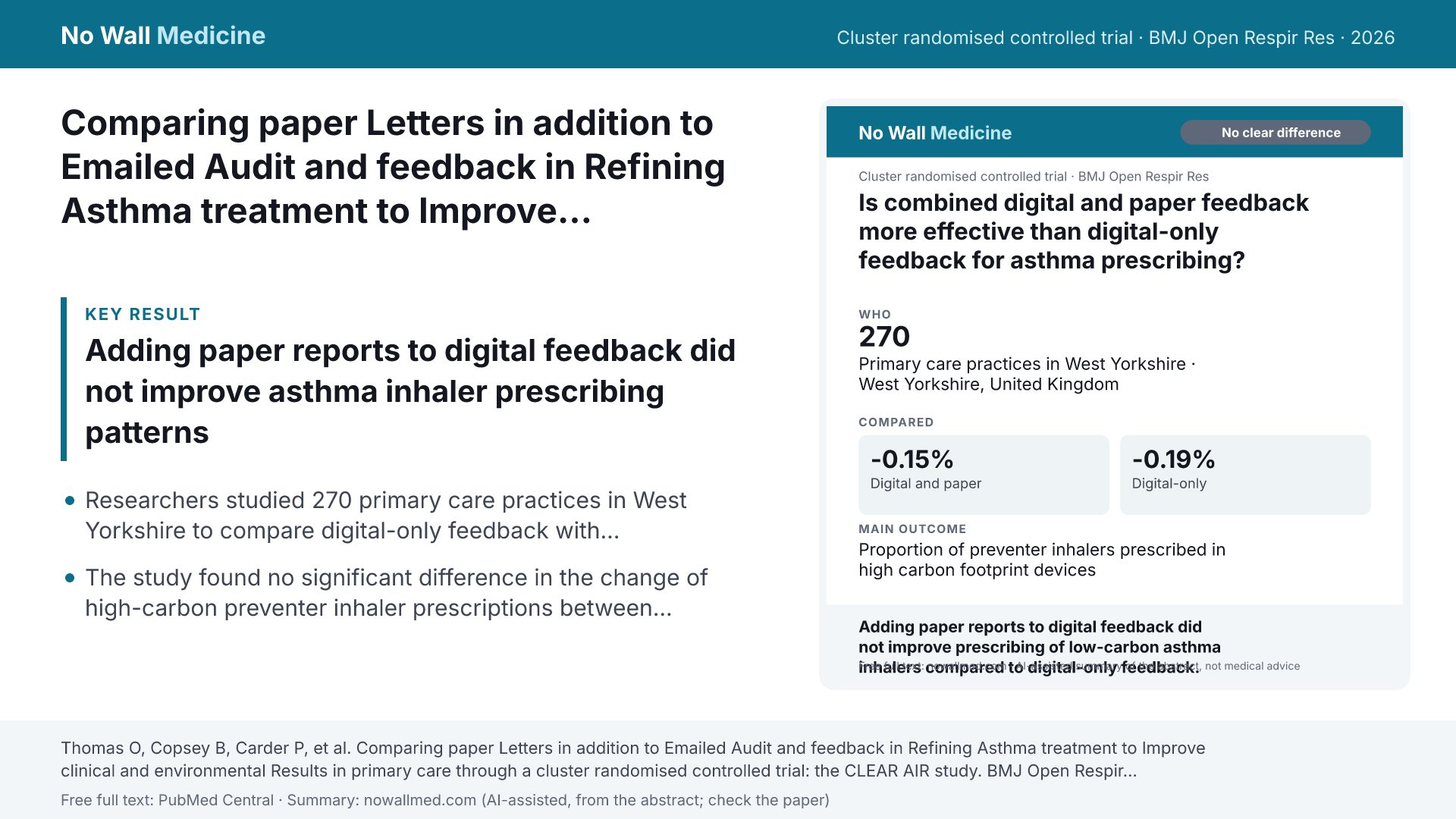
Adding paper reports to digital feedback did not improve asthma inhaler prescribing patterns
Comparing paper Letters in addition to Emailed Audit and feedback in Refining Asthma treatment to Improve clinical and environmental Results in primary care through a cluster randomised controlled trial: the CLEAR AIR study
Cluster randomised controlled trialNo clear difference
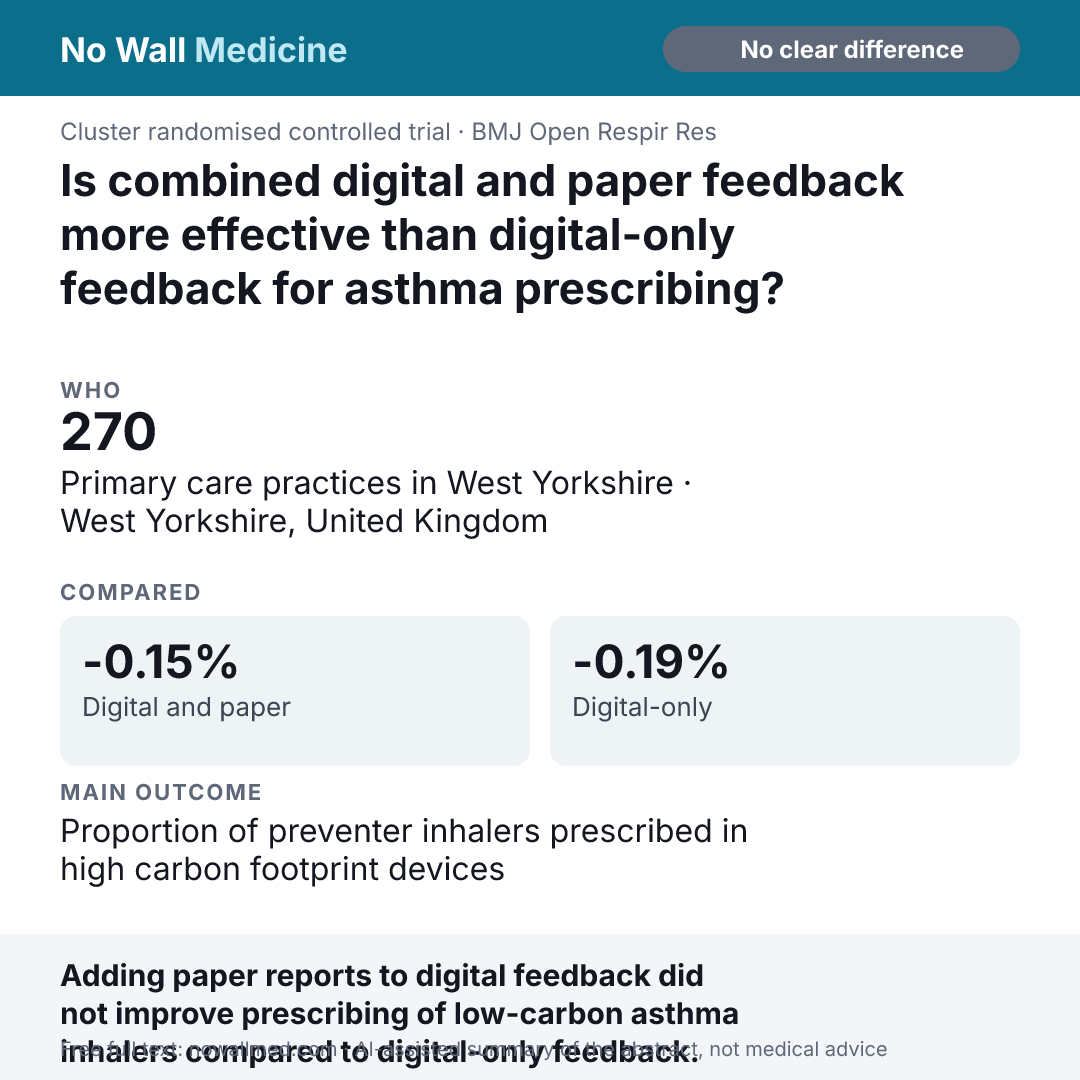
Is combined digital and paper feedback more effective than digital-only feedback for asthma prescribing?
Who
270
Primary care practices in West Yorkshire · West Yorkshire, United Kingdom
Compared
-0.15%Digital and paper
-0.19%Digital-only
Main outcome
Proportion of preventer inhalers prescribed in high carbon footprint devices
Result: risk ratio 1.00 (95% CI 0.98 to 1.03)
Bottom line: Adding paper reports to digital feedback did not improve prescribing of low-carbon asthma inhalers compared to digital-only feedback.
BMJ Open Respir Res · 2026-04-17 · NCT05761873
Why it matters: Clinicians may respond differently to printed reports compared to digital feedback when trying to reduce carbon emissions and improve asthma treatment.
Headline and visual abstract written with AI from the paper’s abstract, with every number checked against it. Read the paper before relying on them.
Was this summary helpful?
Abstract
Background
Suboptimal use of preventer inhalers and salbutamol reliever overprescribing are associated with preventable asthma deaths and are a major source of primary care carbon emissions. Audit and feedback produces modest behaviour change by assessing clinical performance and delivering feedback to encourage improvement. Although feedback is increasingly delivered digitally, clinicians may respond more to additional printed feedback reports. We evaluated whether combined digital and paper feedback was more effective than digital-only feedback in promoting safer and greener asthma prescribing at the practice level. Methods
In this parallel, cluster randomised controlled trial, all 273 primary care practices in West Yorkshire were assigned within their primary care network clusters by stratified, permuted block randomisation to receive seven bimonthly reports on asthma prescribing either in 'digital and paper' (intervention) or 'digital-only' (control) formats. The primary outcome was the proportion of preventer inhalers prescribed in pressurised metred-dose devices due to their high carbon footprint. Intervention group allocation was concealed. The intention-to-treat population was analysed and adjusted for both potential confounders and preintervention achievement. Results
Final analysis assessed 270 practices in 26 clusters per arm due to practice mergers within the control group. There was no significant difference between the intervention groups based on change in the primary outcome (intervention-0.15%; control-0.19%; risk ratio-1.00; 95% CI 0.98 to 1.03) nor any secondary outcome. Analysis of both interventions combined showed a background trend of mixed improvement following feedback. Conclusions
There was no evidence that combined paper and digital feedback was more effective than digital-only feedback, despite the background of mixed improvements following both interventions. Challenges remain to understanding the barriers to influencing the prescribing of preventer inhalers and transitioning inhaler devices towards low-carbon 'green' alternatives; however, this study demonstrated the value of an efficient 'real-world' trial embedded within an existing quality improvement initiative. Trial registration number
NCT05761873.
Abstract reproduced under the article’s CC BY licence.
Subject terms
Cite this article
Thomas O, Copsey B, Carder P, et al. Comparing paper Letters in addition to Emailed Audit and feedback in Refining Asthma treatment to Improve clinical and environmental Results in primary care through a cluster randomised controlled trial: the CLEAR AIR study. BMJ Open Respir Res. 2026;13(1). doi:10.1136/bmjresp-2025-003601
Spotted a mistake? Suggest a correction