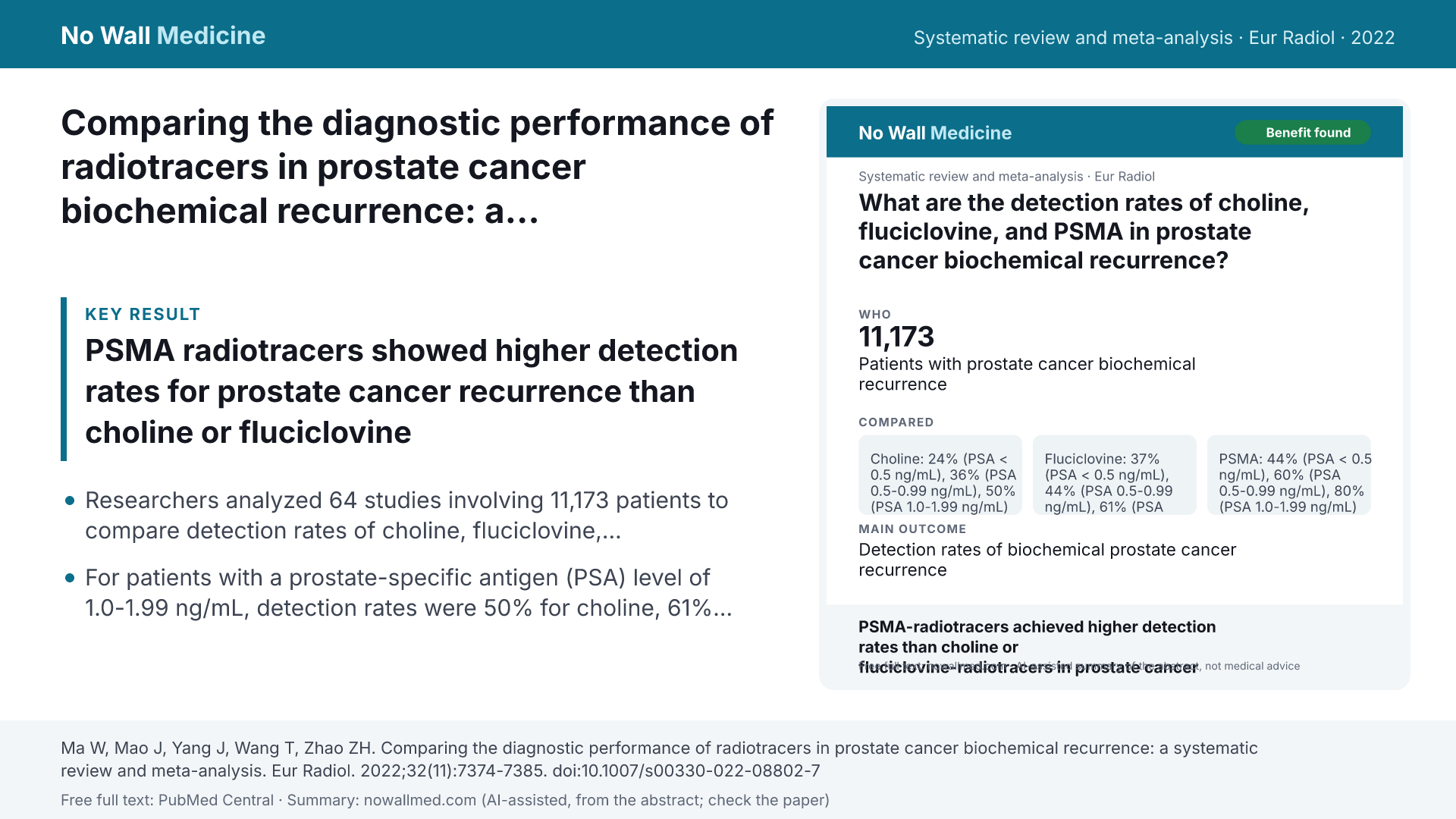
PSMA radiotracers showed higher detection rates for prostate cancer recurrence than choline or fluciclovine
Comparing the diagnostic performance of radiotracers in prostate cancer biochemical recurrence: a systematic review and meta-analysis
Systematic review and meta-analysisBenefit found
What are the detection rates of choline, fluciclovine, and PSMA in prostate cancer biochemical recurrence?
Who
11,173
Patients with prostate cancer biochemical recurrence
Compared
Choline: 24% (PSA < 0.5 ng/mL), 36% (PSA 0.5-0.99 ng/mL), 50% (PSA 1.0-1.99 ng/mL)
Fluciclovine: 37% (PSA < 0.5 ng/mL), 44% (PSA 0.5-0.99 ng/mL), 61% (PSA 1.0-1.99 ng/mL)
PSMA: 44% (PSA < 0.5 ng/mL), 60% (PSA 0.5-0.99 ng/mL), 80% (PSA 1.0-1.99 ng/mL)
Main outcome
Detection rates of biochemical prostate cancer recurrence
Bottom line: PSMA-radiotracers achieved higher detection rates than choline or fluciclovine-radiotracers in prostate cancer biochemical recurrence.
Eur Radiol · 2022-04-29Download image
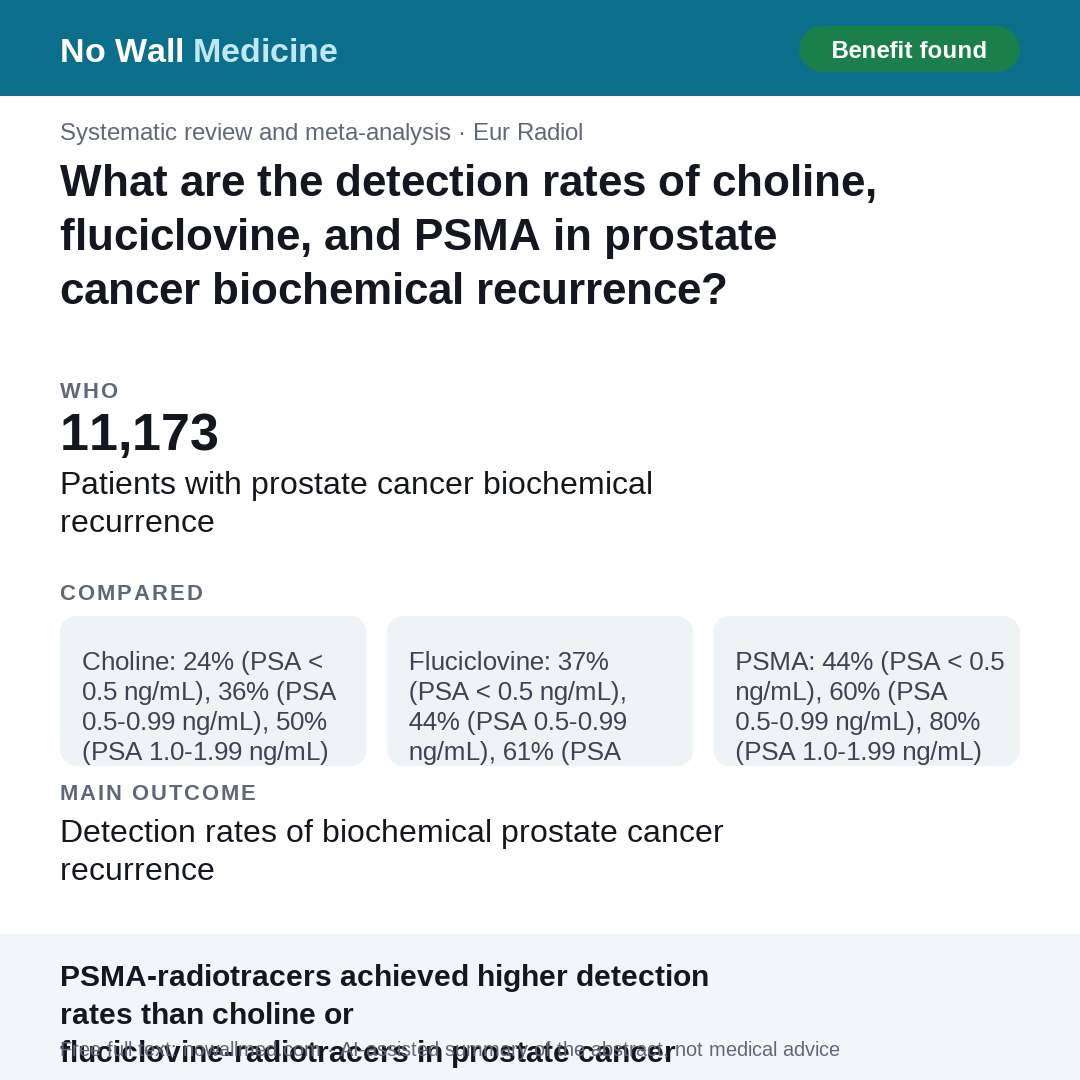
Clinical question: What are the detection rates of choline, fluciclovine, and PSMA in prostate cancer biochemical recurrence?
Key points
- Researchers analyzed 64 studies involving 11,173 patients to compare detection rates of choline, fluciclovine, and prostate-specific membrane antigen (PSMA) tracers.
- For patients with a prostate-specific antigen (PSA) level of 1.0-1.99 ng/mL, detection rates were 50% for choline, 61% for fluciclovine, and 80% for PSMA.
- The detection rate for 18F-labeled PSMA was higher than 68Ga-labeled PSMA, reaching 88% at PSA levels of 1.0-1.99 ng/mL.
Headline and key points written with AI from the paper’s abstract, with every number checked against it. Read the paper before relying on them.
Was this summary helpful?
Subject terms
Headline, design, result, key points, caveat and citation as plain text.
Cite this article
Ma W, Mao J, Yang J, Wang T, Zhao ZH. Comparing the diagnostic performance of radiotracers in prostate cancer biochemical recurrence: a systematic review and meta-analysis. Eur Radiol. 2022. doi:10.1007/s00330-022-08802-7
Spotted a mistake? Suggest a correction