ClinicalAge biomarker associated with mortality and disease risk in UK datasets
ClinicalAge, a framework for modelling ageing trajectories from longitudinal electronic health records in the UK: a model development and validation study
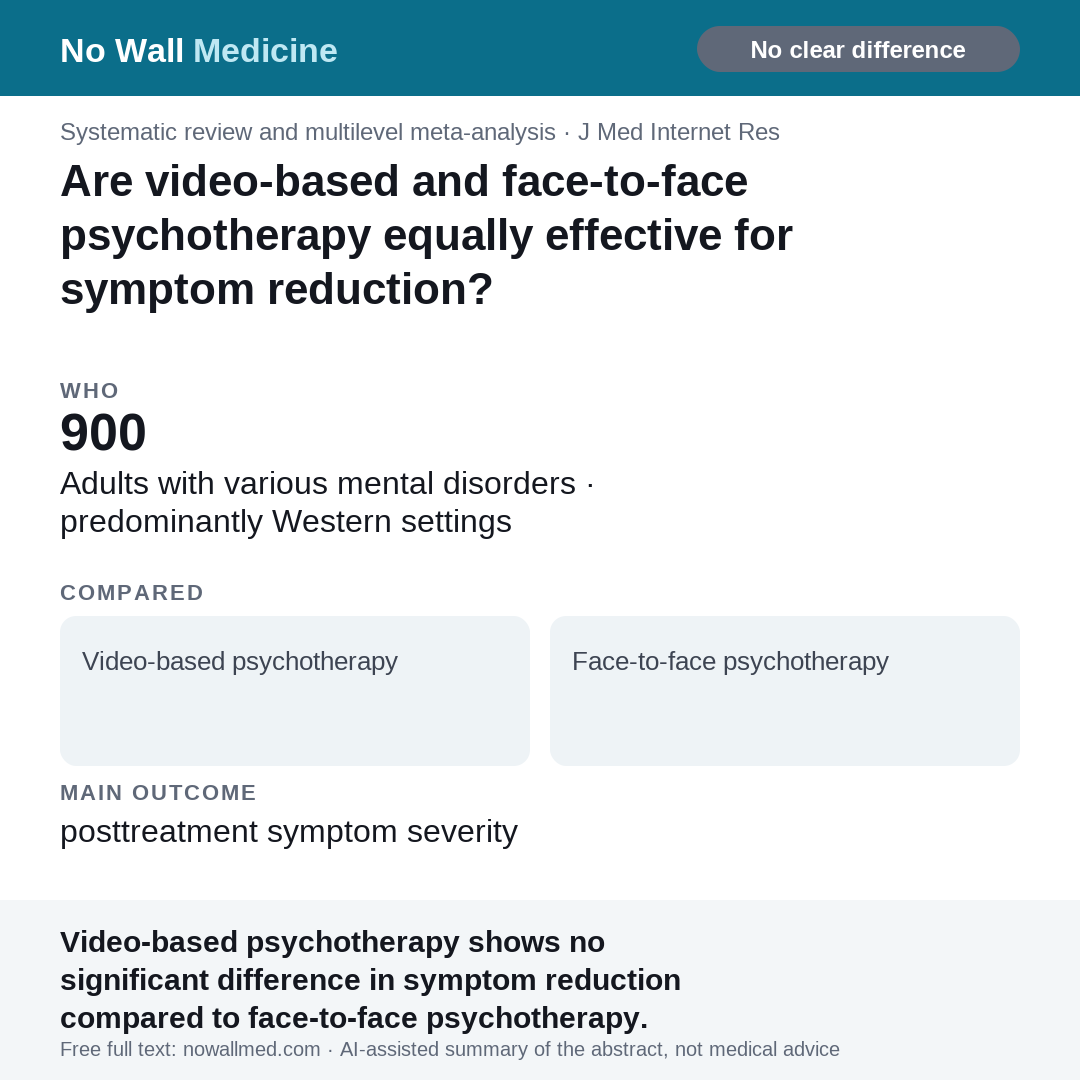
Comparing Video-Based and Face-to-Face Psychotherapy: Systematic Review and Multilevel Meta-Analysis Across Mental Disorders
Clinical question: Are video-based and face-to-face psychotherapy equally effective for symptom reduction?
Why it matters: It was unclear what portion of mental health treatment effects could be attributed specifically to the video-based setting compared to face-to-face sessions.
Limitation the authors note: The evidence base was limited in size and scope, consisting predominantly of Western settings, posttraumatic stress disorder diagnoses, and cognitive behavioral interventions.
Headline and key points written with AI from the paper’s abstract, with every number checked against it. Read the paper before relying on them.
Spotted a mistake? Suggest a correction
ClinicalAge, a framework for modelling ageing trajectories from longitudinal electronic health records in the UK: a model development and validation study
Foundation artificial intelligence models for health recognition by use of face photographs (FAHR-Face): a model development and validation study
A prognostic model for use at labour onset to estimate the risk of severe fetal compromise at birth: a retrospective, model development and validation study
ECG foundation models for cardiovascular screening in a cohort of young competitive athletes
Medical Reasoning in Large Language Models: Development and Evaluation of the MedEvalArena Benchmark