Three minimally invasive surgical techniques for lumbar spinal stenosis showed similar clinical outcomes
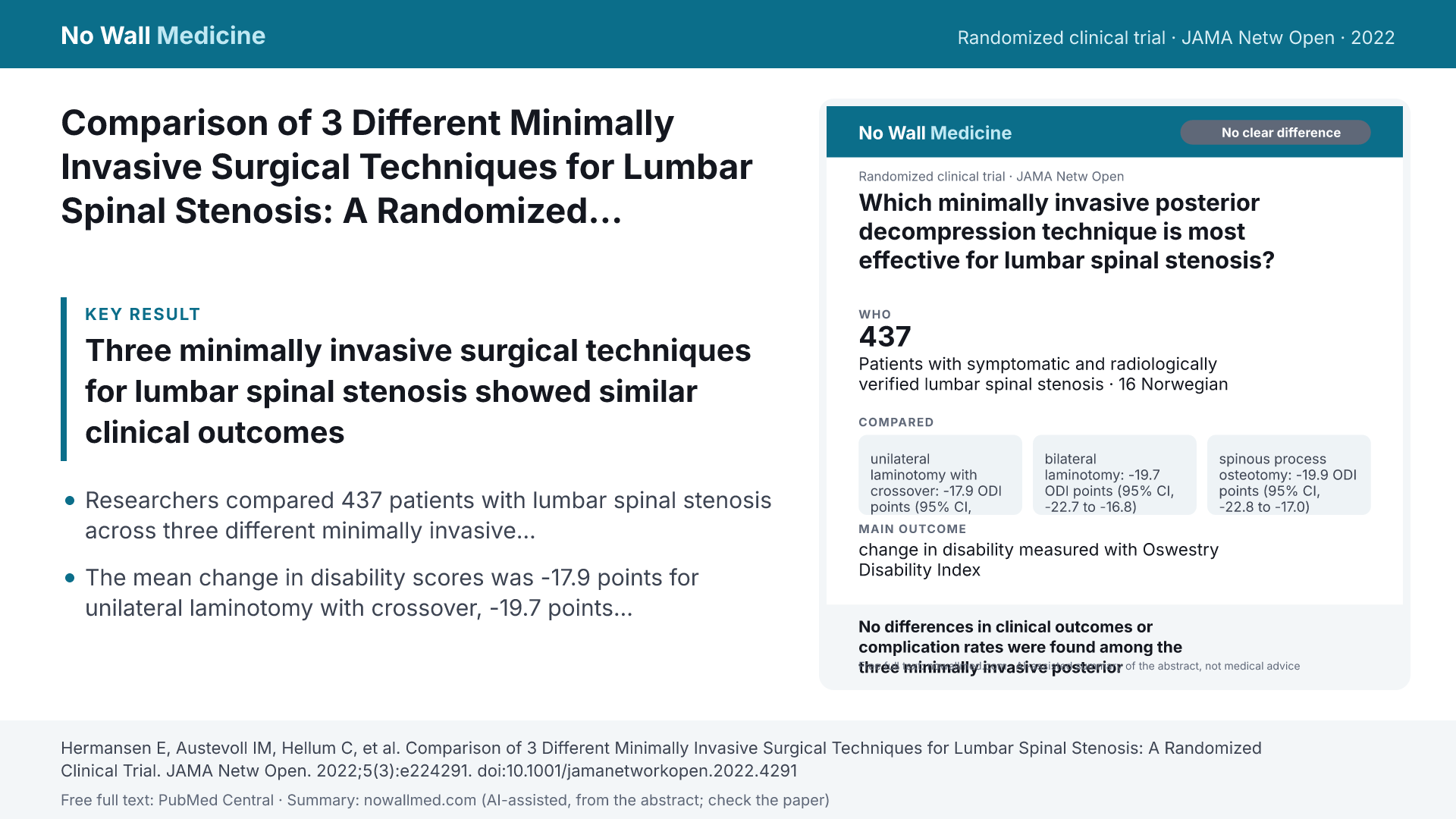
Comparison of 3 Different Minimally Invasive Surgical Techniques for Lumbar Spinal Stenosis: A Randomized Clinical Trial
Randomized clinical trialNo clear difference
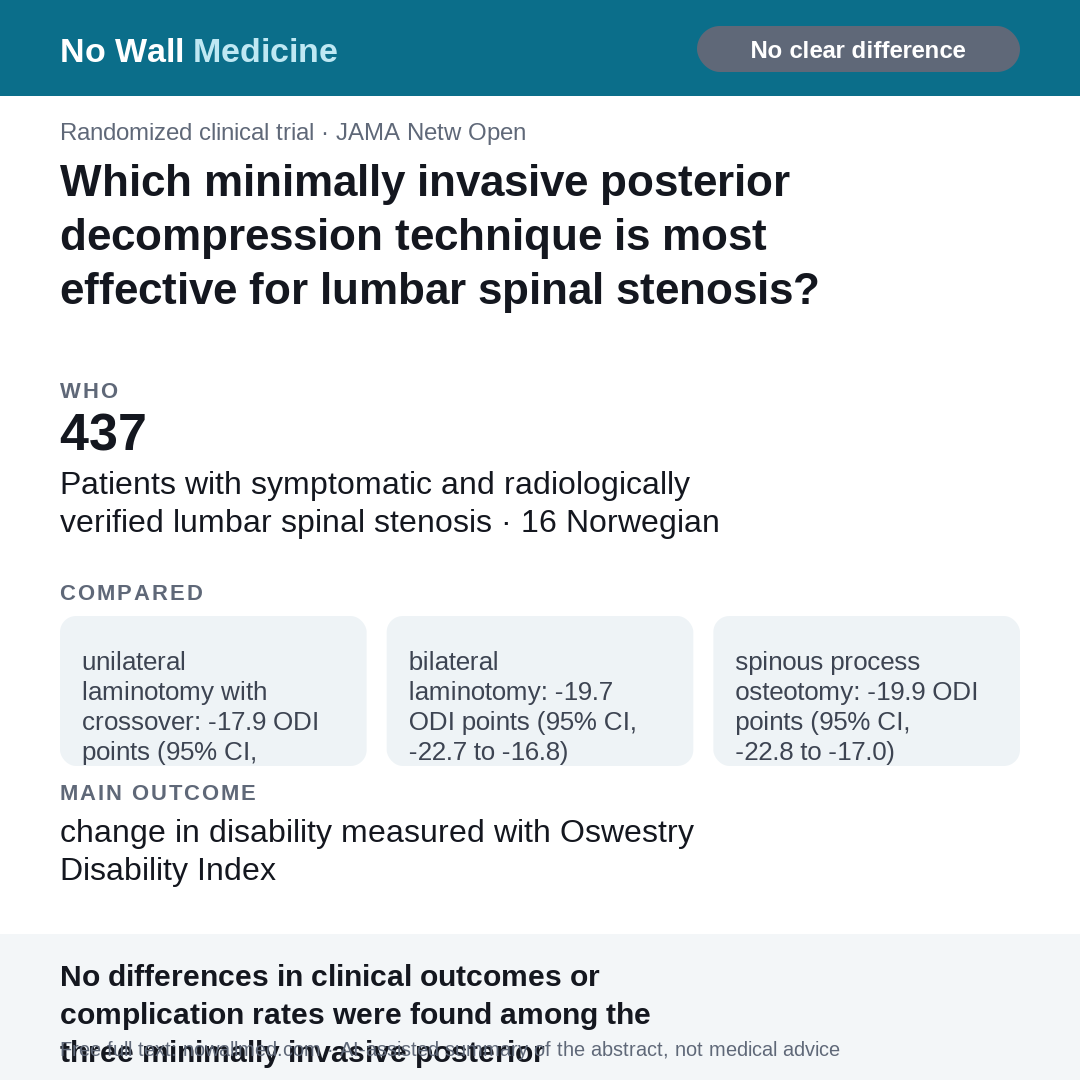
Which minimally invasive posterior decompression technique is most effective for lumbar spinal stenosis?
Who
437
Patients with symptomatic and radiologically verified lumbar spinal stenosis · 16 Norwegian public hospitals
Compared
unilateral laminotomy with crossover: -17.9 ODI points (95% CI, -20.8 to -14.9)
bilateral laminotomy: -19.7 ODI points (95% CI, -22.7 to -16.8)
spinous process osteotomy: -19.9 ODI points (95% CI, -22.8 to -17.0)
Main outcome
change in disability measured with Oswestry Disability Index
Bottom line: No differences in clinical outcomes or complication rates were found among the three minimally invasive posterior decompression techniques.
JAMA Netw Open · 2022-03-01Download image
Clinical question: Which minimally invasive posterior decompression technique is most effective for lumbar spinal stenosis?
Why it matters: It was unknown how the three most commonly used minimally invasive posterior decompression techniques compare regarding effectiveness and clinical outcomes for lumbar spinal stenosis.
Key points
- Researchers compared 437 patients with lumbar spinal stenosis across three different minimally invasive posterior decompression techniques.
- The mean change in disability scores was -17.9 points for unilateral laminotomy with crossover, -19.7 points for bilateral laminotomy, and -19.9 points for spinous process osteotomy.
- No significant differences were found in primary or secondary outcomes, though bilateral laminotomy was associated with a longer surgical procedure duration.
Headline and key points written with AI from the paper’s abstract, with every number checked against it. Read the paper before relying on them.
Was this summary helpful?
Subject terms
Cite this article
Hermansen E, Austevoll IM, Hellum C, Storheim K, Myklebust TÅ, Aaen J. Comparison of 3 Different Minimally Invasive Surgical Techniques for Lumbar Spinal Stenosis: A Randomized Clinical Trial. JAMA Netw Open. 2022. doi:10.1001/jamanetworkopen.2022.4291
Spotted a mistake? Suggest a correction