Enhanced recovery protocols reduced adverse events and improved recovery quality after elective cesarean delivery
Comparison of enhanced recovery after surgery protocol and standard protocol for cesarean delivery: A two-center, double-blind, randomized controlled trial
Two-center, double-blind, randomized controlled trialBenefit found
Does an anesthesiologist-led enhanced recovery protocol improve recovery after elective cesarean delivery?
Who
122
Women undergoing elective cesarean delivery under spinal anesthesia · Two centers
Compared
71%Conventional care
45%Enhanced recovery after cesarean delivery protocol
Main outcome
Composite of perioperative adverse events
Result: odds ratio 0.25, 95% CI 0.11 to 0.56
Bottom line: An anesthesiologist-led enhanced recovery protocol significantly reduced perioperative adverse events and enhanced recovery quality after elective cesarean delivery.
Int J Surg · 2026-03-20Download image
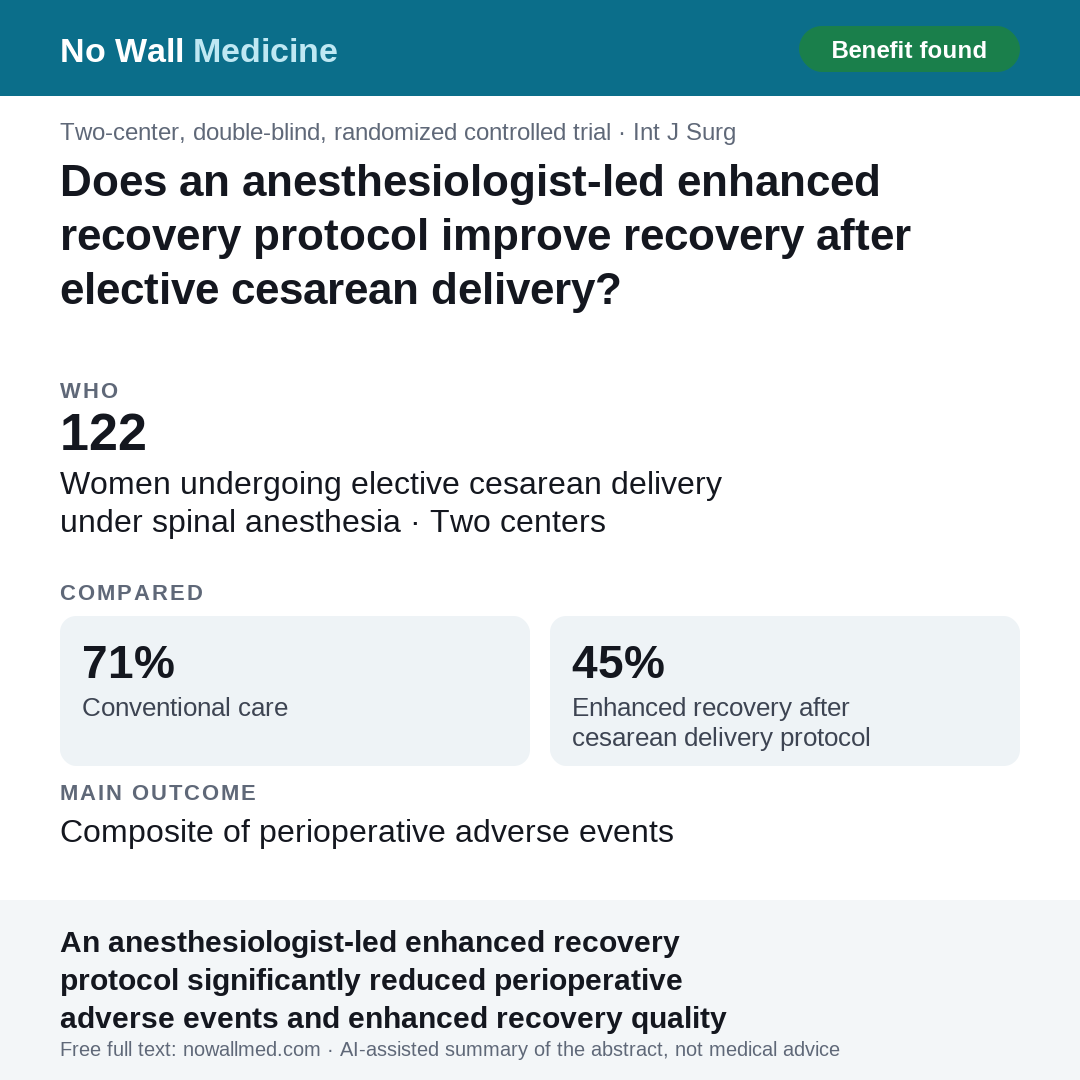
Clinical question: Does an anesthesiologist-led enhanced recovery protocol improve recovery after elective cesarean delivery?
Why it matters: High-quality evidence supporting the efficacy of enhanced recovery after cesarean delivery protocols remains limited.
In absolute numbers
Conventional care: 71% · Enhanced recovery after cesarean delivery protocol: 45% → a difference of 26 percentage points, so about 4 people would need the treatment for 1 more to benefit (number needed to treat) over the trial’s follow-up.
Worked out by us from the two group results above, not reported by the authors. Check the paper for the exact outcome and timing.
Key points
- Researchers studied 122 women undergoing elective cesarean delivery under spinal anesthesia, comparing a bundled enhanced recovery after cesarean delivery protocol to conventional care.
- Among 116 participants, the enhanced recovery group had a lower incidence of perioperative adverse events, such as low blood pressure or nausea, at 45% compared to 71%.
- The enhanced recovery group also showed lower pain scores with movement and fewer patient-controlled analgesia boluses on postoperative day 1.
Headline and key points written with AI from the paper’s abstract, with every number checked against it. Read the paper before relying on them.
Cite this article
Du W, Liu H, Liu R, Xu C, Xu Z, Liu Z. Comparison of enhanced recovery after surgery protocol and standard protocol for cesarean delivery: A two-center, double-blind, randomized controlled trial. Int J Surg. 2026. doi:10.1097/JS9.0000000000005105
Spotted a mistake? Suggest a correction