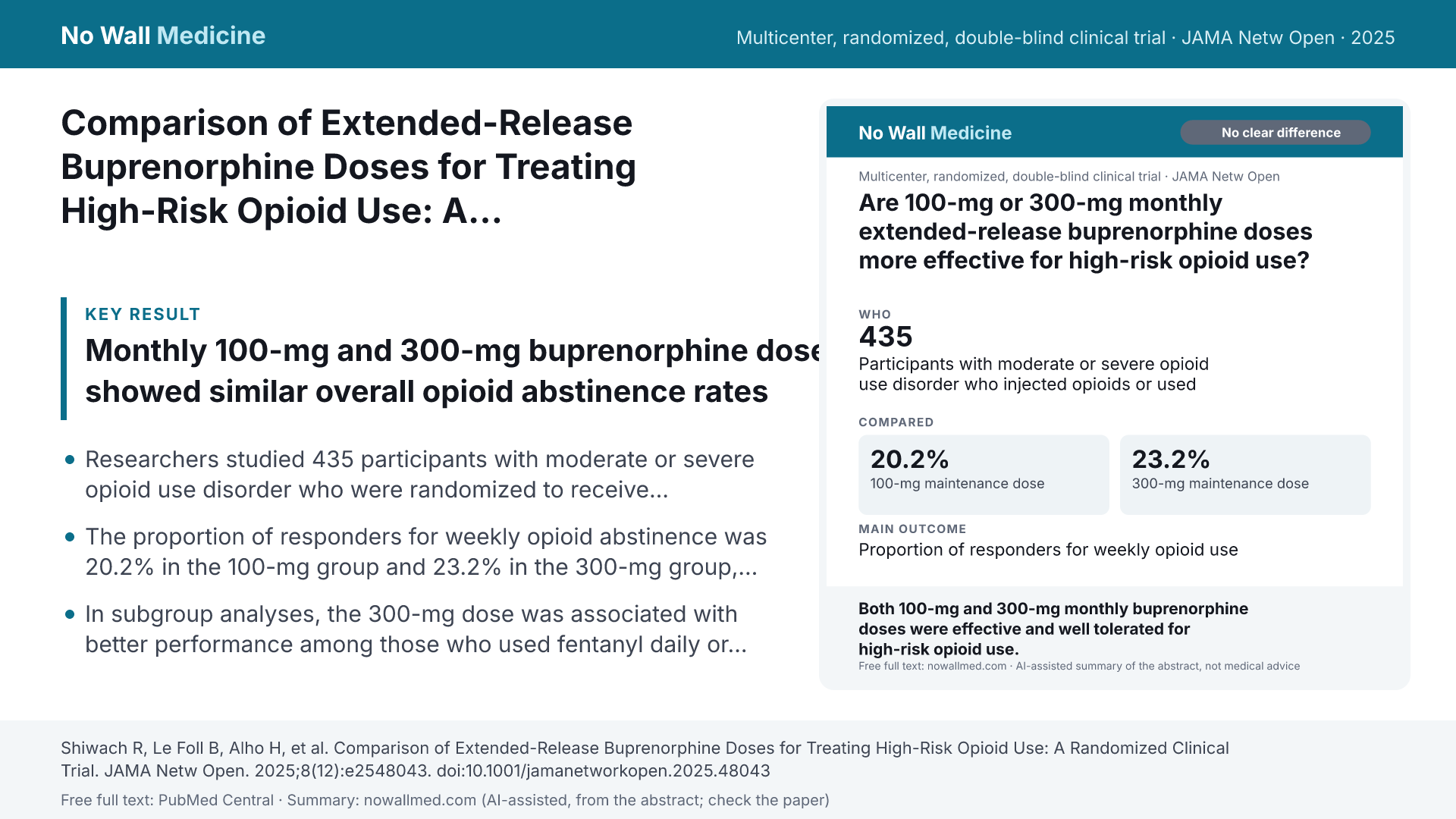
Comparison of Extended-Release Buprenorphine Doses for Treating High-Risk Opioid Use: A Randomized Clinical Trial
Key result: Monthly 100-mg and 300-mg buprenorphine doses showed similar overall opioid abstinence rates
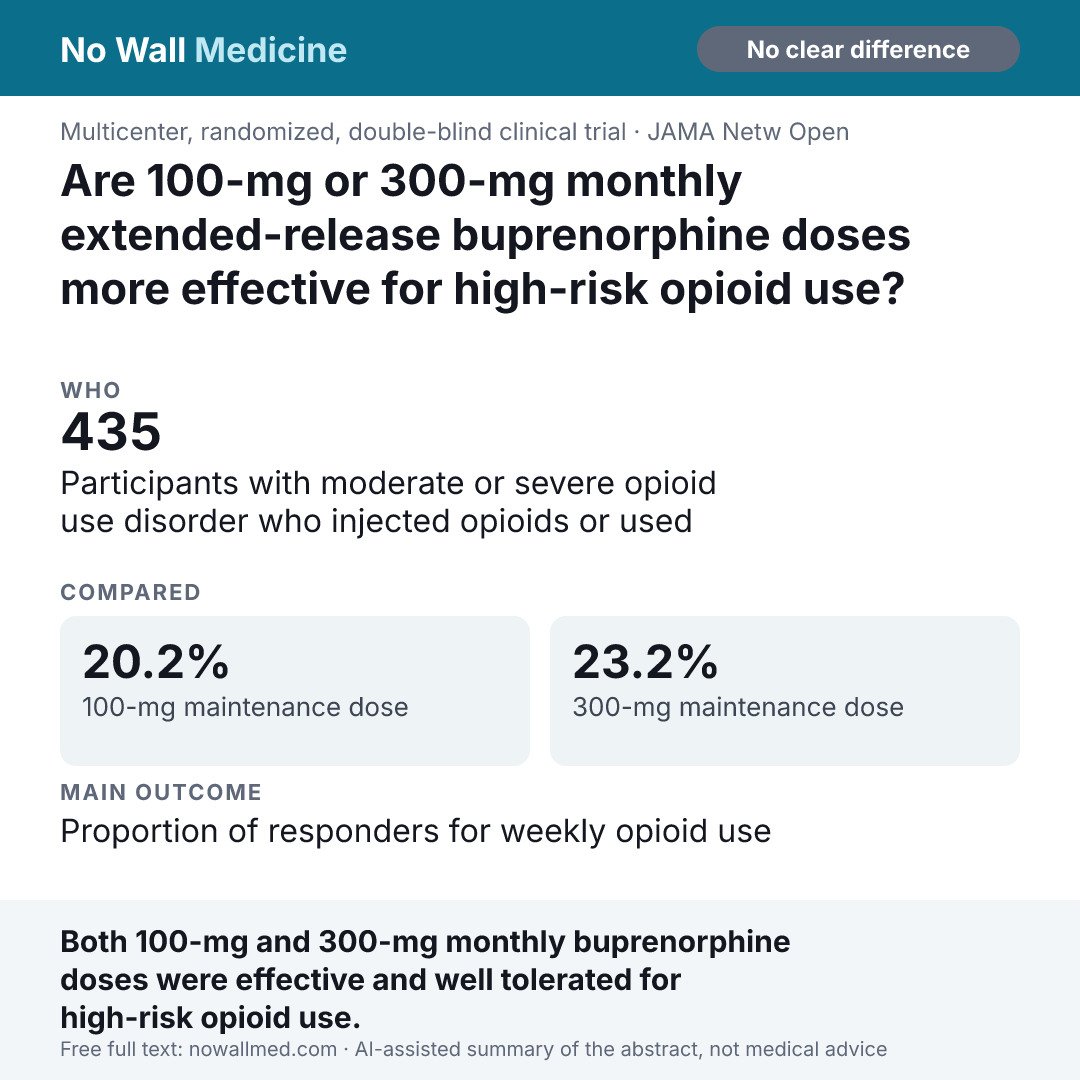
Multicenter, randomized, double-blind clinical trialNo clear difference
Are 100-mg or 300-mg monthly extended-release buprenorphine doses more effective for high-risk opioid use?
Who
435
Participants with moderate or severe opioid use disorder who injected opioids or used fentanyl · 28 outpatient treatment centers in the US and Canada
Compared
20.2%100-mg maintenance dose (44/218)
23.2%300-mg maintenance dose (50/216)
Main outcome
Proportion of responders for weekly opioid use
Result: Cochran-Mantel-Haenszel difference, 2.6%; 95% CI, -4.7% to 9.9%
Bottom line: Both 100-mg and 300-mg monthly buprenorphine doses were effective and well tolerated for high-risk opioid use.
JAMA Netw Open · 2025-12-01 · Save PNG
Key points
- Researchers studied 435 participants with moderate or severe opioid use disorder who were randomized to receive either 100-mg or 300-mg monthly injections of extended-release buprenorphine.
- The proportion of responders for weekly opioid abstinence was 20.2% in the 100-mg group and 23.2% in the 300-mg group, which was not a statistically significant difference.
- In subgroup analyses, the 300-mg dose was associated with better performance among those who used fentanyl daily or 14 times or more per week.
Discussion prompts
- Would these patients look like yours? Who was left out?
- Is the main outcome one that matters to patients?
- Is the difference large enough to change what you do?
Cite: Shiwach R, Le Foll B, Alho H, et al. Comparison of Extended-Release Buprenorphine Doses for Treating High-Risk Opioid Use: A Randomized Clinical Trial. JAMA Netw Open. 2025;8(12):e2548043. doi:10.1001/jamanetworkopen.2025.48043
Free full text: PubMed Central · Summary and visual abstract: nowallmed.com/a/comparison-of-extended-release-buprenorphine-doses-for-treating-high-1fjl9nu/ (AI-assisted from the abstract; check the paper before relying on it).