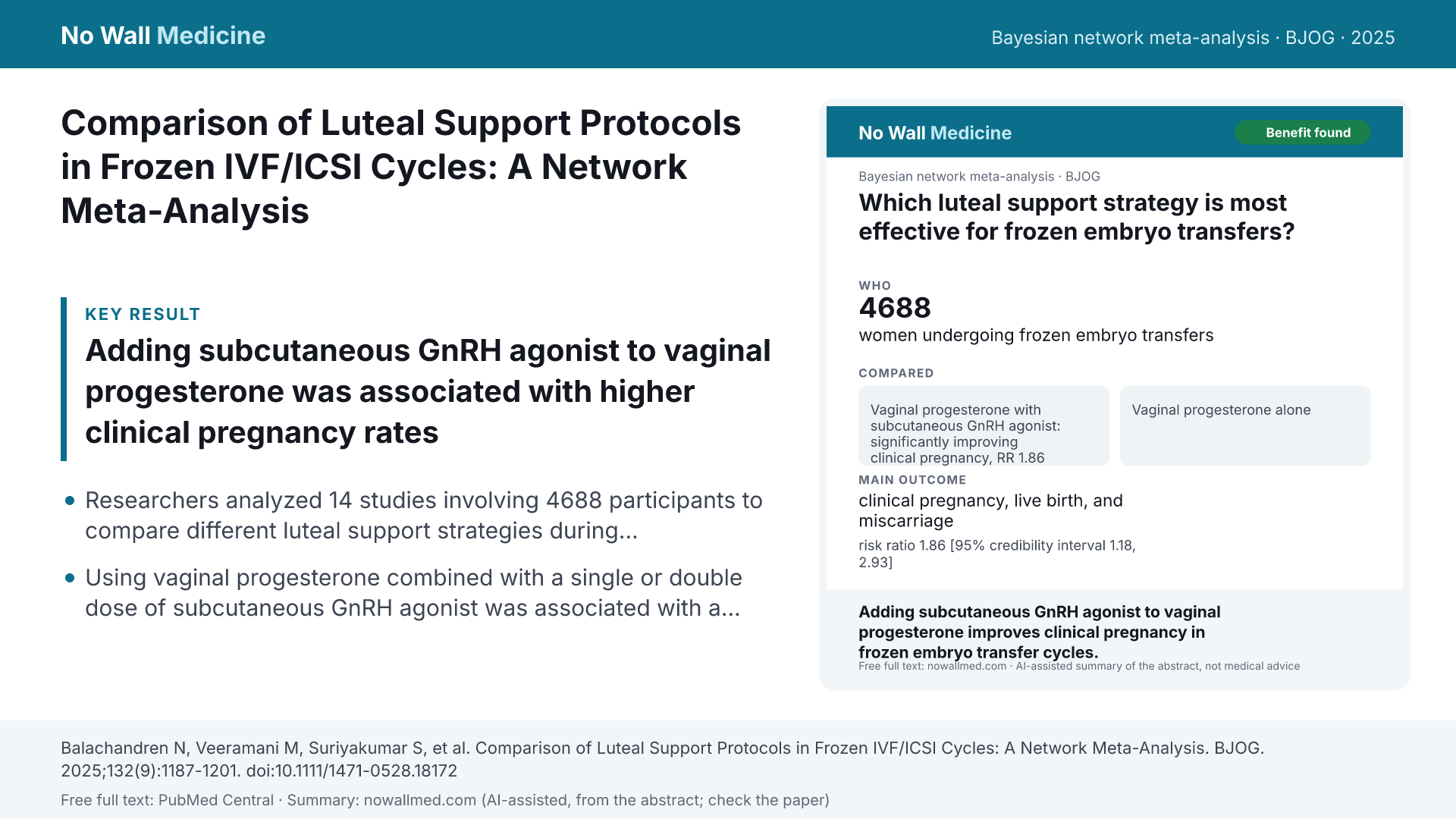
Adding subcutaneous GnRH agonist to vaginal progesterone was associated with higher clinical pregnancy rates
Comparison of Luteal Support Protocols in Frozen IVF/ICSI Cycles: A Network Meta-Analysis
Bayesian network meta-analysisBenefit found
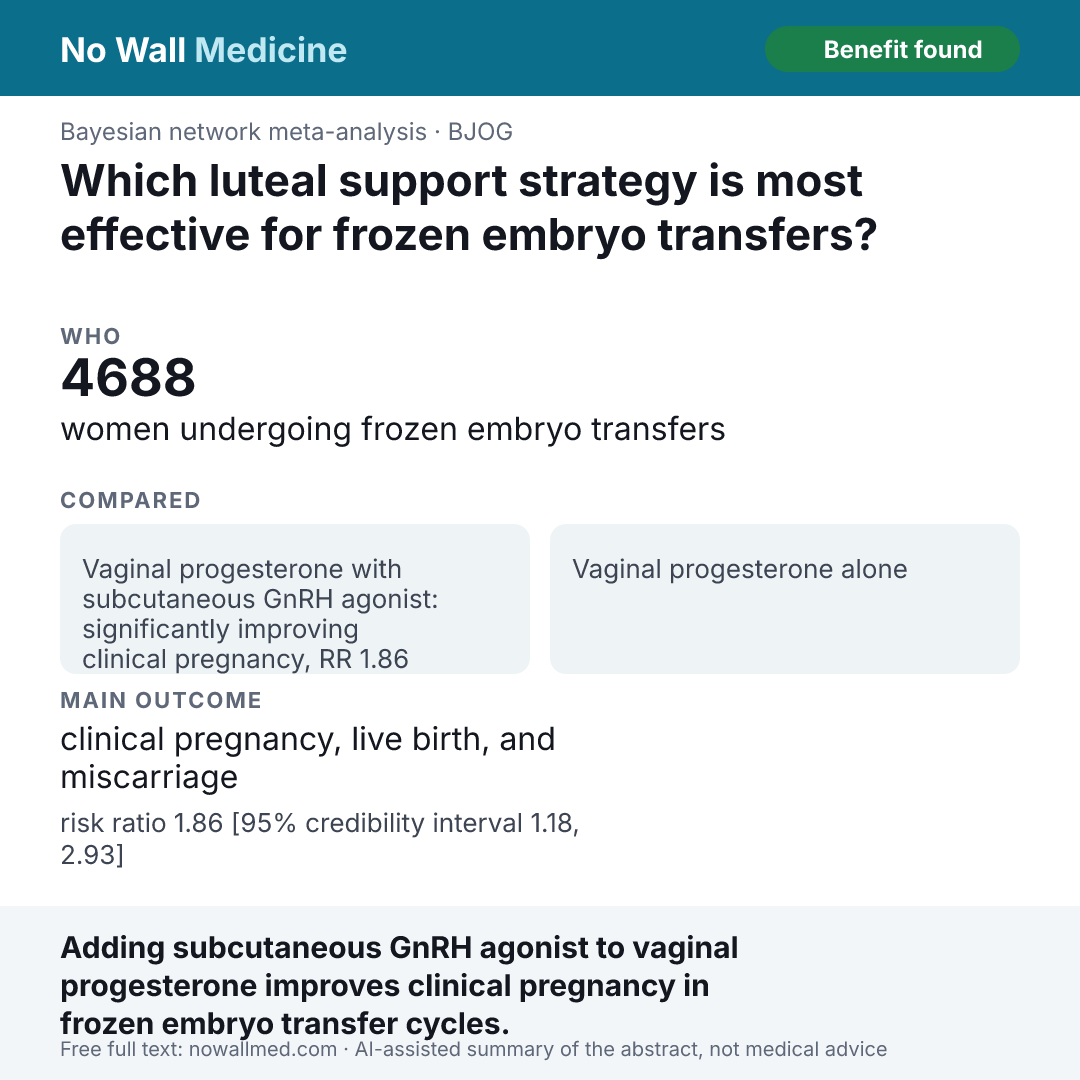
Which luteal support strategy is most effective for frozen embryo transfers?
Who
4688
women undergoing frozen embryo transfers
Compared
Vaginal progesterone with subcutaneous GnRH agonist: significantly improving clinical pregnancy, RR 1.86 [95% CrI 1.18, 2.93]
Vaginal progesterone alone
Main outcome
clinical pregnancy, live birth, and miscarriage
Result: risk ratio 1.86 [95% credibility interval 1.18, 2.93]
Bottom line: Adding subcutaneous GnRH agonist to vaginal progesterone improves clinical pregnancy in frozen embryo transfer cycles.
Limitation: Overall CiNeMa risk of bias was moderate
BJOG · 2025-05-02 · PROSPERO CRD42024513549
Why it matters: Inconsistency across recommended luteal support protocols for frozen embryo transfers creates variation in reproductive outcomes.
Headline and visual abstract written with AI from the paper’s abstract, with every number checked against it. Read the paper before relying on them.
Was this summary helpful?
Subject terms
Cite this article
Balachandren N, Veeramani M, Suriyakumar S, et al. Comparison of Luteal Support Protocols in Frozen IVF/ICSI Cycles: A Network Meta-Analysis. BJOG. 2025;132(9):1187-1201. doi:10.1111/1471-0528.18172
Spotted a mistake? Suggest a correction