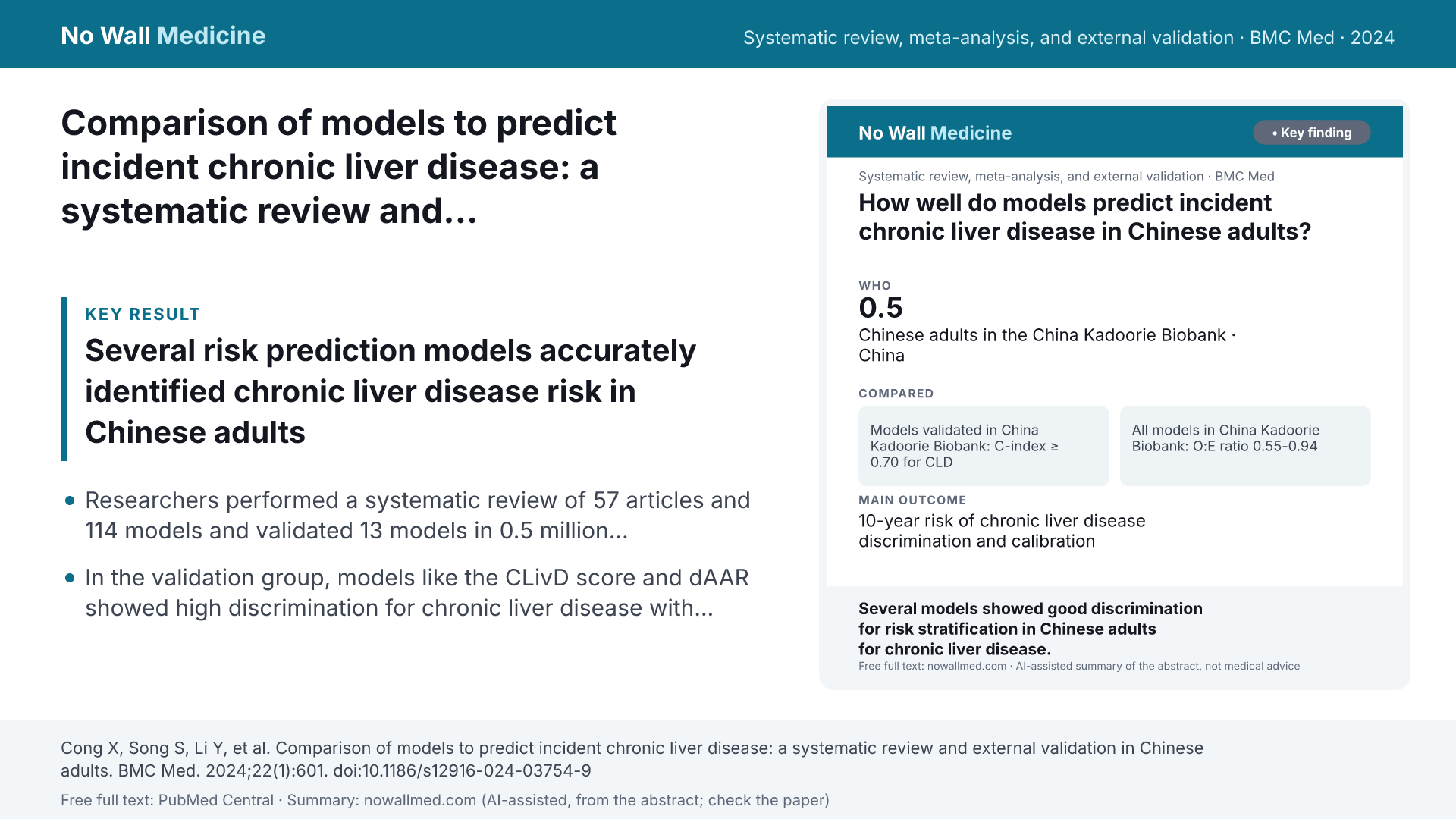
Several risk prediction models accurately identified chronic liver disease risk in Chinese adults
Comparison of models to predict incident chronic liver disease: a systematic review and external validation in Chinese adults
Systematic review, meta-analysis, and external validationKey finding
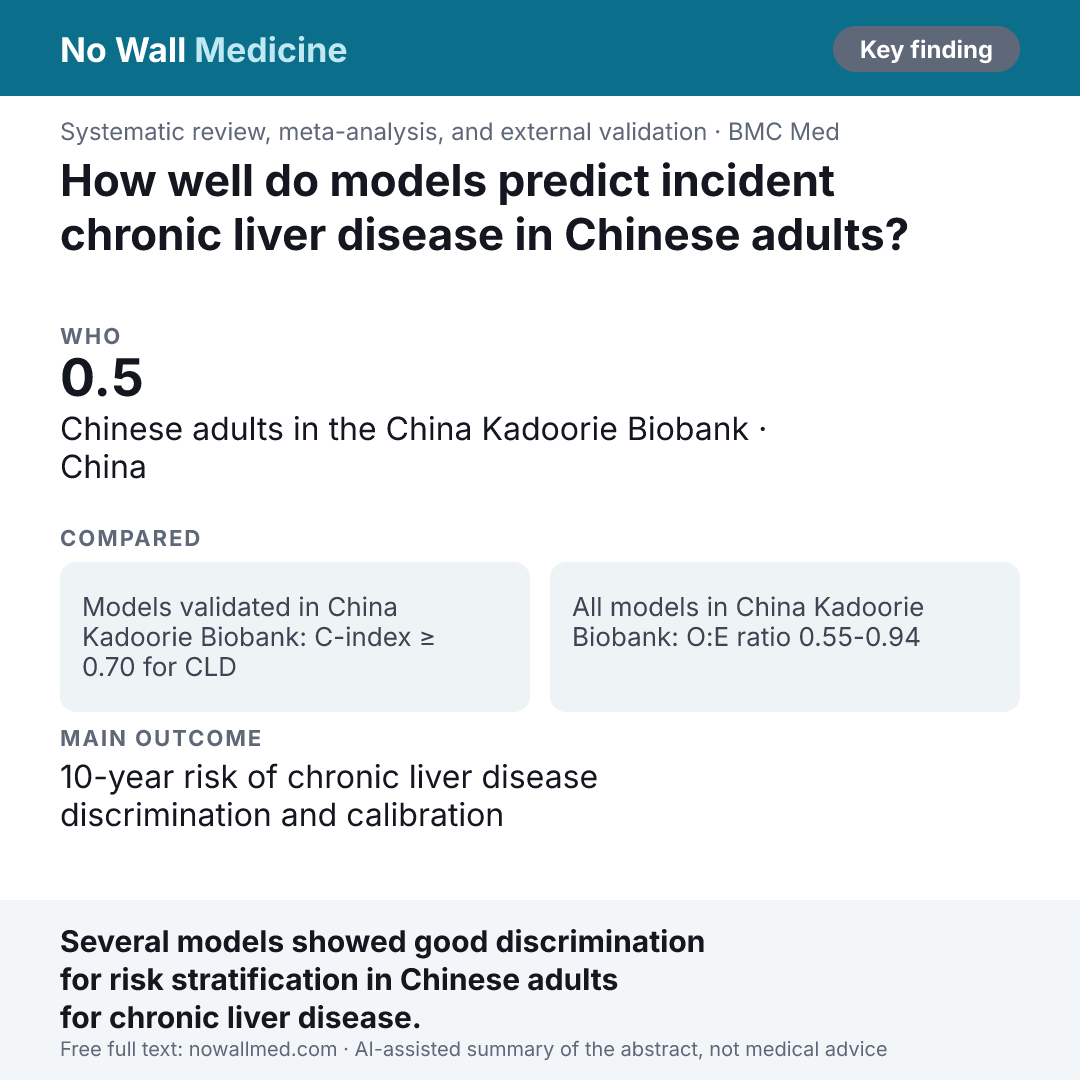
How well do models predict incident chronic liver disease in Chinese adults?
Who
0.5
Chinese adults in the China Kadoorie Biobank · China
Compared
Models validated in China Kadoorie Biobank: C-index ≥ 0.70 for CLD
All models in China Kadoorie Biobank: O:E ratio 0.55-0.94
Main outcome
10-year risk of chronic liver disease discrimination and calibration
Bottom line: Several models showed good discrimination for risk stratification in Chinese adults for chronic liver disease.
Limitation: All models tended to overestimate the risk in the validation cohort.
BMC Med · 2024-12-31 · Save PNG
Clinical question: How well do models predict incident chronic liver disease in Chinese adults?
Key points
- Researchers performed a systematic review of 57 articles and 114 models and validated 13 models in 0.5 million Chinese adults.
- In the validation group, models like the CLivD score and dAAR showed high discrimination for chronic liver disease with a C-index of 0.70 or higher.
- All models tested in the China Kadoorie Biobank tended to overestimate the risk, with an observed-to-expected ratio between 0.55-0.94.
Headline and key points written with AI from the paper’s abstract, with every number checked against it. Read the paper before relying on them.
Was this summary helpful?
Subject terms
Headline, design, result, key points, caveat and citation as plain text.
Cite this article
Cong X, Song S, Li Y, et al. Comparison of models to predict incident chronic liver disease: a systematic review and external validation in Chinese adults. BMC Med. 2024;22(1):601. doi:10.1186/s12916-024-03754-9
Spotted a mistake? Suggest a correction