Percutaneous access for abdominal aortic repair was linked to faster recovery than cutdown access
Comparison of percutaneous versus cutdown access in patients after endovascular abdominal aortic repair: a randomized controlled trial (SWEET-EVAR trial)
Single-blind, single-center, non-inferiority, randomized controlled trialBenefit found
Are percutaneous or cutdown access methods better after endovascular abdominal aortic repair?
Who
120
Patients diagnosed with abdominal aortic diseases · single-center
Compared
percutaneous endovascular abdominal aortic repair: 8.1% (10/124) access-related complications
cutdown endovascular abdominal aortic repair: 14.7% (17/116) access-related complications
Main outcome
access-related complications and time return to normal life/work
Result: median difference: 7 days, 95% CI 0-13 days
Bottom line: Percutaneous access accelerates recovery and improves quality of life compared to cutdown access without increasing access-related complications.
Int J Surg · 2025-03-01Download image
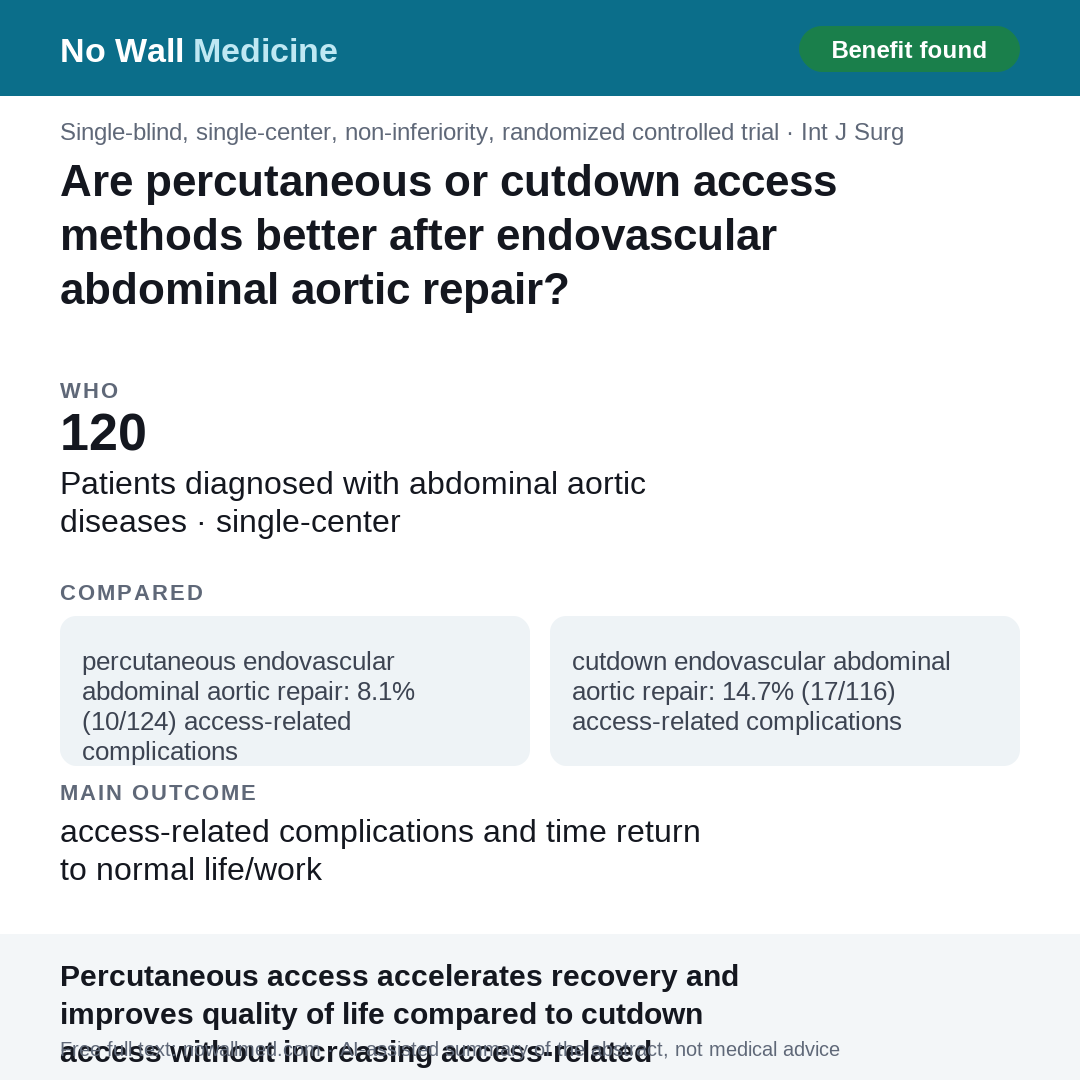
Clinical question: Are percutaneous or cutdown access methods better after endovascular abdominal aortic repair?
Why it matters: It is uncertain whether percutaneous or cutdown access is better for clinician-reported outcomes and patient-centered outcomes after endovascular abdominal aortic repair.
Key points
- Researchers randomized 120 patients to receive either percutaneous access or cutdown access (a surgical incision) during endovascular abdominal aortic repair.
- Percutaneous access was associated with a median recovery time of 16 days compared to 28 days for cutdown access.
- Percutaneous access was linked to shorter access-related pain (4 vs. 8 days) and lower use of pain medication (0% vs. 10.9%).
Limitation the authors note: The study was a single-blind, single-center trial.
Headline and key points written with AI from the paper’s abstract, with every number checked against it. Read the paper before relying on them.
Was this summary helpful?
Subject terms
Cite this article
Zhou Y, Wang J, Zhao J, Yuan D, Weng C, Huang B. Comparison of percutaneous versus cutdown access in patients after endovascular abdominal aortic repair: a randomized controlled trial (SWEET-EVAR trial). Int J Surg. 2025. doi:10.1097/JS9.0000000000002233
Spotted a mistake? Suggest a correction
Top studies every Monday
The week’s key trials and guidelines in your specialties, plus any topics you follow. By email, free.
Get the weekly digest