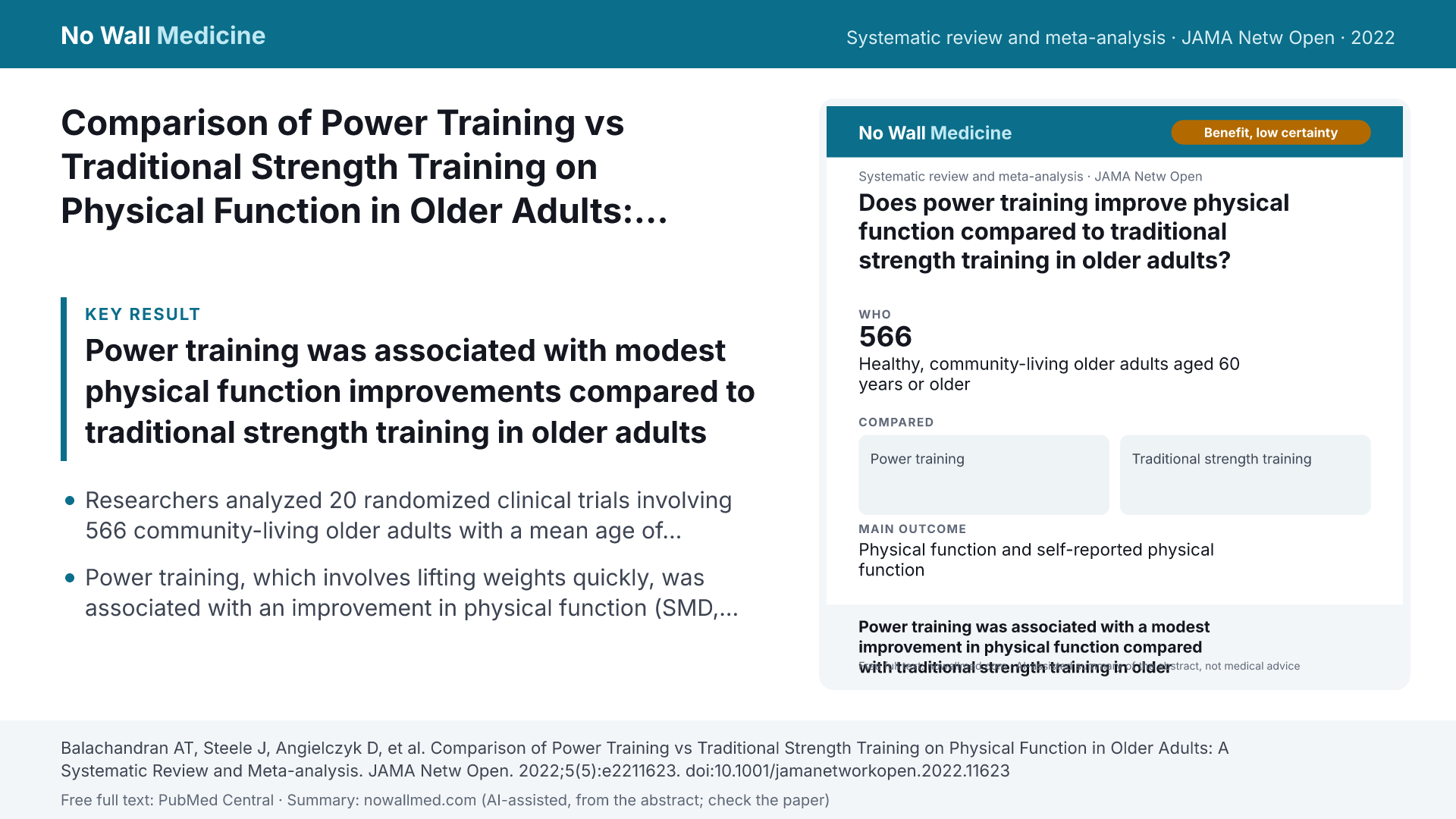
Comparison of Power Training vs Traditional Strength Training on Physical Function in Older Adults: A Systematic Review and Meta-analysis
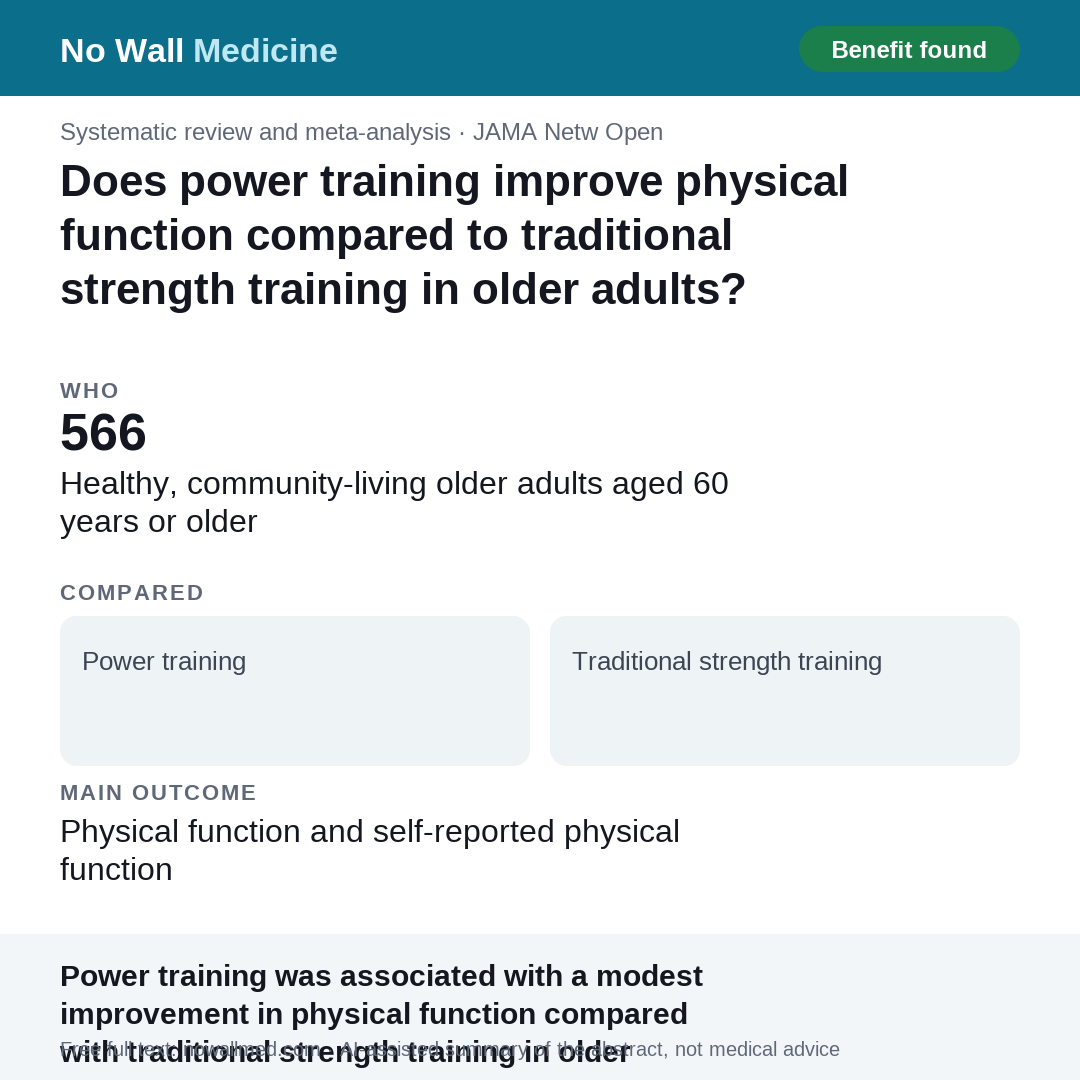
Key result: Power training was associated with modest physical function improvements compared to traditional strength training in older adults
Key points
- Researchers analyzed 20 randomized clinical trials involving 566 community-living older adults with a mean age of 70.1 years.
- Power training, which involves lifting weights quickly, was associated with an improvement in physical function (SMD, 0.30; 95% CI, 0.05-0.54) in 13 trials.
- The evidence for improvements in self-reported physical function was not statistically significant (SMD, 0.38; 95% CI, -0.62 to 1.37).
Limitation the authors note: The authors state that the evidence was downgraded due to high risk of bias and imprecision, and larger randomized clinical trials are required.
Discussion prompts
- Would these patients look like yours? Who was left out?
- Is the main outcome one that matters to patients?
- Is the difference large enough to change what you do?
Cite: Balachandran AT, Steele J, Angielczyk D, et al. Comparison of Power Training vs Traditional Strength Training on Physical Function in Older Adults: A Systematic Review and Meta-analysis. JAMA Netw Open. 2022. doi:10.1001/jamanetworkopen.2022.11623
Free full text: PubMed Central · Summary and visual abstract: nowallmed.com/a/comparison-of-power-training-vs-traditional-strength-training-on-n08q71/ (AI-assisted from the abstract; check the paper before relying on it).