Goal-directed fluid therapy was associated with lower delirium rates after spinal surgery in older patients
Comparison of restrictive fluid therapy with goal-directed fluid therapy for postoperative delirium in patients undergoing spine surgery: a randomized controlled trial
Randomized controlled trialMixed results
Does restrictive fluid therapy or goal-directed fluid therapy reduce postoperative delirium in spine surgery?
Who
195
195 patients aged 50 years or older undergoing spinal surgery
Compared
4.1%Restrictive fluid therapy
12.4%Goal-directed fluid therapy
Main outcome
Incidence of postoperative delirium
Bottom line: Goal-directed fluid therapy resulted in a higher incidence of postoperative delirium compared to restrictive fluid therapy in this study.
Perioper Med · 2021-12-15Download image
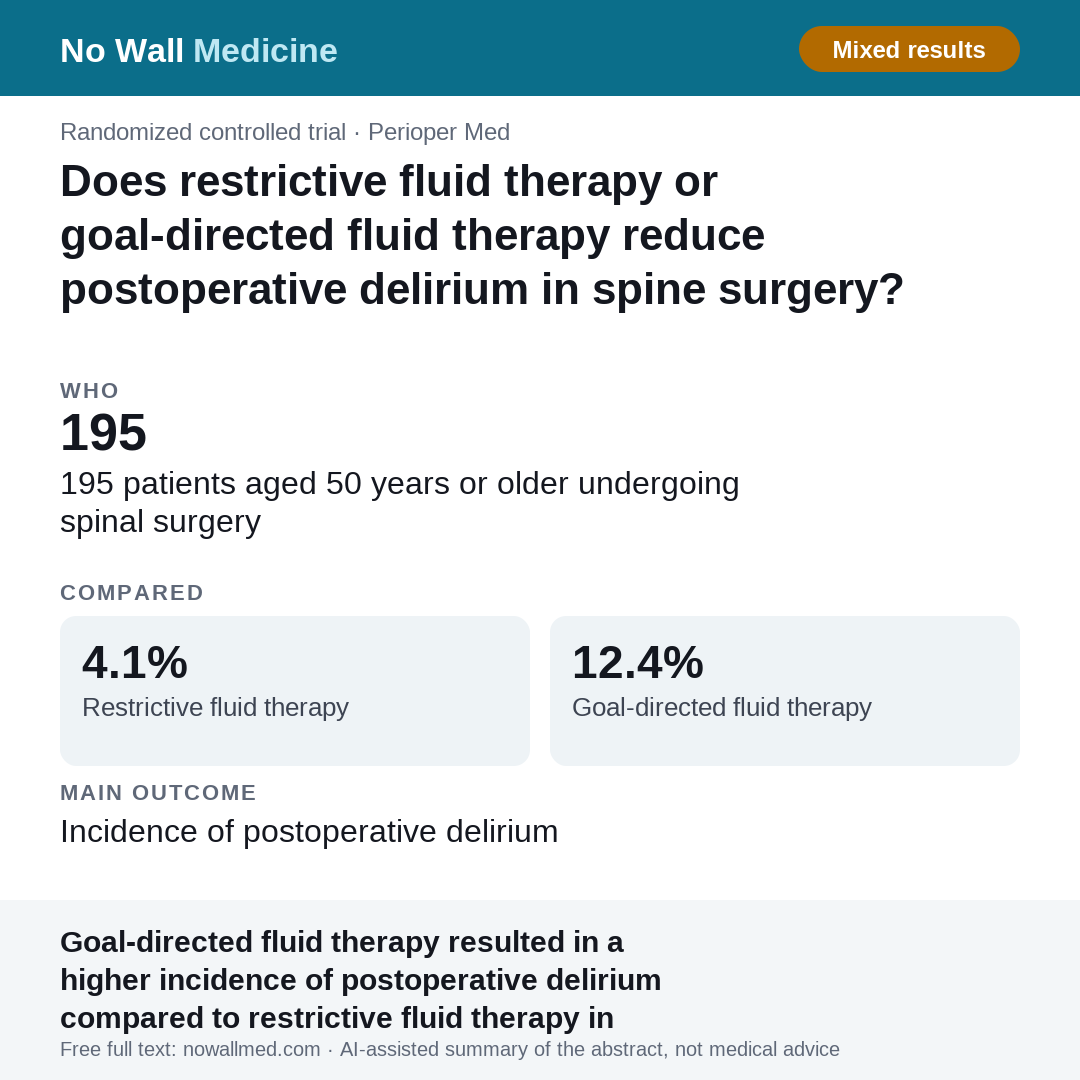
Clinical question: Does restrictive fluid therapy or goal-directed fluid therapy reduce postoperative delirium in spine surgery?
Why it matters: It is unknown how different methods of managing intravenous fluids during surgery affect the occurrence of postoperative delirium in patients undergoing spinal procedures.
Key points
- Researchers studied 195 patients aged 50 years or older undergoing spinal surgery, comparing restrictive fluid therapy to goal-directed fluid therapy using continuous noninvasive arterial pressure monitoring.
- The incidence of postoperative delirium was 4.1% in the restrictive group compared to 12.4% in the goal-directed group during the first 3 days after surgery.
- Patients receiving goal-directed therapy had higher intraoperative urine volumes and a shorter hospital stay of 14.5 days compared to 17.0 days in the restrictive group.
Headline and key points written with AI from the paper’s abstract, with every number checked against it. Read the paper before relying on them.
Was this summary helpful?
Cite this article
Wang DD, Li Y, Hu XW, Zhang MC, Xu XM, Tang J. Comparison of restrictive fluid therapy with goal-directed fluid therapy for postoperative delirium in patients undergoing spine surgery: a randomized controlled trial. Perioper Med. 2021. doi:10.1186/s13741-021-00220-5
Spotted a mistake? Suggest a correction
Top studies every Monday
The week’s key trials and guidelines in your specialties, plus any topics you follow. By email, free.
Get the weekly digest