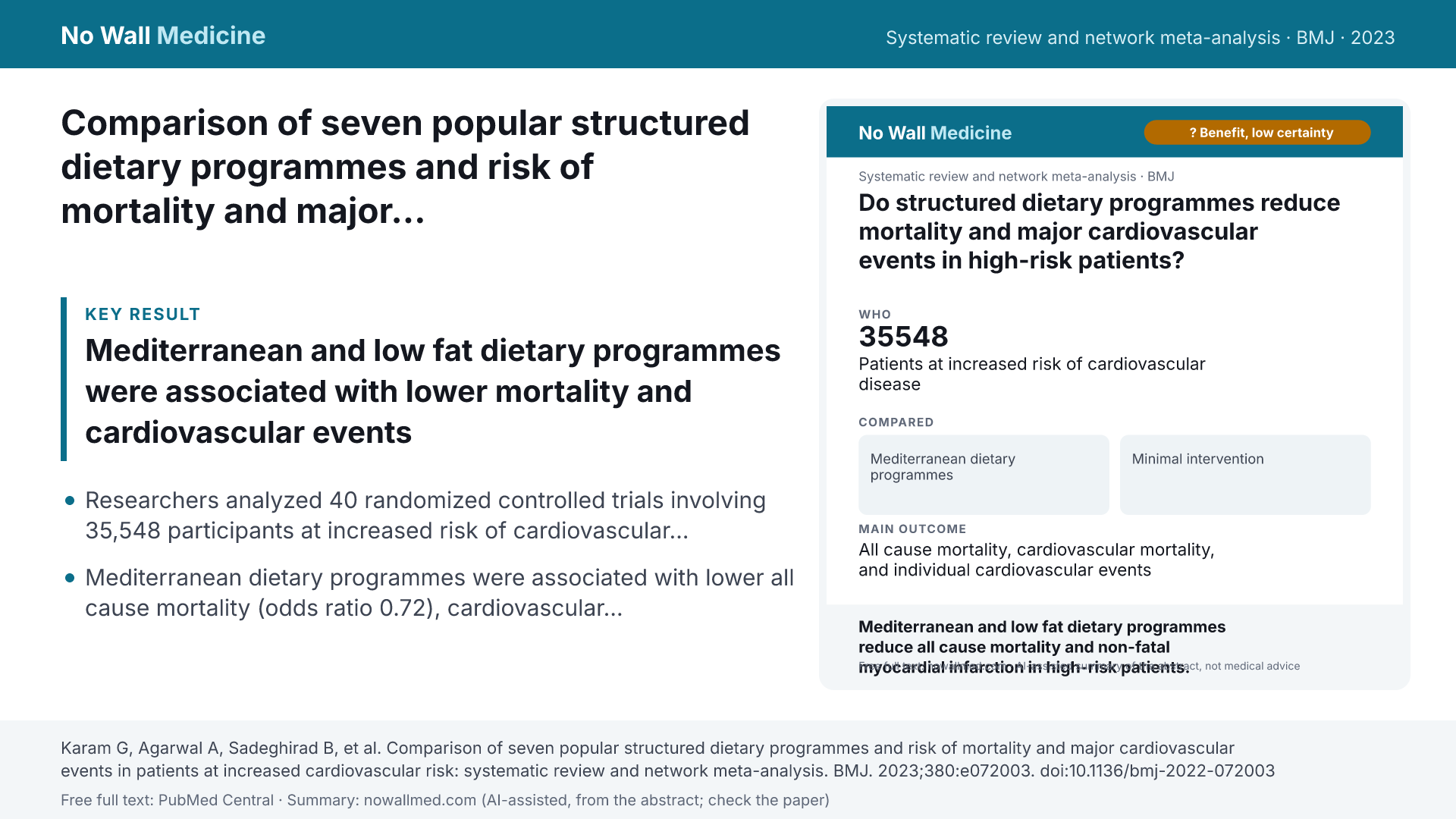
Mediterranean and low fat dietary programmes were associated with lower mortality and cardiovascular events
Comparison of seven popular structured dietary programmes and risk of mortality and major cardiovascular events in patients at increased cardiovascular risk: systematic review and network meta-analysis
Systematic review and network meta-analysisBenefit, low certainty
Do structured dietary programmes reduce mortality and major cardiovascular events in high-risk patients?
Who
35548
Patients at increased risk of cardiovascular disease
Compared
Mediterranean dietary programmes
Minimal intervention
Main outcome
All cause mortality, cardiovascular mortality, and individual cardiovascular events
Result: odds ratio 0.72 (95% confidence interval 0.56 to 0.92) for all cause mortality
Bottom line: Mediterranean and low fat dietary programmes reduce all cause mortality and non-fatal myocardial infarction in high-risk patients.
BMJ · 2023-03-29 · Save PNG
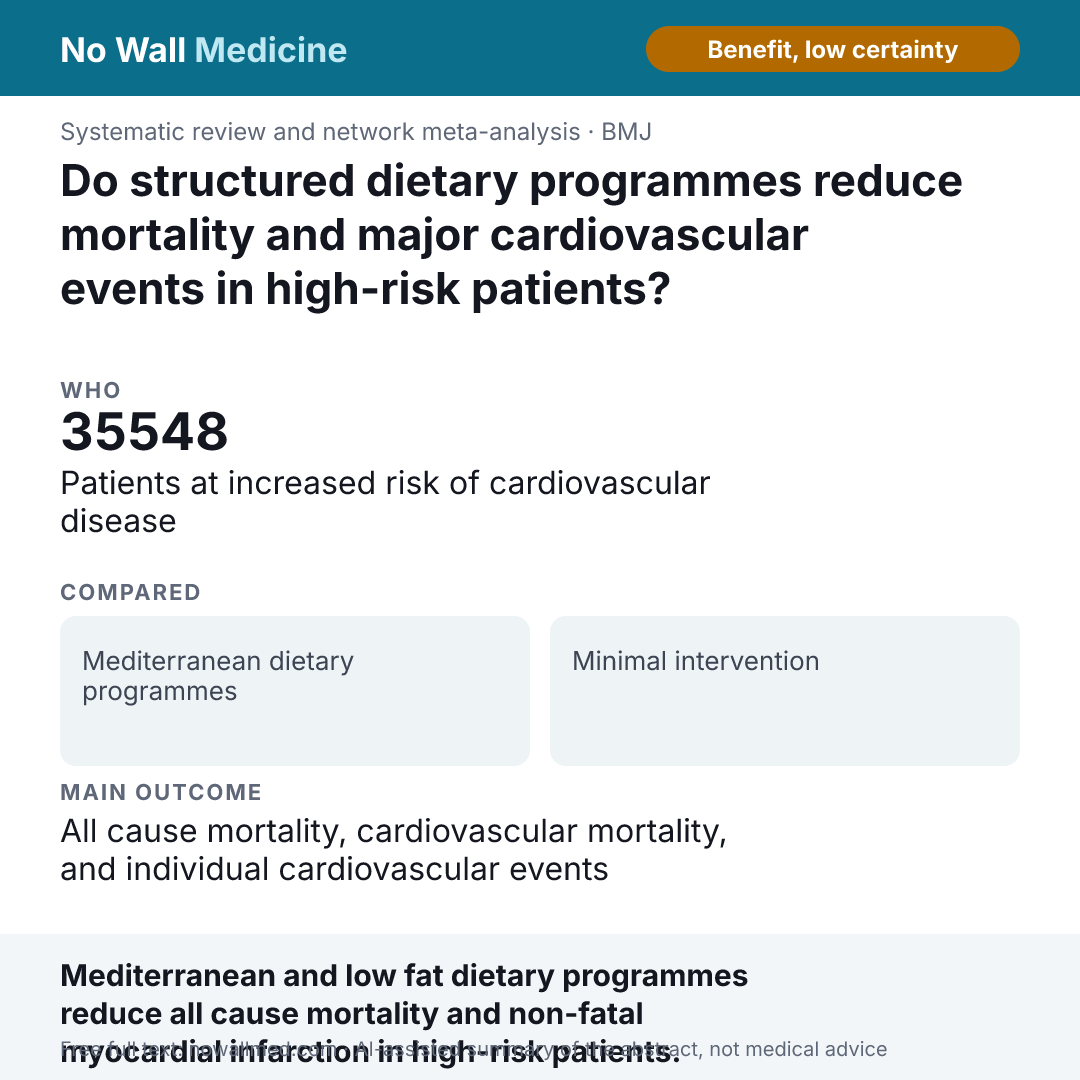
Clinical question: Do structured dietary programmes reduce mortality and major cardiovascular events in high-risk patients?
Key points
- Researchers analyzed 40 randomized controlled trials involving 35,548 participants at increased risk of cardiovascular disease to compare seven different dietary programmes.
- Mediterranean dietary programmes were associated with lower all cause mortality (odds ratio 0.72), cardiovascular mortality (0.55), stroke (0.65), and non-fatal heart attacks (0.48) compared to minimal intervention.
- Low fat programmes were associated with lower all cause mortality (0.84) and non-fatal heart attacks (0.77) compared to minimal intervention.
Headline and key points written with AI from the paper’s abstract, with every number checked against it. Read the paper before relying on them.
Was this summary helpful?
Abstract
Objective
To determine the relative efficacy of structured named diet and health behaviour programmes (dietary programmes) for prevention of mortality and major cardiovascular events in patients at increased risk of cardiovascular disease. Design
Systematic review and network meta-analysis of randomised controlled trials. Data sources
AMED (Allied and Complementary Medicine Database), CENTRAL (Cochrane Central Register of Controlled Trials), Embase, Medline, CINAHL (Cumulative Index to Nursing and Allied Health Literature), and ClinicalTrials.gov were searched up to September 2021. Study selection
Randomised trials of patients at increased risk of cardiovascular disease that compared dietary programmes with minimal intervention (eg, healthy diet brochure) or alternative programmes with at least nine months of follow-up and reporting on mortality or major cardiovascular events (such as stroke or non-fatal myocardial infarction). In addition to dietary intervention, dietary programmes could also include exercise, behavioural support, and other secondary interventions such as drug treatment. Outcomes and measures
All cause mortality, cardiovascular mortality, and individual cardiovascular events (stroke, non-fatal myocardial infarction, and unplanned cardiovascular interventions). Review methods
Pairs of reviewers independently extracted data and assessed risk of bias. A random effects network meta-analysis was performed using a frequentist approach and grading of recommendations assessment, development and evaluation (GRADE) methods to determine the certainty of evidence for each outcome. Results
40 eligible trials were identified with 35 548 participants across seven named dietary programmes (low fat, 18 studies; Mediterranean, 12; very low fat, 6; modified fat, 4; combined low fat and low sodium, 3; Ornish, 3; Pritikin, 1). At last reported follow-up, based on moderate certainty evidence, Mediterranean dietary programmes proved superior to minimal intervention for the prevention of all cause mortality (odds ratio 0.72, 95% confidence interval 0.56 to 0.92; patients at intermediate risk: risk difference 17 fewer per 1000 followed over five years), cardiovascular mortality (0.55, 0.39 to 0.78; 13 fewer per 1000), stroke (0.65, 0.46 to 0.93; 7 fewer per 1000), and non-fatal myocardial infarction (0.48, 0.36 to 0.65; 17 fewer per 1000). Based on moderate certainty evidence, low fat programmes proved superior to minimal intervention for prevention of all cause mortality (0.84, 0.74 to 0.95; 9 fewer per 1000) and non-fatal myocardial infarction (0.77, 0.61 to 0.96; 7 fewer per 1000). The absolute effects for both dietary programmes were more pronounced for patients at high risk. There were no convincing differences between Mediterranean and low fat programmes for mortality or non-fatal myocardial infarction. The five remaining dietary programmes generally had little or no benefit compared with minimal intervention typically based on low to moderate certainty evidence. Conclusions
Moderate certainty evidence shows that programmes promoting Mediterranean and low fat diets, with or without physical activity or other interventions, reduce all cause mortality and non-fatal myocardial infarction in patients with increased cardiovascular risk. Mediterranean programmes are also likely to reduce stroke risk. Generally, other named dietary programmes were not superior to minimal intervention. Systematic review registration
PROSPERO CRD42016047939.
Abstract reproduced under the article’s CC BY NC licence.
Subject terms
Headline, design, result, key points, caveat and citation as plain text.
Cite this article
Karam G, Agarwal A, Sadeghirad B, et al. Comparison of seven popular structured dietary programmes and risk of mortality and major cardiovascular events in patients at increased cardiovascular risk: systematic review and network meta-analysis. BMJ. 2023;380:e072003. doi:10.1136/bmj-2022-072003
Spotted a mistake? Suggest a correction