Low bicarbonate replacement fluid was associated with fewer acid-base level fluctuations during continuous veno-venous hemofiltration
Comparison of two different bicarbonate replacement fluids during CVVH with RCA: a prospective, randomized, controlled trial
Prospective, randomized, controlled, open-label, cross-over trialBenefit found
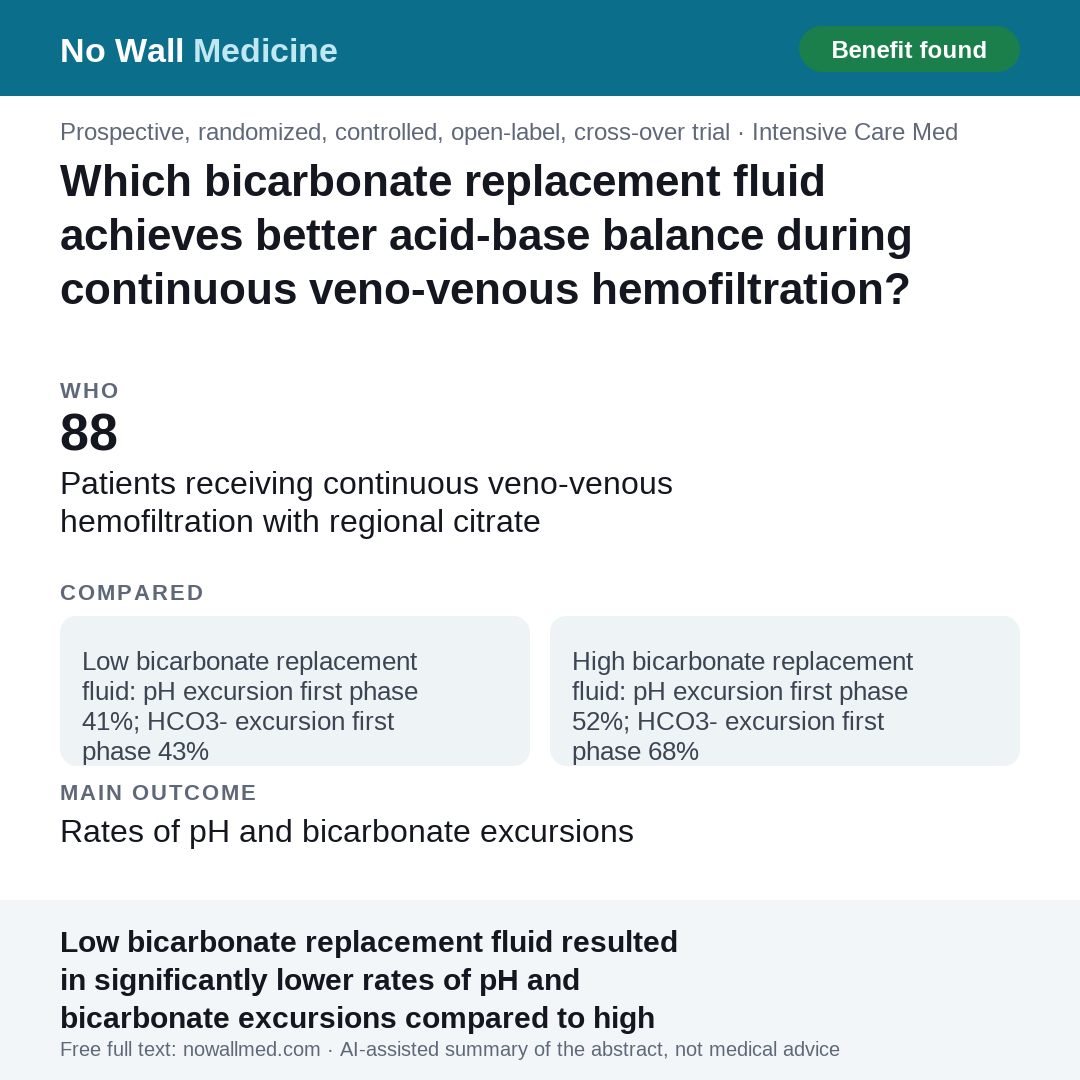
Which bicarbonate replacement fluid achieves better acid-base balance during continuous veno-venous hemofiltration?
Who
88
Patients receiving continuous veno-venous hemofiltration with regional citrate anticoagulation · single-center trial
Compared
Low bicarbonate replacement fluid: pH excursion first phase 41%; HCO3- excursion first phase 43%
High bicarbonate replacement fluid: pH excursion first phase 52%; HCO3- excursion first phase 68%
Main outcome
Rates of pH and bicarbonate excursions
Result: odds ratio 1.78 (95% CI 1.12-2.82) for pH; 3.60 (95% CI 2.16-5.99) for HCO3-
Bottom line: Low bicarbonate replacement fluid resulted in significantly lower rates of pH and bicarbonate excursions compared to high bicarbonate replacement fluid.
Intensive Care Med · 2025-11-17Download image
Clinical question: Which bicarbonate replacement fluid achieves better acid-base balance during continuous veno-venous hemofiltration?
Why it matters: Clinicians need to know whether high or low bicarbonate replacement fluids provide better acid-base balance during continuous veno-venous hemofiltration with regional citrate anticoagulation.
Key points
- Researchers studied 88 patients receiving continuous veno-venous hemofiltration, a type of blood cleaning treatment, using either low or high bicarbonate replacement fluids.
- The low bicarbonate fluid was associated with lower rates of pH and bicarbonate excursions compared to the high bicarbonate fluid.
- The time required to normalize pH or bicarbonate levels did not differ significantly between the two fluid groups.
Headline and key points written with AI from the paper’s abstract, with every number checked against it. Read the paper before relying on them.
Topics
Cite this article
Perschinka F, Köglberger P, Köhler A, Lehner GF, Peer A, Maier S. Comparison of two different bicarbonate replacement fluids during CVVH with RCA: a prospective, randomized, controlled trial. Intensive Care Med. 2025. doi:10.1007/s00134-025-08175-7
Spotted a mistake? Suggest a correction