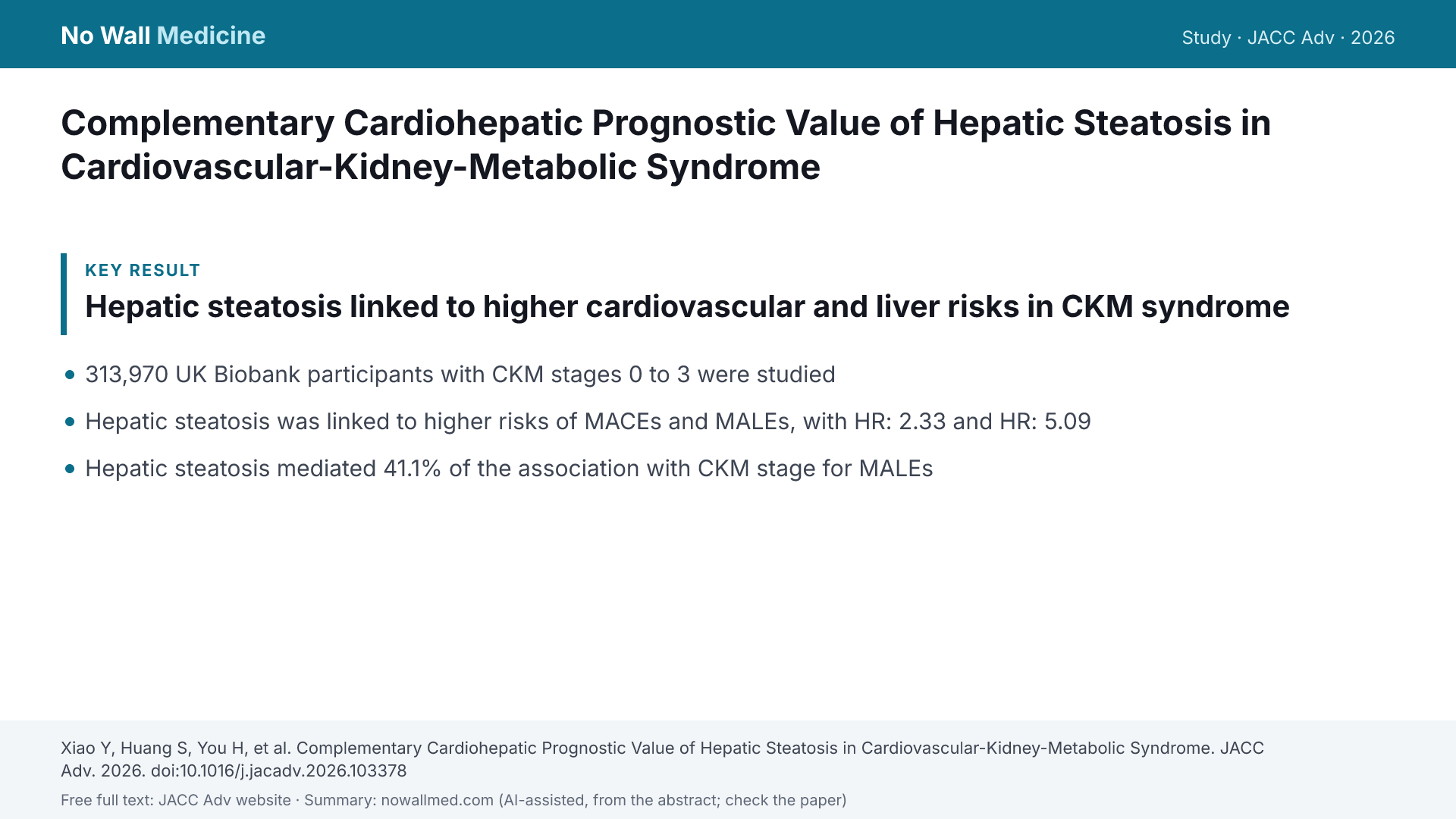
Hepatic steatosis linked to higher cardiovascular and liver risks in CKM syndrome
Complementary Cardiohepatic Prognostic Value of Hepatic Steatosis in Cardiovascular-Kidney-Metabolic Syndrome
Why it matters: CKM syndrome and hepatic steatosis both contribute to liver disease progression and cardiovascular risk
Key points
- 313,970 UK Biobank participants with CKM stages 0 to 3 were studied.
- Hepatic steatosis was linked to higher risks of MACEs and MALEs, with HR: 2.33 and HR: 5.09.
- Hepatic steatosis mediated 41.1% of the association with CKM stage for MALEs.
Study type: Observational study: it can show a link, but not prove that one thing causes another.
Headline and key points written with AI from the paper’s abstract, with every number checked against it. Read the paper before relying on them.
Was this summary helpful?
Headline, design, result, key points, caveat and citation as plain text.
Cite this article
Xiao Y, Huang S, You H, et al. Complementary Cardiohepatic Prognostic Value of Hepatic Steatosis in Cardiovascular-Kidney-Metabolic Syndrome. JACC Adv. 2026. doi:10.1016/j.jacadv.2026.103378
Spotted a mistake? Suggest a correction