Complete revascularization reduced major adverse events in older patients with high bleeding risk
Complete vs Culprit-Only Revascularization in Older Patients With Myocardial Infarction and High Bleeding Risk: A Randomized Clinical Trial
Open-label, multicenter randomized clinical trialBenefit found
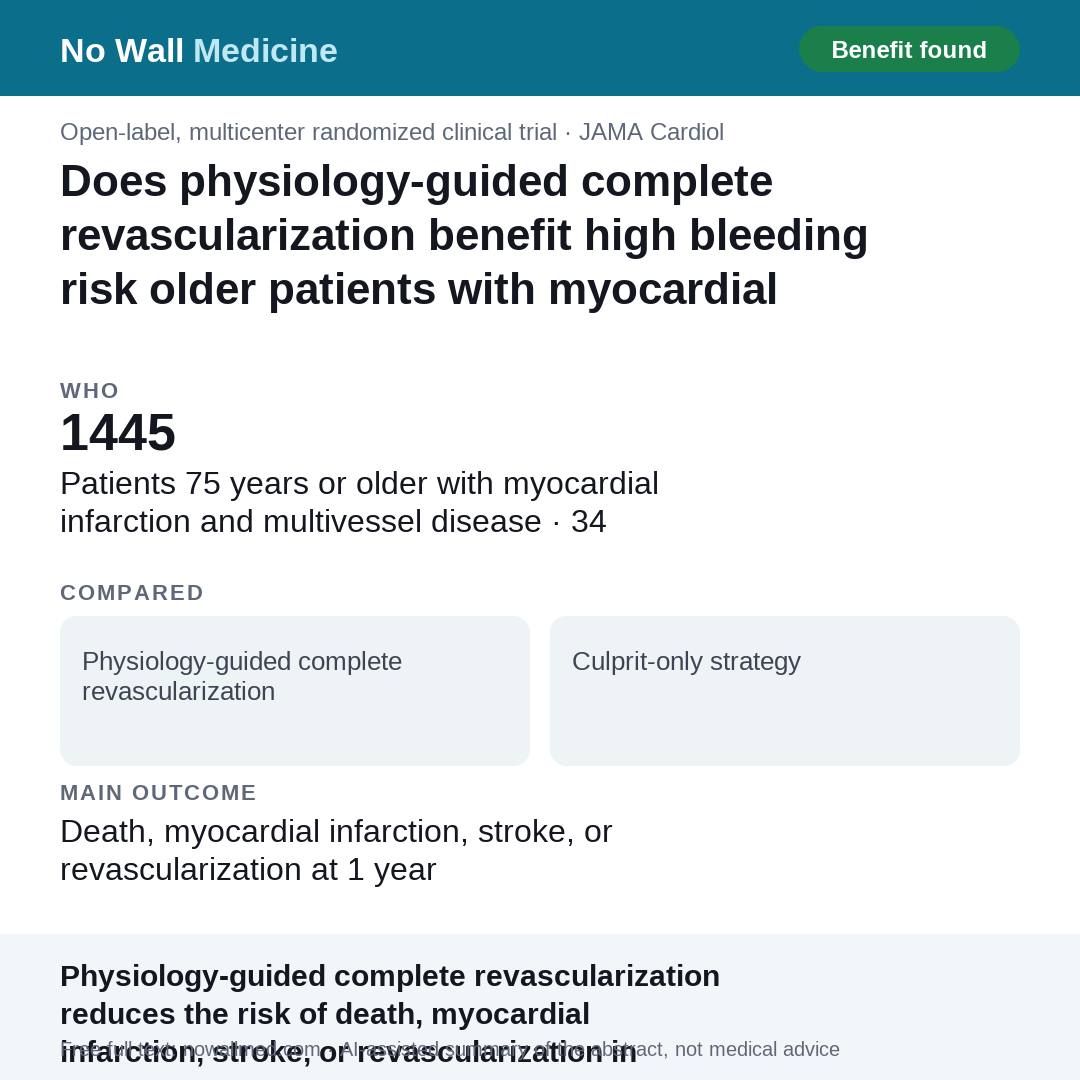
Does physiology-guided complete revascularization benefit high bleeding risk older patients with myocardial infarction?
Who
1445
Patients 75 years or older with myocardial infarction and multivessel disease · 34 European centers
Compared
Physiology-guided complete revascularization
Culprit-only strategy
Main outcome
Death, myocardial infarction, stroke, or revascularization at 1 year
Result: hazard ratio 0.73 (95% CI 0.55-0.96)
Bottom line: Physiology-guided complete revascularization reduces the risk of death, myocardial infarction, stroke, or revascularization in high bleeding risk patients.
JAMA Cardiol · 2024-05-08Download image
Clinical question: Does physiology-guided complete revascularization benefit high bleeding risk older patients with myocardial infarction?
Why it matters: It was not known if patients with high bleeding risk might benefit from complete revascularization after a heart attack.
Key points
- The study analyzed 1445 patients aged 75 years or older with heart attack and multivessel disease, where 71% met high bleeding risk criteria.
- In patients with high bleeding risk, physiology-guided complete revascularization reduced the primary composite outcome of death, heart attack, stroke, or repeat revascularization (HR, 0.73; 95% CI, 0.55-0.96).
- Patients with high bleeding risk were associated with higher risks for the primary endpoint (HR, 2.01; 95% CI, 1.47-2.76) and severe bleeding (HR, 3.28; 95% CI, 1.40-7.64).
Headline and key points written with AI from the paper’s abstract, with every number checked against it. Read the paper before relying on them.
Was this summary helpful?
Subject terms
Cite this article
Erriquez A, Campo G, Guiducci V, Escaned J, Moreno R, Casella G. Complete vs Culprit-Only Revascularization in Older Patients With Myocardial Infarction and High Bleeding Risk: A Randomized Clinical Trial. JAMA Cardiol. 2024. doi:10.1001/jamacardio.2024.0804
Spotted a mistake? Suggest a correction
Top studies every Monday
The week’s key trials and guidelines in your specialties, plus any topics you follow. By email, free.
Get the weekly digest