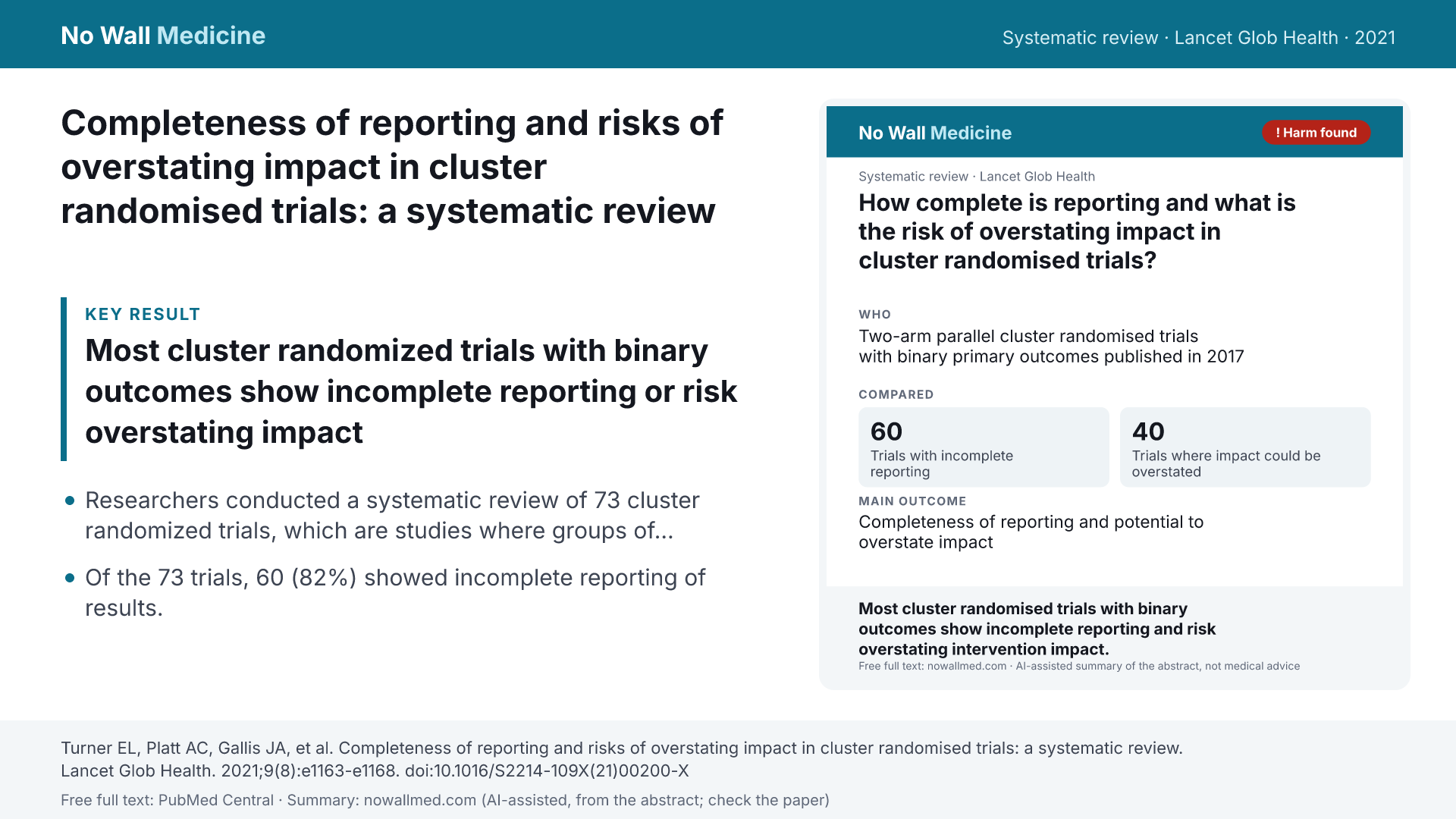
Most cluster randomized trials with binary outcomes show incomplete reporting or risk overstating impact
Completeness of reporting and risks of overstating impact in cluster randomised trials: a systematic review
Systematic reviewHarm found
How complete is reporting and what is the risk of overstating impact in cluster randomised trials?
Who
73
Two-arm parallel cluster randomised trials with binary primary outcomes published in 2017 · Cochrane Central Register of Controlled Trials
Compared
60Trials with incomplete reporting (82%)
40Trials where impact could be overstated (63%)
Main outcome
Completeness of reporting and potential to overstate impact
Bottom line: Most cluster randomised trials with binary outcomes show incomplete reporting and risk overstating intervention impact.
Lancet Glob Health · 2021-07-24Download image
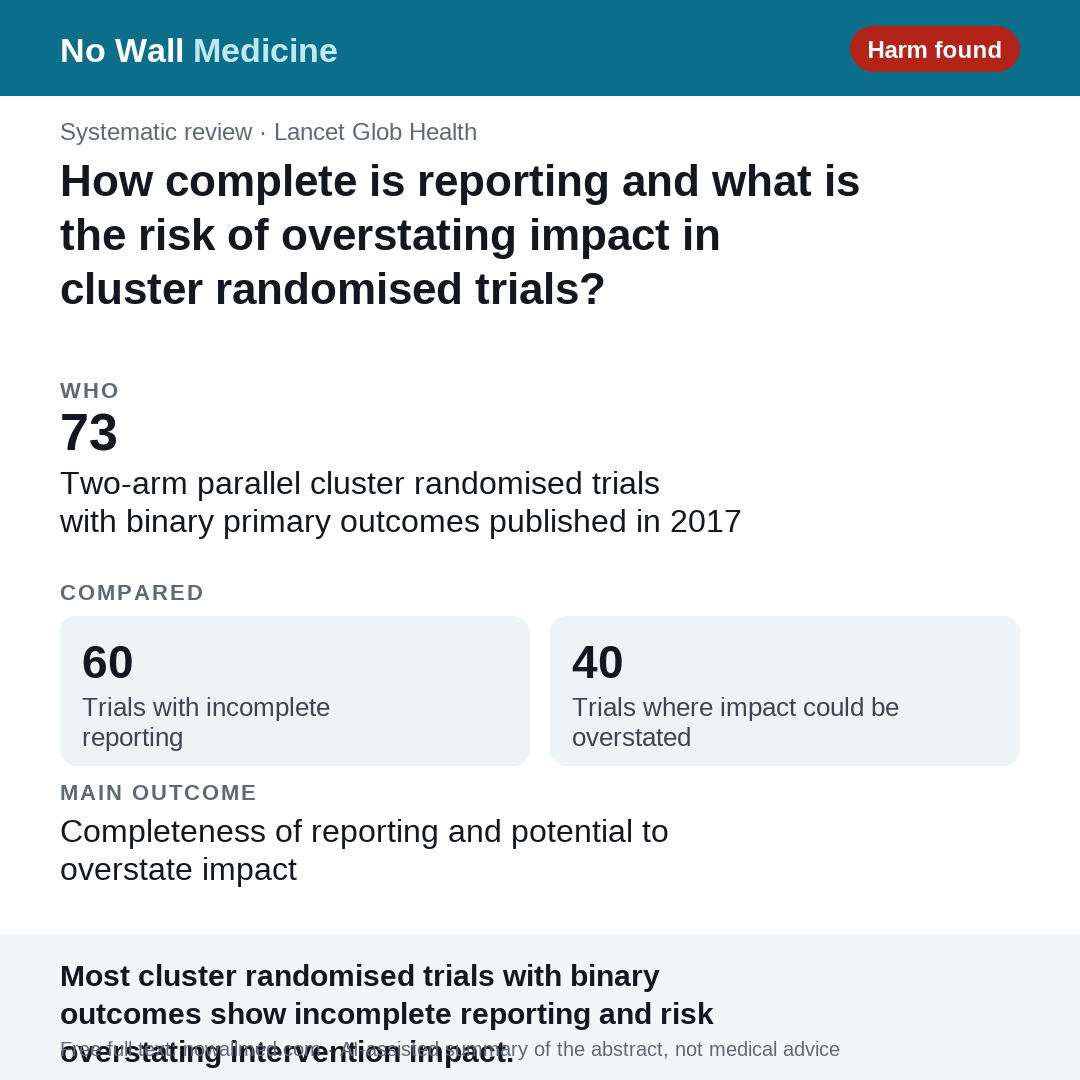
Clinical question: How complete is reporting and what is the risk of overstating impact in cluster randomised trials?
Why it matters: Incomplete or inaccurate reporting of binary outcomes in cluster randomized trials can lead to the inappropriate scale-up of interventions with low impact.
Key points
- Researchers conducted a systematic review of 73 cluster randomized trials, which are studies where groups of people rather than individuals are assigned to interventions.
- Of the 73 trials, 60 (82%) showed incomplete reporting of results.
- Among 64 trials where evaluation was possible, 40 (63%) reported results in a way that could overstate the impact of the intervention.
Headline and key points written with AI from the paper’s abstract, with every number checked against it. Read the paper before relying on them.
Was this summary helpful?
Abstract
Overstating the impact of interventions through incomplete or inaccurate reporting can lead to inappropriate scale-up of interventions with low impact. Accurate reporting of the impact of interventions is of great importance in global health research to protect scarce resources. In global health, the cluster randomised trial design is commonly used to evaluate complex, multicomponent interventions, and outcomes are often binary. Complete reporting of impact for binary outcomes means reporting both relative and absolute measures. We did a systematic review to assess reporting practices and potential to overstate impact in contemporary cluster randomised trials with binary primary outcome. We included all reports registered in the Cochrane Central Register of Controlled Trials of two-arm parallel cluster randomised trials with at least one binary primary outcome that were published in 2017. Of 73 cluster randomised trials, most (60 [82%]) showed incomplete reporting. Of 64 cluster randomised trials for which it was possible to evaluate, most (40 [63%]) reported results in such a way that impact could be overstated. Care is needed to report complete evidence of impact for the many interventions evaluated using the cluster randomised trial design worldwide.
Abstract reproduced under the article’s CC BY NC ND licence.
Subject terms
Cite this article
Turner EL, Platt AC, Gallis JA, et al. Completeness of reporting and risks of overstating impact in cluster randomised trials: a systematic review. Lancet Glob Health. 2021. doi:10.1016/S2214-109X(21)00200-X
Spotted a mistake? Suggest a correction