Completion, safety, and efficacy of tuberculosis preventive treatment regimens containing rifampicin or rifapentine: an individual patient data network meta-analysis
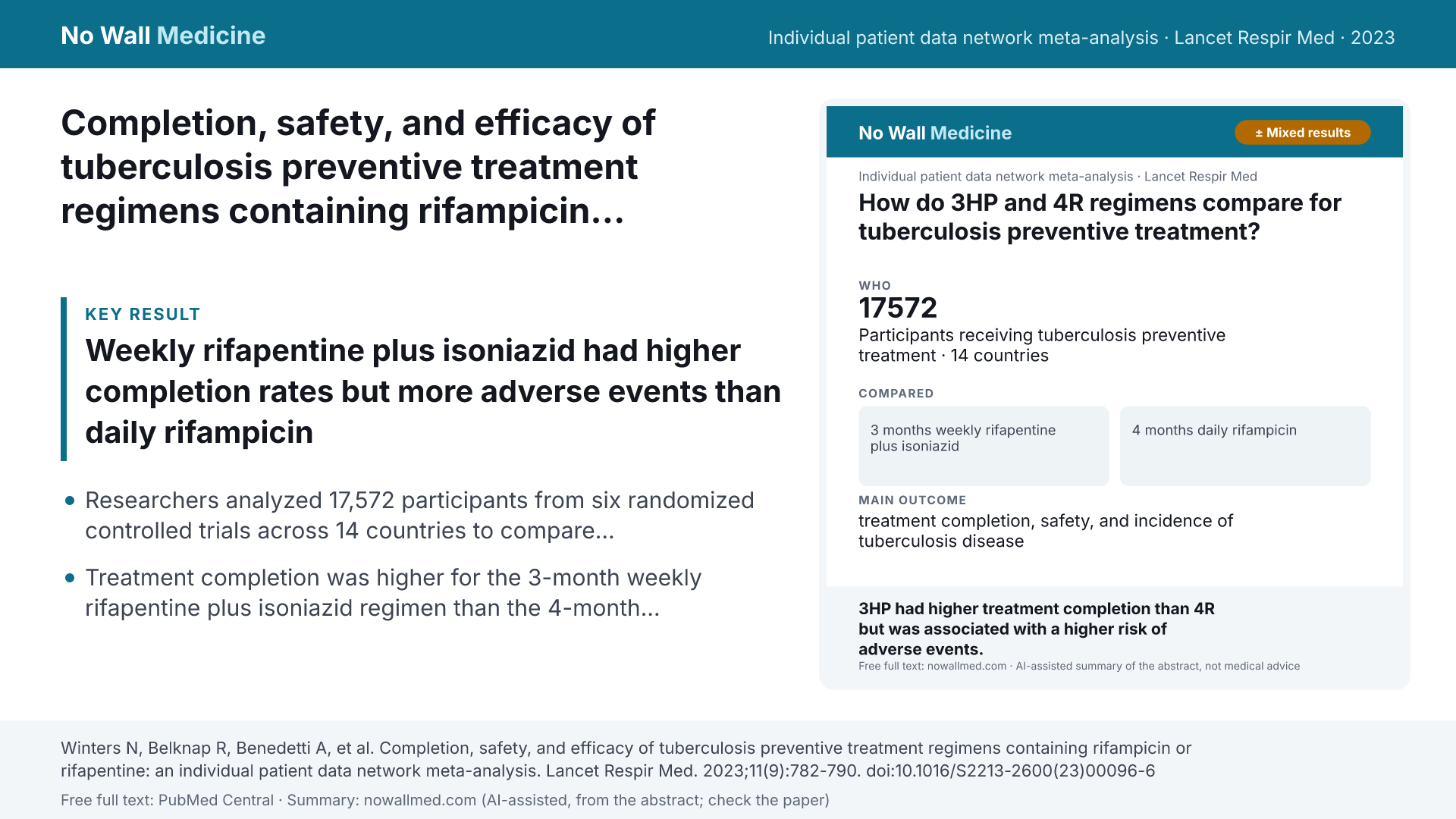
Key result: Weekly rifapentine plus isoniazid had higher completion rates but more adverse events than daily rifampicin
Key points
- Researchers analyzed 17,572 participants from six randomized controlled trials across 14 countries to compare two tuberculosis preventive treatment regimens.
- Treatment completion was higher for the 3-month weekly rifapentine plus isoniazid regimen than the 4-month daily rifampicin regimen (aRR 1.06 [95% CI 1.02-1.10]).
- The 3-month regimen was associated with higher risks of any severity adverse events (aRR 2.86 [2.12-4.21]) and grade 3-4 adverse events (aRR 3.46 [2.09-6.17]).
Why it matters: Direct comparisons between 3 months of weekly rifapentine plus isoniazid and 4 months of daily rifampicin for tuberculosis preventive treatment have not been performed in randomized controlled trials.
Discussion prompts
- Would these patients look like yours? Who was left out?
- Is the main outcome one that matters to patients?
- Is the difference large enough to change what you do?
Cite: Winters N, Belknap R, Benedetti A, et al. Completion, safety, and efficacy of tuberculosis preventive treatment regimens containing rifampicin or rifapentine: an individual patient data network meta-analysis. Lancet Respir Med. 2023;11(9):782-790. doi:10.1016/S2213-2600(23)00096-6
Free full text: PubMed Central · Summary and visual abstract: nowallmed.com/a/completion-safety-and-efficacy-of-tuberculosis-preventive-treatment-yay2it/ (AI-assisted from the abstract; check the paper before relying on it).