Complex breathlessness intervention shows feasibility in patients with idiopathic pulmonary fibrosis and fibrotic lung disease
Complex breathlessness intervention in idiopathic pulmonary fibrosis (BREEZE-IPF): a feasibility, wait-list design randomised controlled trial
Randomised, wait-list, feasibility studyUnclear result
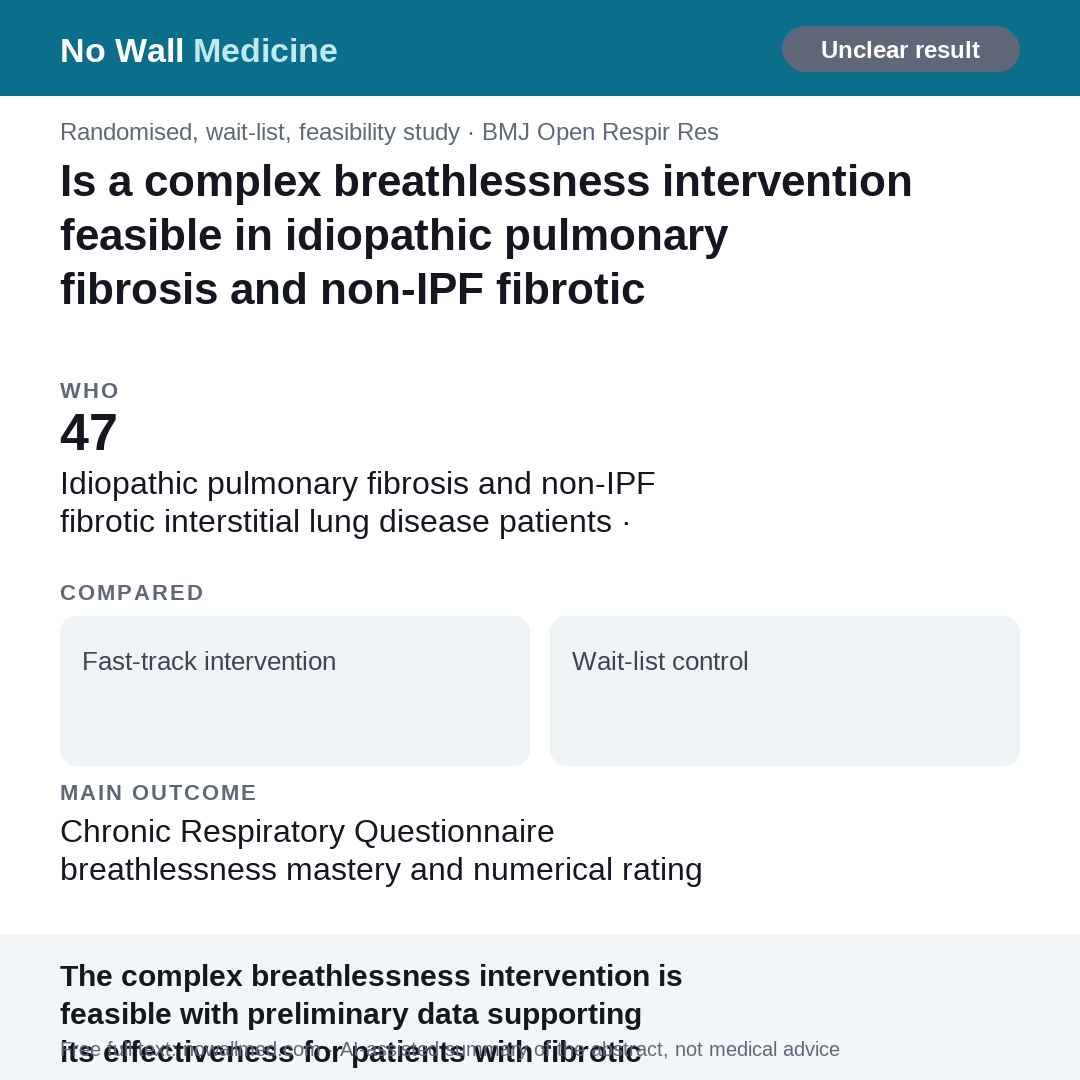
Is a complex breathlessness intervention feasible in idiopathic pulmonary fibrosis and non-IPF fibrotic interstitial lung disease?
Who
47
Idiopathic pulmonary fibrosis and non-IPF fibrotic interstitial lung disease patients · Multicentre, three sites
Compared
Fast-track intervention
Wait-list control
Main outcome
Chronic Respiratory Questionnaire breathlessness mastery and numerical rating scales
Result: Chronic Respiratory Questionnaire breathlessness mastery domain 0.45 (95% CI -0.07, 0.97)
Bottom line: The complex breathlessness intervention is feasible with preliminary data supporting its effectiveness for patients with fibrotic lung diseases.
BMJ Open Respir Res · 2025-03-22Download image
Clinical question: Is a complex breathlessness intervention feasible in idiopathic pulmonary fibrosis and non-IPF fibrotic interstitial lung disease?
Why it matters: It is unknown if a complex intervention involving breathing control, fan use, and pacing is feasible for managing breathlessness in patients with fibrotic lung diseases.
Key points
- Researchers studied 47 patients with idiopathic pulmonary fibrosis or non-idiopathic pulmonary fibrosis fibrotic interstitial lung disease using a wait-list randomized trial design.
- At 4 weeks, the intervention was associated with a mean difference of -1.84 for distress caused by breathlessness on a numerical rating scale.
- The study found the intervention was acceptable to participants and feasible for future definitive trials.
Headline and key points written with AI from the paper’s abstract, with every number checked against it. Read the paper before relying on them.
Abstract
Introduction
Breathlessness is common and impairs the quality of life of people with idiopathic pulmonary fibrosis (IPF) and non-IPF fibrotic interstitial lung diseases (ILD). We report the findings of a multicentre, fast-track (wait-list), mixed-methods, randomised controlled, feasibility study of a complex breathlessness intervention in breathless IPF and non-IPF fibrotic ILD patients. Methods
Breathless IPF and non-IPF fibrotic ILD patients were randomised to receive the intervention within 1 week (fast-track) or after 8 weeks (wait-list). The intervention comprised two face-to-face and one telephone appointment during a 3-week period covering breathing control, handheld fan-use, pacing and breathlessness management techniques, and techniques to manage anxiety. Feasibility and clinical outcomes were assessed to inform progression to, and optimal design for, a definitive trial. A qualitative substudy explored barriers and facilitators to trial and intervention delivery. Results
47 patients (M:F 38:9, mean (SD) age 73.9 (7.2)) were randomised with a recruitment rate of 2.5 participants per month across three sites. The adjusted mean differences (95% CI) for key clinical outcomes at 4 weeks post randomisation were as follows: Chronic Respiratory Questionnaire breathlessness mastery domain (0.45 (-0.07, 0.97)); and numerical rating scales for 'worst' (-0.93 (-1.95, 0.10)), 'best' (-0.19 (-1.38, 1.00)), 'distress caused by' (-1.84 (-3.29, -0.39)) and 'ability to cope with' (0.71 (-0.57, 1.99)) breathlessness within the past 24 hours. The qualitative substudy confirmed intervention acceptability and informed feasibility and acceptability of study outcome measures. Conclusion
A definitive trial of a complex breathlessness intervention in patients with IPF and non-IPF fibrotic ILD is feasible with preliminary data supporting intervention effectiveness. Trial registration number
ISRCTN13784514.
Abstract reproduced under the article’s CC BY licence.
Topics
Cite this article
Crooks MG, Wright C, Hart S, Allgar V, English A, Swan F. Complex breathlessness intervention in idiopathic pulmonary fibrosis (BREEZE-IPF): a feasibility, wait-list design randomised controlled trial. BMJ Open Respir Res. 2025. doi:10.1136/bmjresp-2024-002327
Spotted a mistake? Suggest a correction
Top studies every Monday
The week’s key trials and guidelines in your specialties, by email. Free.
Get the weekly digest