Complex interventions for kidney health work through clinician learning and motivation in supportive contexts
Complex Interventions Across Primary and Secondary Care to Optimize Population Kidney Health: A Systematic Review and Realist Synthesis to Understand Contexts, Mechanisms, and Outcomes
Systematic review and synthesisUnclear result
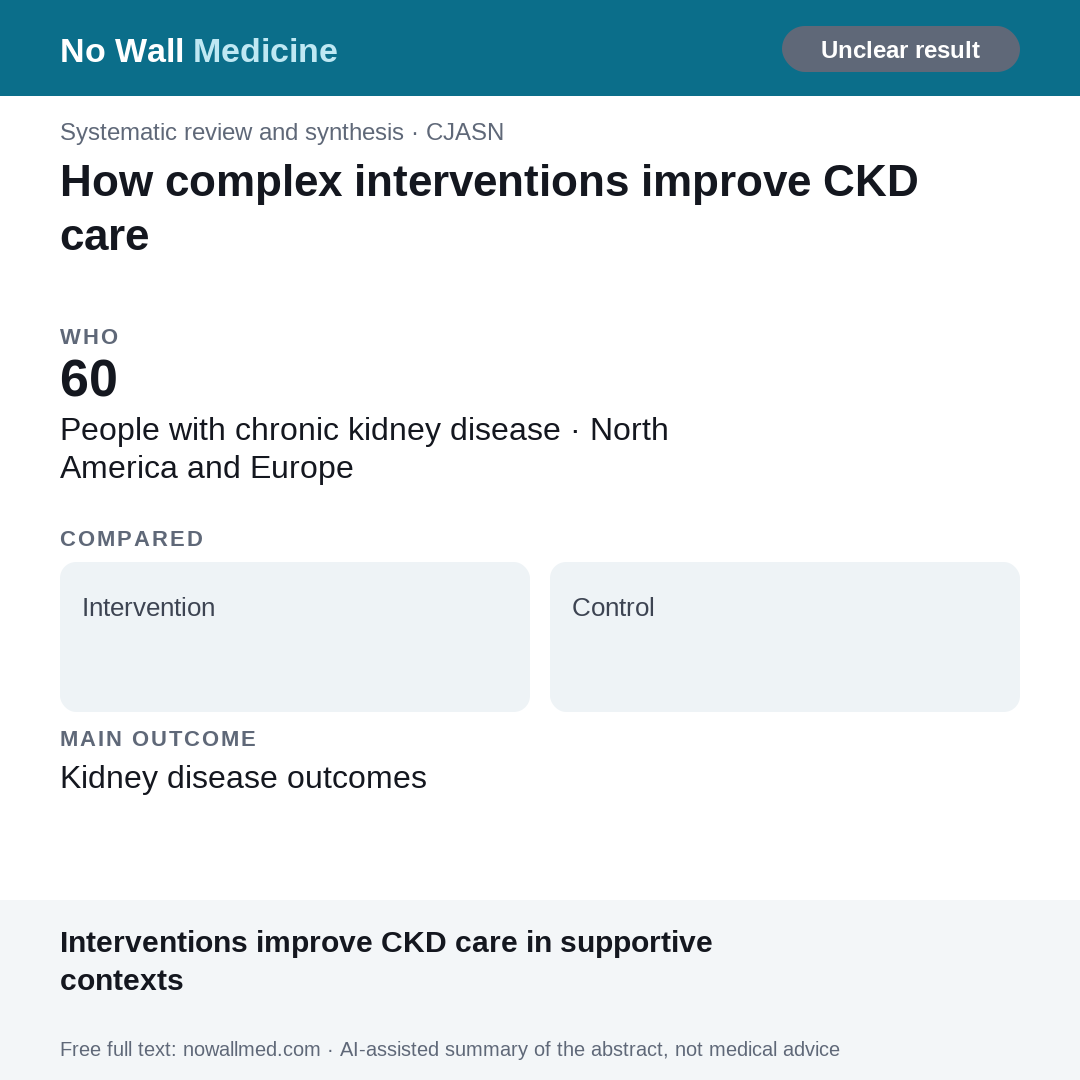
How complex interventions improve CKD care
Who
60
People with chronic kidney disease · North America and Europe
Compared
Intervention
Control
Main outcome
Kidney disease outcomes
Bottom line: Interventions improve CKD care in supportive contexts
Limitation: Patient perspectives lacking
CJASN · 2023-03-08Download image
Why it matters: Existing evidence-based treatments for chronic kidney disease are not implemented in at least a third of eligible patients, and socioeconomic inequities in care access exist.
Key points
- Researchers synthesized 60 studies from 3371 relevant papers to understand how complex interventions affect chronic kidney disease care.
- Successful interventions were associated with increased clinician learning, higher motivation for evidence-based management, and better integration into existing workflows.
- Effective outcomes were linked to supportive contexts such as organizational buy-in, geographical considerations, and compatibility with existing systems.
Headline and key points written with AI from the paper’s abstract, with every number checked against it. Read the paper before relying on them.
Topics
Cite this article
Taylor DM, Nimmo AM, Caskey FJ, Johnson R, Pippias M, Melendez-Torres GJ. Complex Interventions Across Primary and Secondary Care to Optimize Population Kidney Health: A Systematic Review and Realist Synthesis to Understand Contexts, Mechanisms, and Outcomes. CJASN. 2023. doi:10.2215/CJN.0000000000000136
Spotted a mistake? Suggest a correction
Top studies every Monday
The week’s key trials and guidelines in your specialties, plus any topics you follow. By email, free.
Get the weekly digest