Titanium and PEEK implants have similar low complication rates for facial contouring
Complications After Patient-specific Implants for Facial Contouring and Augmentation: A Systematic Review and Meta-analysis
Systematic review and meta-analysisNo clear difference
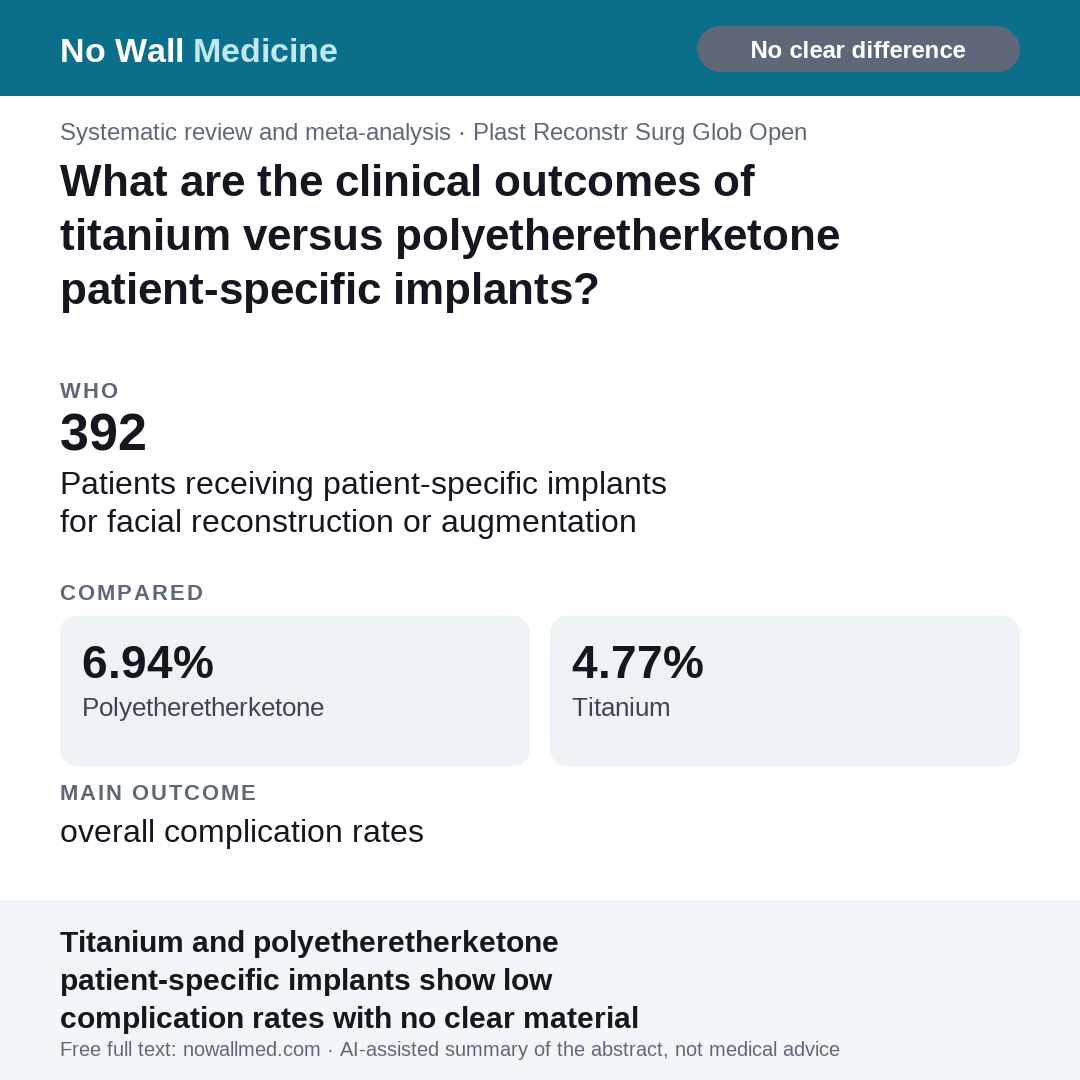
What are the clinical outcomes of titanium versus polyetheretherketone patient-specific implants?
Who
392
Patients receiving patient-specific implants for facial reconstruction or augmentation
Compared
6.94%Polyetheretherketone (95% confidence interval 2.38-12.98)
4.77%Titanium (95% confidence interval 0.05-13.66)
Main outcome
overall complication rates
Bottom line: Titanium and polyetheretherketone patient-specific implants show low complication rates with no clear material superiority.
Plast Reconstr Surg Glob Open · 2026-07-17Download image
Clinical question: What are the clinical outcomes of titanium versus polyetheretherketone patient-specific implants?
Why it matters: Doctors have had little evidence on which material is better for facial contouring and augmentation
Key points
- 392 patients with 543 implants were studied, comparing titanium and PEEK implants.
- Overall complication rates were 6.94% for PEEK and 4.77% for titanium implants.
- No significant difference was found between materials for overall complications or specific issues.
Limitation the authors note: The review notes the need for prospective, standardized, head-to-head studies with longer follow-up
Headline and key points written with AI from the paper’s abstract, with every number checked against it. Read the paper before relying on them.
Spotted a mistake? Suggest a correction