Meta-analysis shows low complication rates for polycaprolactone use in septorhinoplasty procedures
Complications Associated With Polycaprolactone (PCL) Use in Septorhinoplasty: A Systematic Review and Meta-Analysis
Systematic review and meta-analysis of 13 studiesBenefit found
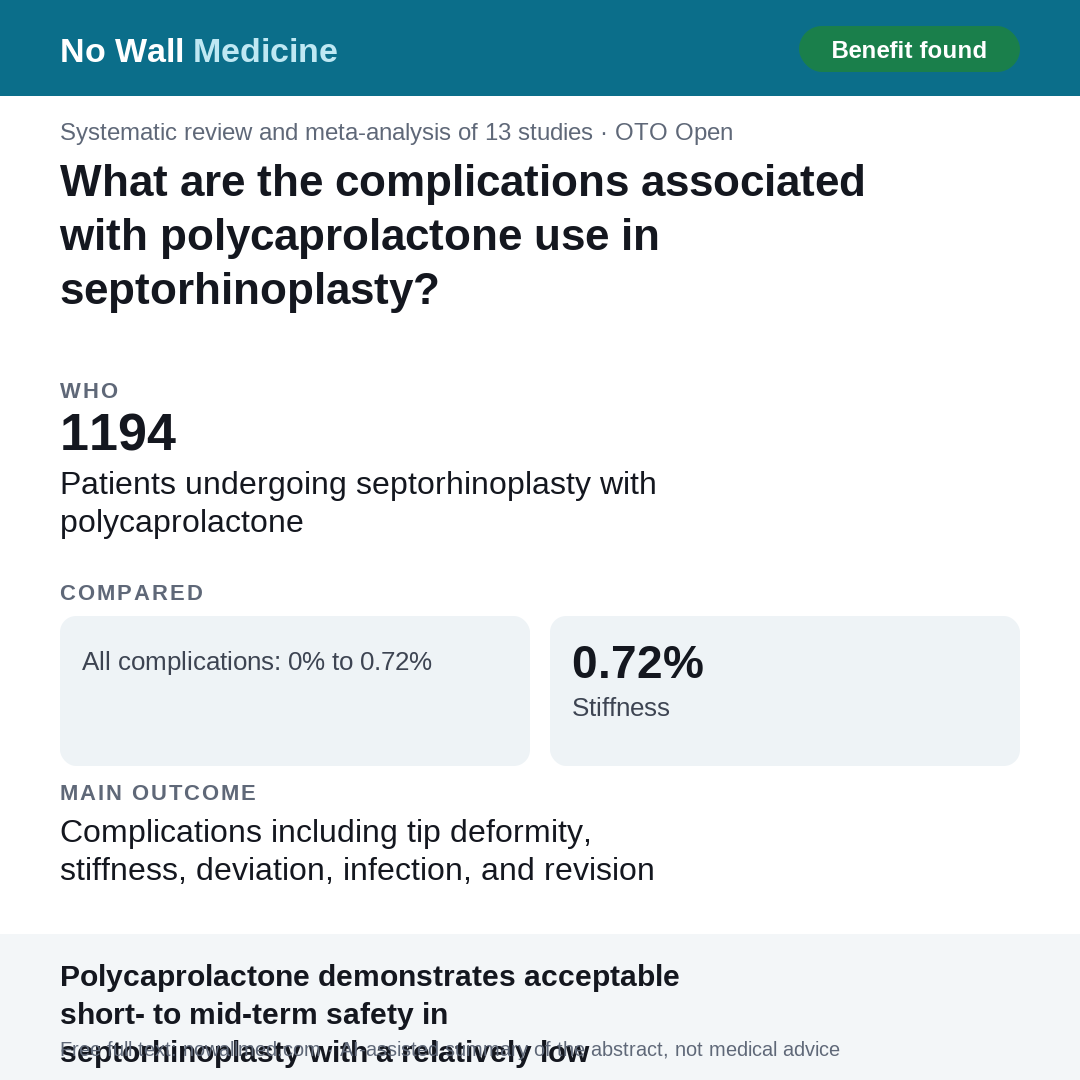
What are the complications associated with polycaprolactone use in septorhinoplasty?
Who
1194
Patients undergoing septorhinoplasty with polycaprolactone
Compared
All complications: 0% to 0.72%
0.72%Stiffness (95% CI 0.59-0.85)
Main outcome
Complications including tip deformity, stiffness, deviation, infection, and revision
Bottom line: Polycaprolactone demonstrates acceptable short- to mid-term safety in septorhinoplasty with a relatively low proportion of complications.
Limitation: Subgroup analysis by surgical approach, procedure type, and material type could not be performed.
OTO Open · 2026-05-04Download image
Clinical question: What are the complications associated with polycaprolactone use in septorhinoplasty?
Why it matters: The role of polycaprolactone in septorhinoplasty needs better definition through long-term and comparative data.
Key points
- Researchers analyzed 13 studies involving 1194 patients to evaluate complications from using polycaprolactone, a synthetic polymer, in nose surgery.
- The pooled mean proportion of complications was low, including 0.72% for stiffness, 0.07% for nosebleeds, and 0.03% for revision surgery.
- Subgroup analyses showed no statistically significant differences in complication rates based on the type of operation or graft type used.
Limitation the authors note: Subgroup analysis by surgical approach, procedure type, and material combination could not be performed due to limitations in the original data.
Headline and key points written with AI from the paper’s abstract, with every number checked against it. Read the paper before relying on them.
Cite this article
Piyananthasomdee P, Hoang MP, Seresirikachorn K, Jullamusi W, Charoenlux P. Complications Associated With Polycaprolactone (PCL) Use in Septorhinoplasty: A Systematic Review and Meta-Analysis. OTO Open. 2026. doi:10.1002/oto2.70248
Spotted a mistake? Suggest a correction