Anterior vertebral body tethering was associated with higher complication and reoperation rates than spinal fusion
Complications, Reoperations, and Mid-Term Outcomes Following Anterior Vertebral Body Tethering Versus Posterior Spinal Fusion: A Meta-Analysis
Meta-analysisHarm found
Are outcomes of anterior vertebral body tethering comparable to posterior spinal fusion for adolescent idiopathic scoliosis?
Who
Patients with adolescent idiopathic scoliosis and Lenke 1 or 2 curves
Compared
Anterior vertebral body tethering: 26% complication rate and 14.1% reoperation rate
Posterior spinal fusion: 2% complication rate and 0.6% reoperation rate
Main outcome
Complication and reoperation rates
Bottom line: Anterior vertebral body tethering has higher complication and reoperation rates than posterior spinal fusion despite similar deformity correction.
Limitation: Future long-term randomized prospective studies are needed.
JBJS Open Access · 2021-06-23 · Save PNG
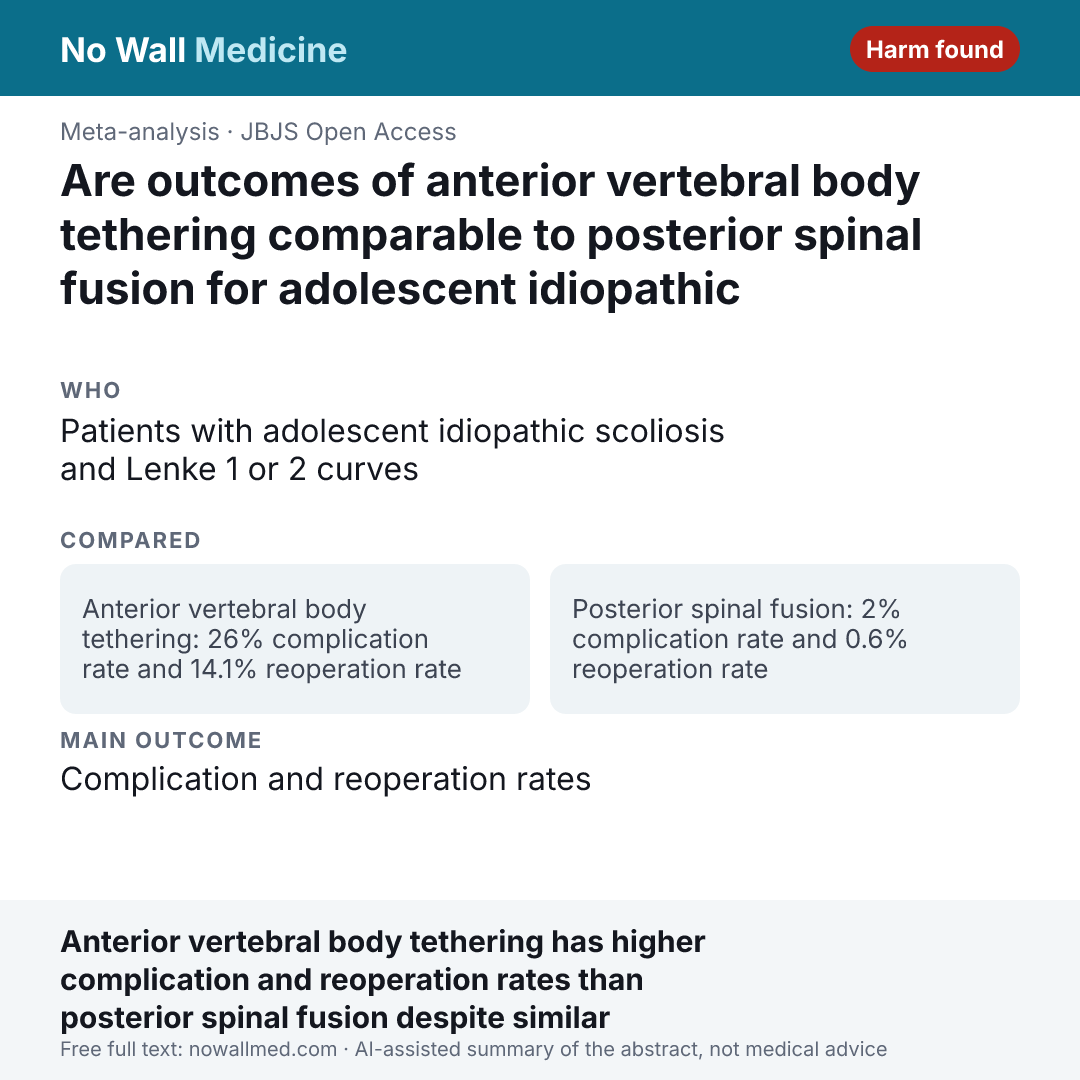
Clinical question: Are outcomes of anterior vertebral body tethering comparable to posterior spinal fusion for adolescent idiopathic scoliosis?
Key points
- Researchers analyzed 211 patients receiving anterior vertebral body tethering and 1,069 patients receiving posterior spinal fusion for adolescent idiopathic scoliosis.
- The pooled complication rate was 26% for anterior vertebral body tethering versus 2% for posterior spinal fusion, and reoperation rates were 14.1% versus 0.6%.
- In studies with follow-up of 36 months or more, the reoperation rate was 24.7% for anterior vertebral body tethering compared to 1.8% for posterior spinal fusion.
Limitation the authors note: Future long-term randomized prospective studies are needed.
Headline and key points written with AI from the paper’s abstract, with every number checked against it. Read the paper before relying on them.
Was this summary helpful?
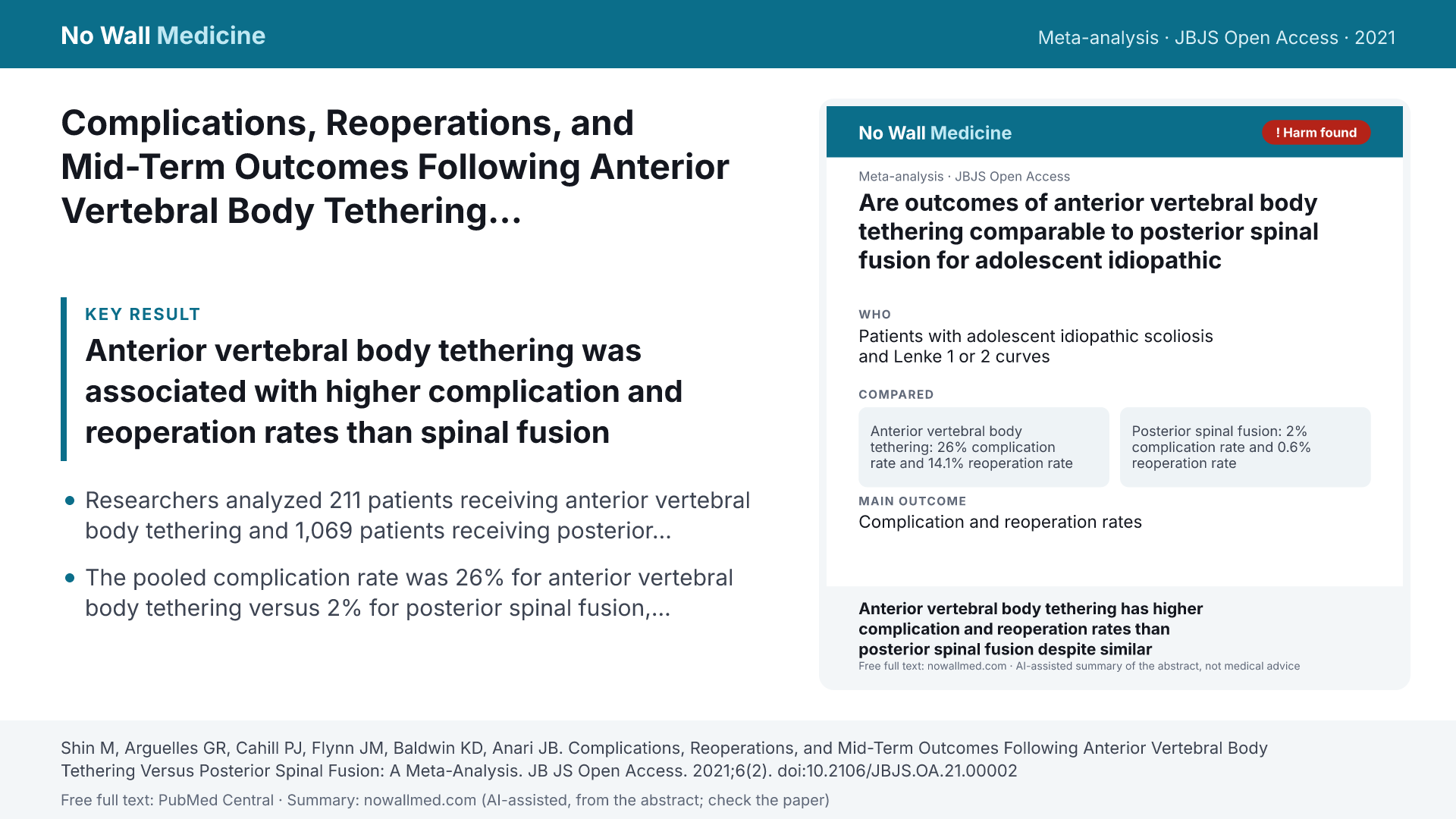
Headline, design, result, key points, caveat and citation as plain text.
Cite this article
Shin M, Arguelles GR, Cahill PJ, Flynn JM, Baldwin KD, Anari JB. Complications, Reoperations, and Mid-Term Outcomes Following Anterior Vertebral Body Tethering Versus Posterior Spinal Fusion: A Meta-Analysis. JBJS Open Access. 2021. doi:10.2106/JBJS.OA.21.00002
Spotted a mistake? Suggest a correction