Composite outcome measures in critical care trials were linked to smaller sample sizes and inconsistent results
Composite outcome measures in high-impact critical care randomised controlled trials: a systematic review
Systematic reviewMixed results
How are composite outcome measures used in high-impact critical care randomized controlled trials?
Who
194
Critical care patients in randomized controlled trials · 16 high-impact journals
Compared
Trials using composite outcomes: 409 (198.8-851.5) participants
Trials using non-composite outcomes: 584 (300-1566) participants
Main outcome
Sample size, statistical significance, and consistency of effect estimates
Bottom line: Composite outcomes use smaller sample sizes but do not increase statistical significance or consistency across components.
Crit Care · 2024-05-28Download image
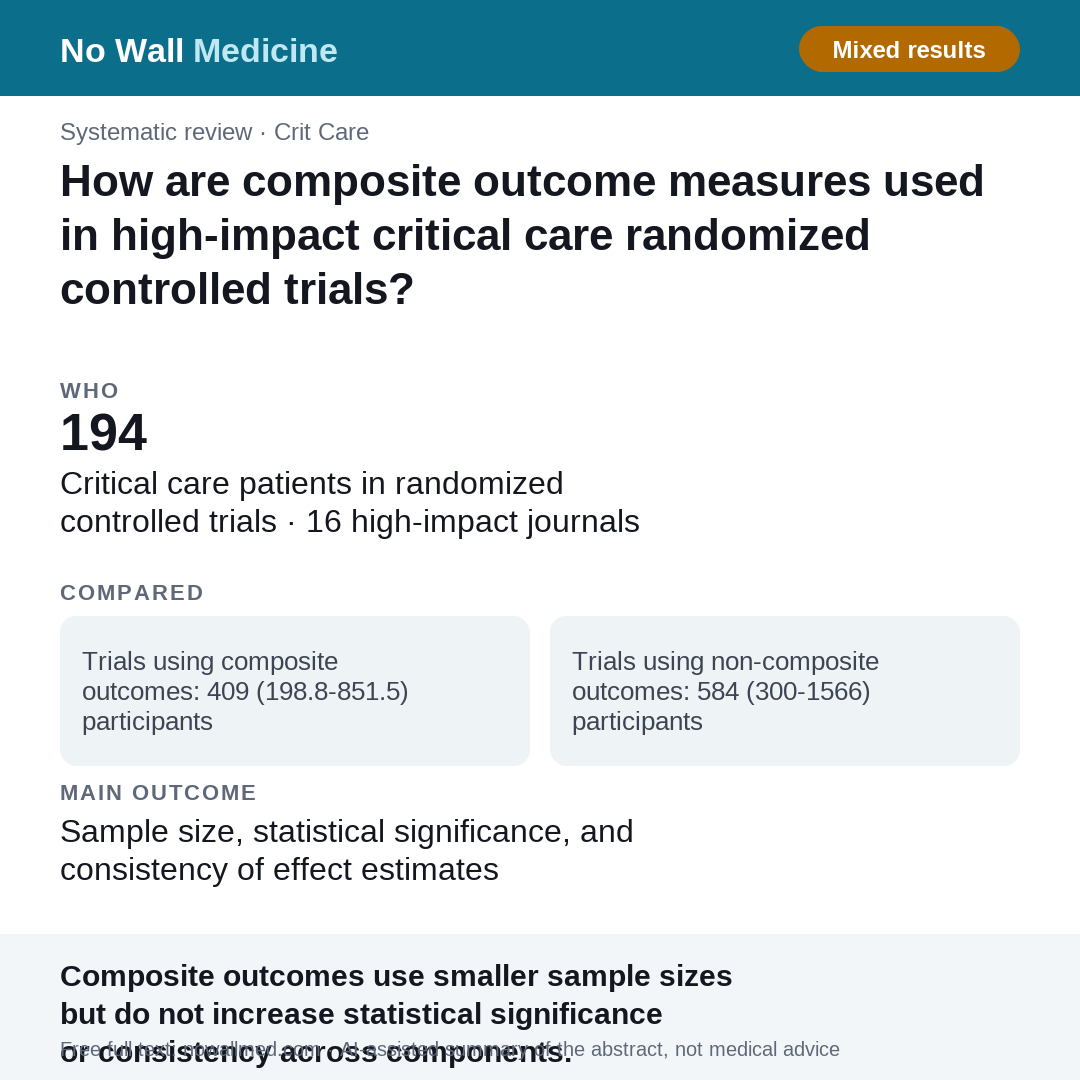
Clinical question: How are composite outcome measures used in high-impact critical care randomized controlled trials?
Why it matters: It is unknown how the increasing use of composite outcome measures affects sample size, statistical significance, and the consistency of effect estimates in critical care research.
Key points
- Researchers reviewed 194 randomized controlled trials published between 2012 and 2022 in high-impact journals involving critical care patients.
- Trials using composite outcome measures, which combine multiple clinical events into one measurement, recruited fewer participants than those using single outcomes (409 vs 584).
- The use of composite outcomes was not associated with increased rates of statistical significance (19.7% vs 17.8%) and 93% included components that were not patient important.
Headline and key points written with AI from the paper’s abstract, with every number checked against it. Read the paper before relying on them.
Was this summary helpful?
Subject terms
Cite this article
Walker HGM, Brown AJ, Vaz IP, Reed R, Schofield MA, Shao J. Composite outcome measures in high-impact critical care randomised controlled trials: a systematic review. Crit Care. 2024. doi:10.1186/s13054-024-04967-3
Spotted a mistake? Suggest a correction
Top studies every Monday
The week’s key trials and guidelines in your specialties, plus any topics you follow. By email, free.
Get the weekly digest