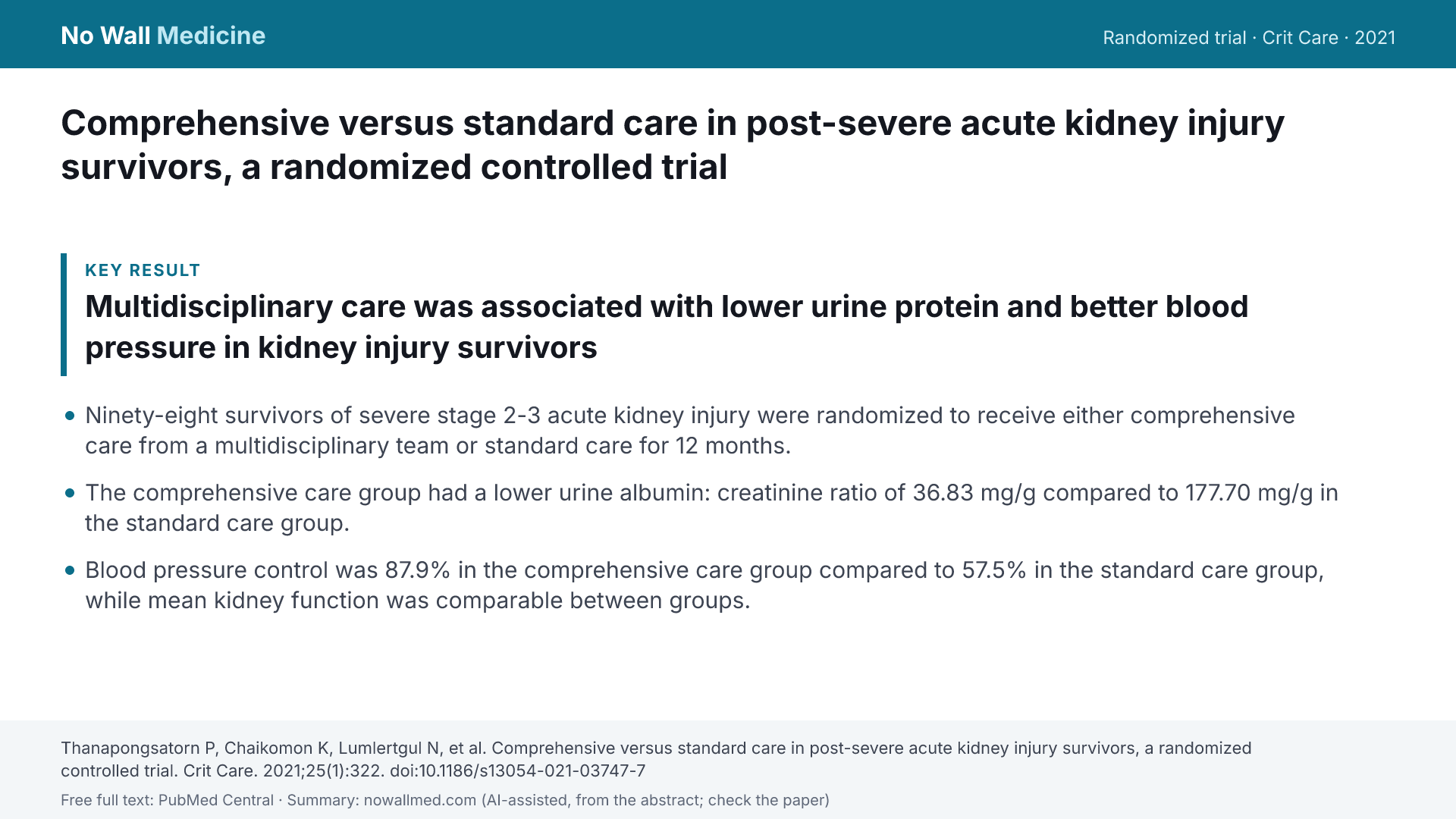
Multidisciplinary care was associated with lower urine protein and better blood pressure in kidney injury survivors
Comprehensive versus standard care in post-severe acute kidney injury survivors, a randomized controlled trial
Key points
- Ninety-eight survivors of severe stage 2-3 acute kidney injury were randomized to receive either comprehensive care from a multidisciplinary team or standard care for 12 months.
- The comprehensive care group had a lower urine albumin: creatinine ratio of 36.83 mg/g compared to 177.70 mg/g in the standard care group.
- Blood pressure control was 87.9% in the comprehensive care group compared to 57.5% in the standard care group, while mean kidney function was comparable between groups.
Headline and key points written with AI from the paper’s abstract, with every number checked against it. Read the paper before relying on them.
Was this summary helpful?
Abstract
Background
Currently, there is a lack of evidence to guide optimal care for acute kidney injury (AKI) survivors. Therefore, post-discharge care by a multidisciplinary care team (MDCT) may improve these outcomes. This study aimed to demonstrate the outcomes of implementing comprehensive care by a MDCT in severe AKI survivors. Methods
This study was a randomized controlled trial conducted between August 2018 to January 2021. Patients who survived severe AKI stage 2-3 were enrolled and randomized to be followed up with either comprehensive or standard care for 12 months. The comprehensive post-AKI care involved an MDCT (nephrologists, nurses, nutritionists, and pharmacists). The primary outcome was the feasibility outcomes; comprising of the rates of loss to follow up, 3-d dietary record, drug reconciliation, and drug alert rates at 12 months. Secondary outcomes included major adverse kidney events, estimated glomerular filtration rate (eGFR), and the amount of albuminuria at 12 months. Results
Ninety-eight AKI stage 3 survivors were enrolled and randomized into comprehensive care and standard care groups (49 patients in each group). Compared to the standard care group, the comprehensive care group had significantly better feasibility outcomes; 3-d dietary record, drug reconciliation, and drug alerts (p < 0.001). The mean eGFR at 12 months were comparable between the two groups (66.74 vs. 61.12 mL/min/1.73 m2, p = 0.54). The urine albumin: creatinine ratio (UACR) was significantly lower in the comprehensive care group (36.83 vs. 177.70 mg/g, p = 0.036), while the blood pressure control was also better in the comprehensive care group (87.9% vs. 57.5%, p = 0.006). There were no differences in the other renal outcomes between the two groups. Conclusions
Comprehensive care by an MDCT is feasible and could be implemented for severe AKI survivors. MDCT involvement also yields better reduction of the UACR and better blood pressure control. Trial registration Clinicaltrial.gov: NCT04012008 (First registered July 9, 2019).
Abstract reproduced under the article’s CC BY licence.
Subject terms
Headline, design, result, key points, caveat and citation as plain text.
Cite this article
Thanapongsatorn P, Chaikomon K, Lumlertgul N, et al. Comprehensive versus standard care in post-severe acute kidney injury survivors, a randomized controlled trial. Crit Care. 2021;25(1):322. doi:10.1186/s13054-021-03747-7
Spotted a mistake? Suggest a correction