Computed tomography in pediatric blunt abdominal trauma: current evidence, challenges, and future directions - a systematic review and meta-analysis
Systematic review and meta-analysisNo clear difference
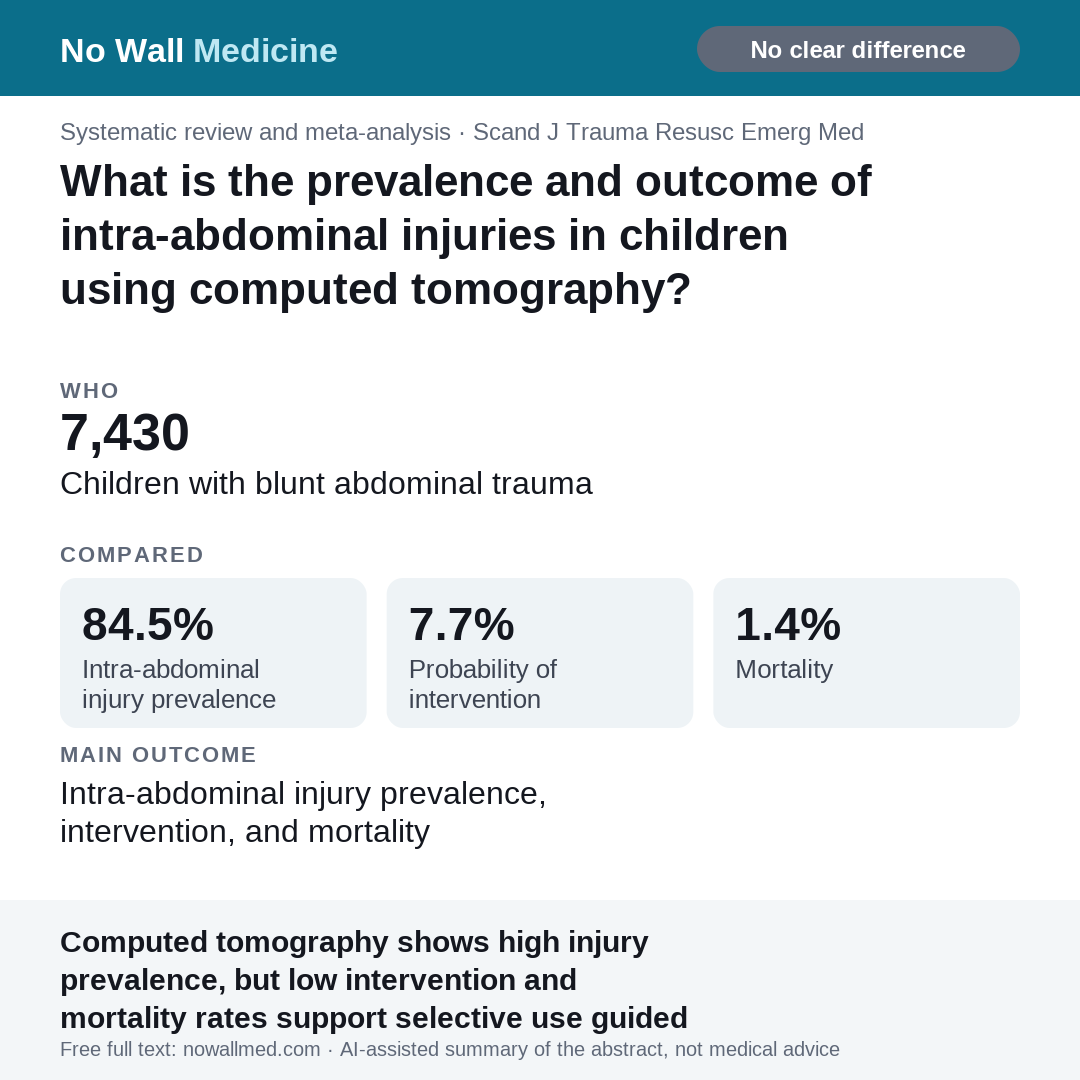
What is the prevalence and outcome of intra-abdominal injuries in children using computed tomography?
Who
7,430
Children with blunt abdominal trauma
Compared
84.5%Intra-abdominal injury prevalence (95% credible interval: 62-94%)
7.7%Probability of intervention
1.4%Mortality
Main outcome
Intra-abdominal injury prevalence, intervention, and mortality
Bottom line: Computed tomography shows high injury prevalence, but low intervention and mortality rates support selective use guided by decision rules.
Scand J Trauma Resusc Emerg Med · 2026-02-07Download image
Clinical question: What is the prevalence and outcome of intra-abdominal injuries in children using computed tomography?
Abstract
Introduction
Assessment of intra-abdominal injuries (IAIs) in children is challenging due to unreliable physical examination, communication barriers, and the serious consequences of missed injuries. Computed tomography (CT) is widely used for its high sensitivity, but concerns persist regarding radiation exposure and resource utilization. This systematic review and meta-analysis aimed to quantify IAI prevalence, describe organ-specific injury patterns, and evaluate intervention and mortality outcomes in children with blunt abdominal trauma assessed using CT. Methods
We searched PubMed, Web of Science, Cochrane Library, and Scopus through August 2025 for studies evaluating pediatric blunt abdominal trauma, CT-based assessment, and CT-detected IAIs. Bayesian random-effects meta-analyses were used to estimate pooled prevalence and outcomes, with additional hierarchical and meta-regression models for organ-specific injuries and study-level covariates. Certainty of evidence was assessed using the GRADE framework. Results
Fifteen studies including 7,430 children were analyzed. The pooled posterior median prevalence of IAI was 84.5% (95% credible interval [CrI]: 62-94%), while the probability of intervention was 7.7% and mortality was 1.4%. Solid organ injuries predominated, with liver (13.1%, 95% CrI: 4.9-45.5%), bowel (11.2%, 4.2-40.9%), spleen (11.1%, 4.1-40.4%), and kidney (8.7%, 3.2-34.3%) injuries most common; adrenal (3.4%) and pancreatic (1.4%) injuries were rare. Meta-regression showed higher injury probabilities with increasing age and male predominance. Injury Severity Score-based subgroup analyses yielded substantially lower IAI probabilities (11-12%), reflecting broader trauma populations. Certainty of evidence was moderate for overall IAI prevalence and low for other outcomes due to heterogeneity and sparse events. Conclusion
Although CT is highly sensitive for detecting IAIs in pediatric blunt abdominal trauma, low rates of intervention and mortality support selective CT use guided by validated decision rules and observation rather than routine imaging. Future research should prioritize multicenter prospective studies, pragmatic implementation of decision tools, and development of non-ionizing imaging alternatives to optimize CT use and minimize long-term risks in children.
Topics
Cite this article
Alsabri M, Rath S, Elkarargy MA, Aboali AA, Elsnhory AB, Ezz MH. Computed tomography in pediatric blunt abdominal trauma: current evidence, challenges, and future directions - a systematic review and meta-analysis. Scand J Trauma Resusc Emerg Med. 2026. doi:10.1186/s13049-026-01578-5
Spotted a mistake? Suggest a correction