Computer-assisted management reduced time spent with low blood pressure during intermediate and high-risk surgery
Computer-assisted Individualized Hemodynamic Management Reduces Intraoperative Hypotension in Intermediate- and High-risk Surgery: A Randomized Controlled Trial
Single-blinded prospective randomized controlled trialBenefit found
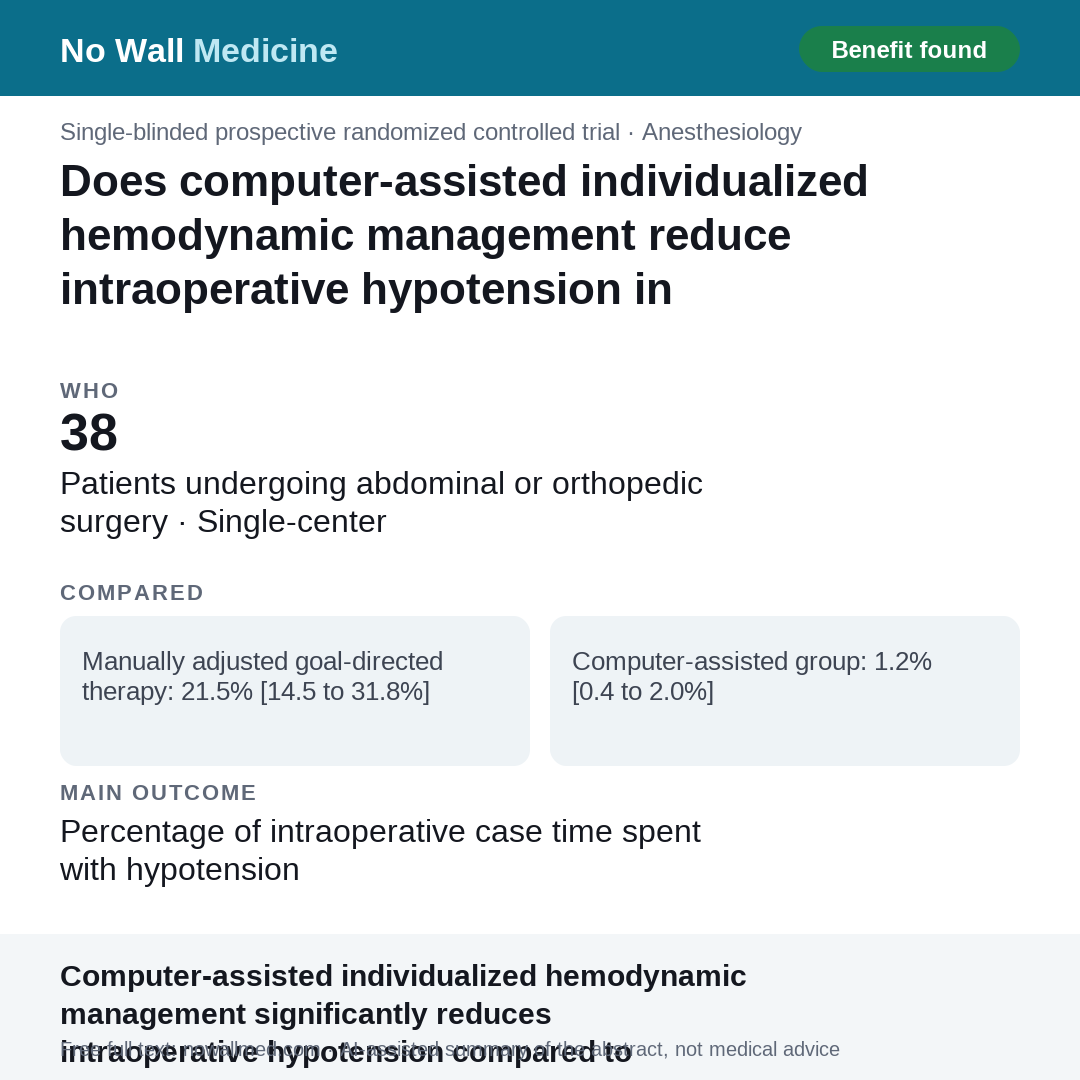
Does computer-assisted individualized hemodynamic management reduce intraoperative hypotension in intermediate- to high-risk surgery?
Who
38
Patients undergoing abdominal or orthopedic surgery · Single-center
Compared
Manually adjusted goal-directed therapy: 21.5% [14.5 to 31.8%]
Computer-assisted group: 1.2% [0.4 to 2.0%]
Main outcome
Percentage of intraoperative case time spent with hypotension
Result: difference, -21.1 (95% CI, -15.9 to -27.6%)
Bottom line: Computer-assisted individualized hemodynamic management significantly reduces intraoperative hypotension compared to manual goal-directed therapy in intermediate- to high-risk surgery.
Anesthesiology · 2021-05-06Download image
Clinical question: Does computer-assisted individualized hemodynamic management reduce intraoperative hypotension in intermediate- to high-risk surgery?
Why it matters: It was unknown if computer-assisted systems could reduce the time patients spend with low blood pressure during intermediate- to high-risk surgery compared to manual management.
Key points
- Researchers studied 38 patients undergoing abdominal or orthopedic surgery, comparing manual titration of fluids and blood pressure medication to a computer-assisted closed-loop system.
- The computer-assisted group spent 1.2% [0.4 to 2.0%] of the operation time with low blood pressure, compared to 21.5% [14.5 to 31.8%] in the manual group.
- The incidence of minor postoperative complications was not different between the two groups at 42% versus 58%.
Limitation the authors note: This was a single-center study.
Headline and key points written with AI from the paper’s abstract, with every number checked against it. Read the paper before relying on them.
Was this summary helpful?
Subject terms
Cite this article
Joosten A, Rinehart J, Van der Linden P, Alexander B, Penna C, De Montblanc J. Computer-assisted Individualized Hemodynamic Management Reduces Intraoperative Hypotension in Intermediate- and High-risk Surgery: A Randomized Controlled Trial. Anesthesiology. 2021. doi:10.1097/ALN.0000000000003807
Spotted a mistake? Suggest a correction
Top studies every Monday
The week’s key trials and guidelines in your specialties, plus any topics you follow. By email, free.
Get the weekly digest