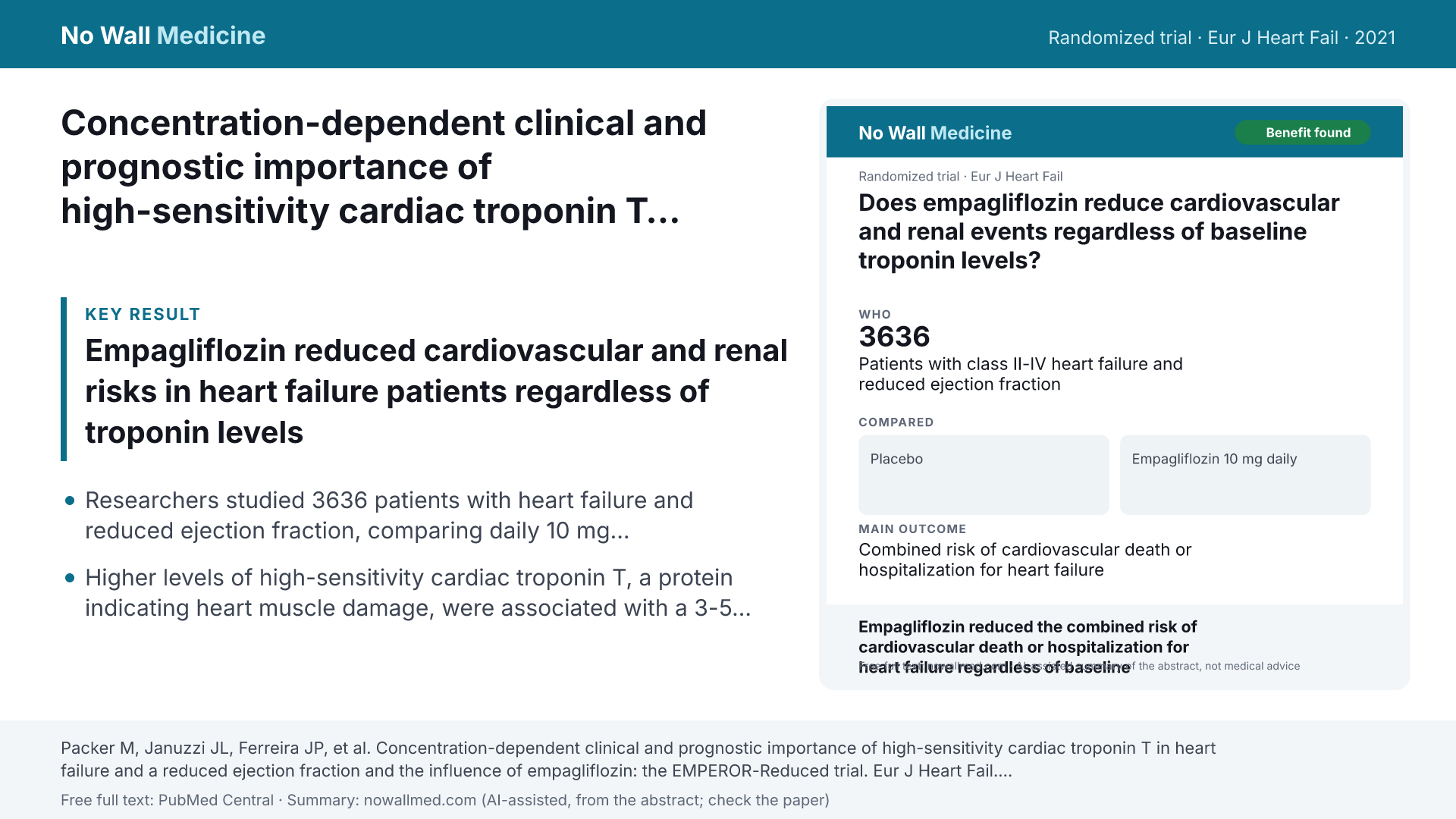
Empagliflozin reduced cardiovascular and renal risks in heart failure patients regardless of troponin levels
Concentration-dependent clinical and prognostic importance of high-sensitivity cardiac troponin T in heart failure and a reduced ejection fraction and the influence of empagliflozin: the EMPEROR-Reduced trial
Randomized trialBenefit found
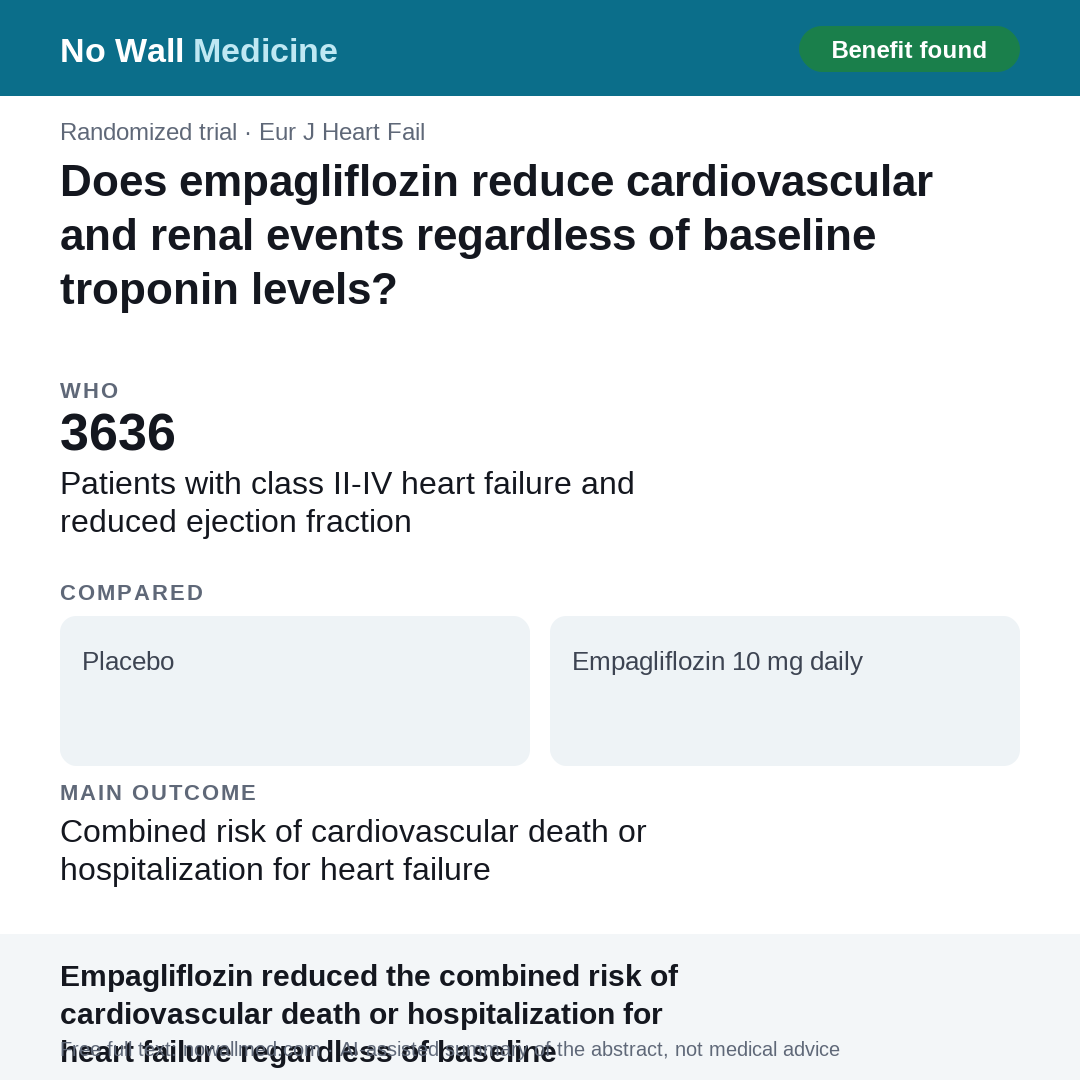
Does empagliflozin reduce cardiovascular and renal events regardless of baseline troponin levels?
Who
3636
Patients with class II-IV heart failure and reduced ejection fraction
Compared
Placebo
Empagliflozin 10 mg daily
Main outcome
Combined risk of cardiovascular death or hospitalization for heart failure
Bottom line: Empagliflozin reduced the combined risk of cardiovascular death or hospitalization for heart failure regardless of baseline high-sensitivity cardiac troponin T.
Eur J Heart Fail · 2021-06-21Download image
Clinical question: Does empagliflozin reduce cardiovascular and renal events regardless of baseline troponin levels?
Why it matters: It was unknown if the severity of heart disease, measured by troponin levels, influences how patients respond to empagliflozin treatment.
Key points
- Researchers studied 3636 patients with heart failure and reduced ejection fraction, comparing daily 10 mg empagliflozin to a placebo.
- Higher levels of high-sensitivity cardiac troponin T, a protein indicating heart muscle damage, were associated with a 3-5 fold greater risk of cardiovascular death or hospitalization when using a placebo.
- Empagliflozin reduced the combined risk of cardiovascular death or hospitalization for heart failure across all baseline levels of high-sensitivity cardiac troponin T.
Headline and key points written with AI from the paper’s abstract, with every number checked against it. Read the paper before relying on them.
Was this summary helpful?
Subject terms
Cite this article
Packer M, Januzzi JL, Ferreira JP, Anker SD, Butler J, Filippatos G. Concentration-dependent clinical and prognostic importance of high-sensitivity cardiac troponin T in heart failure and a reduced ejection fraction and the influence of empagliflozin: the EMPEROR-Reduced trial. Eur J Heart Fail. 2021. doi:10.1002/ejhf.2256
Spotted a mistake? Suggest a correction