Conditional Cash Transfers to Incentivize Tuberculosis Screening: Description of a Novel Strategy for Contact Investigation in Rural South Africa
Secondary analysis of a cluster randomized trialMixed results
Does incentive-based contact investigation increase the number of contacts referred compared to household-based investigation?
Who
3776
Index participants and contacts in Limpopo District, South Africa · Twenty-eight clinics in Limpopo District, South Africa
Compared
Incentive-based contact investigation
Household-based contact investigation
Main outcome
Mean number of contacts per index participant
Bottom line: Incentive-based investigation identifies higher-risk contacts, but household-based investigation is better for participants with large households.
Clin Infect Dis · 2021-07-03Download image
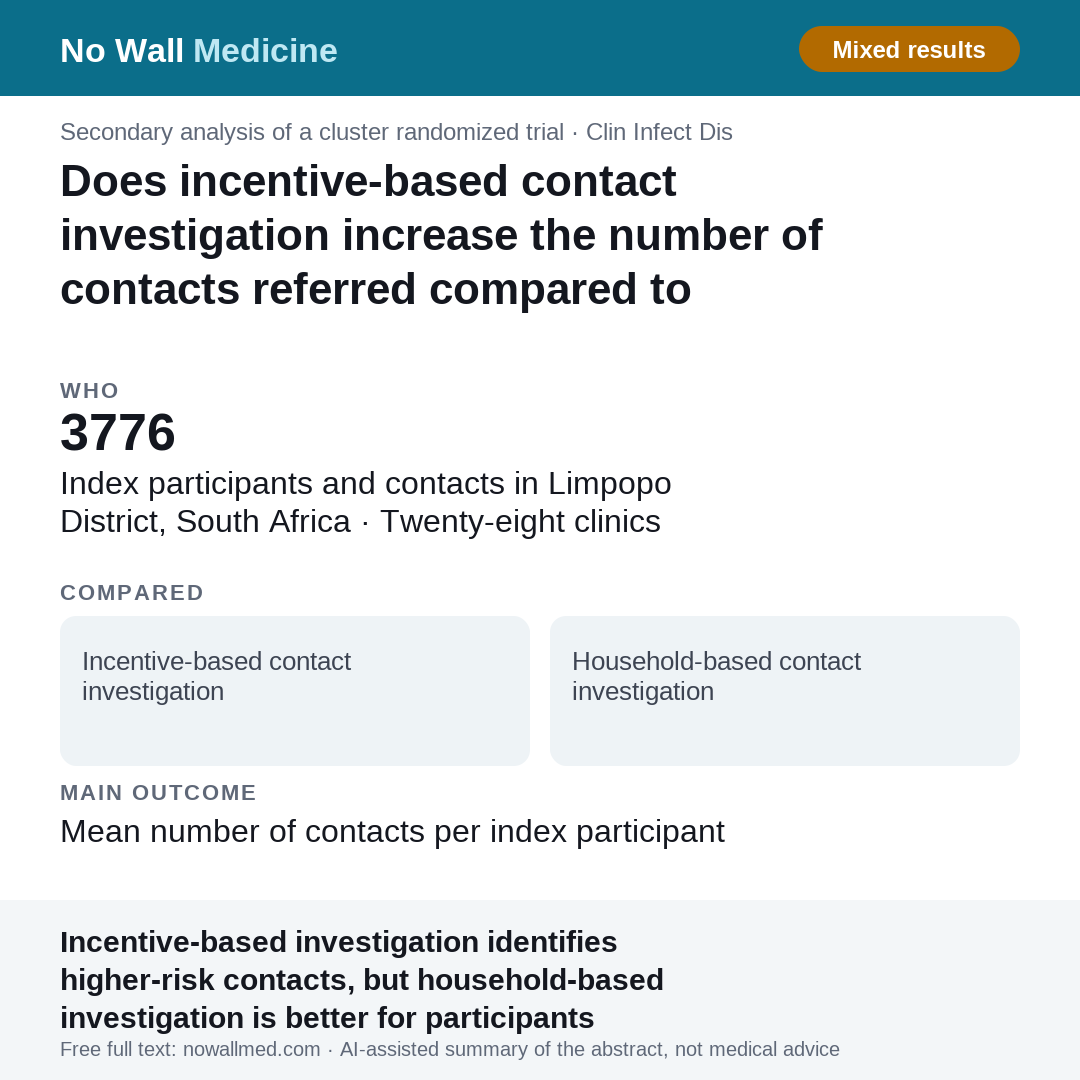
Clinical question: Does incentive-based contact investigation increase the number of contacts referred compared to household-based investigation?
Abstract
Background
Providing incentives to screen close contacts for tuberculosis (TB) is an alternative to household-based contact investigation. We aimed to characterize patients and contexts where this incentive-based strategy might be preferred. Methods
This is a secondary analysis of a cluster randomized trial of TB contact investigation in Limpopo District, South Africa, conducted between 2016 and 2020. Twenty-eight clinics were randomly allocated to household-based vs incentive-based contact investigation. In the incentive-based arm, index participants and contacts received transport reimbursement and incentives for TB screening and microbiological diagnosis of contacts. We estimated differences in mean number of contacts per index participant with household-based vs incentive-based contact investigation overall and within subgroups of index participants. Results
A total of 3776 contacts (1903 in the incentive-based and 1873 in the household-based arm) were referred by 2501 index participants. A higher proportion of contacts in the incentive-based than household-based arm were adults (72% vs 59%), reported chronic TB symptoms (25% vs 16%) or ever smoking (23% vs 11%). Index participants who walked or bicycled to a clinic referred 1.03 more contacts per index (95% confidence interval [CI], .48 to 1.57) through incentive-based than household-based investigation. Index participants living with >5 household members referred 0.48 more contacts per index (95% CI, .03 to .94) through household-based than incentive-based investigation. Conclusions
Relative to household-based investigation, incentive-based investigation identifies contacts likely at higher risk for active TB. Incentive-based investigation may be more appropriate for index participants who can easily access clinics, versus household-based investigation for patients with large households. Clinical Trials Registration. NCT02808507.
Subject terms
Cite this article
Baik Y, Hanrahan CF, Mmolawa L, Nonyane BAS, Albaugh NW, Lebina L. Conditional Cash Transfers to Incentivize Tuberculosis Screening: Description of a Novel Strategy for Contact Investigation in Rural South Africa. Clin Infect Dis. 2021. doi:10.1093/cid/ciab601
Spotted a mistake? Suggest a correction
Top studies every Monday
The week’s key trials and guidelines in your specialties, plus any topics you follow. By email, free.
Get the weekly digest